Houston’s heat, humidity, and clay-soil slab movement make commercial flooring specification trickier than in most US metros. Commercial flooring Houston TX projects range from medical office suites in the Galleria to warehouse epoxy in Pasadena to corporate carpet tile across downtown high-rises, and the right material depends on traffic load, moisture conditions, and the building’s HVAC stability. Pricing runs $3 to $14 per square foot installed depending on category. Get the substrate testing right up front and you’ll avoid 80 percent of the failures we see in this market.
- Why Houston's Climate Drives Material Choice
- Commercial Flooring Categories and Pricing
- LVT for Houston Medical and Retail
- Carpet Tile for Houston Office Markets
- Polished Concrete in Warehouses and Lofts
- Pros of Commercial-Grade Materials
- Cons and Houston-Specific Risks
- How to Vet a Commercial Flooring Contractor in Houston
- Best Time of Year to Install
- Hurricane and Flooding Considerations
- Final Notes for Houston Specifiers
Why Houston’s Climate Drives Material Choice
Two factors dominate flooring failures in Houston. First, the Gulf coast humidity averages 75 to 90 percent in summer with frequent dewpoint swings. Adhesive-applied floors fail when moisture migrates through the slab. Second, the expansive clay subsoil (locally called “gumbo”) shifts seasonally, cracking slabs and creating uneven substrates that betray rigid floors over time.
ASTM F2170 in-situ relative humidity probe testing is non-negotiable for any glue-down install in this market. Readings above 75 percent RH require a moisture mitigation primer like Ardex MC Rapid or Mapei Planiseal MRB before any glue-down product touches the slab.
Commercial Flooring Categories and Pricing
Houston commercial projects typically pick from five main categories.
- Carpet tile: $3.50 to $6.75 per square foot installed. Interface, Shaw Contract, and Mohawk Group dominate. Best for offices, hospitality back-of-house, and call centers
- LVT and SPC: $4.25 to $7.95 per square foot installed. Karndean, Armstrong Flooring Parallel, Mannington Commercial. Best for retail, medical, light commercial
- Polished concrete: $4 to $9 per square foot. Best for warehouses, showrooms, and industrial loft conversions
- Epoxy and urethane resin: $5 to $12 per square foot. Manufacturing, food processing, garages
- Sheet vinyl (heterogeneous): $6.50 to $11 per square foot installed. Healthcare, schools, dialysis suites
Houston labor rates typically run $1.50 to $3.25 per square foot for the install portion, with downtown high-rise work commanding the premium.
LVT for Houston Medical and Retail
Luxury vinyl tile has become the default for Houston medical office buildings, retail, and corporate common areas. The 20 to 28 mil wear layer handles wheelchair and cart traffic, the printed visuals replace dated VCT looks, and the seamless heat-welded versions deliver the cleanability of sheet vinyl.
Karndean LooseLay and Armstrong Parallel 20 are the workhorses. Both carry FloorScore certification for indoor air quality and 15-year commercial wear warranties. Expect $5.50 to $7.95 per square foot installed including adhesive and substrate prep.
Carpet Tile for Houston Office Markets
Carpet tile dominates the corporate office market because of acoustic performance, replaceability, and modular install. Interface’s GlasBac and CQuest tiles, Shaw Contract Eco Solution Q, and Mohawk Group Air.O are the three lines specified most often in Houston A and B class office buildings.
Pricing typically lands at $4.25 to $6.75 per square foot installed for 24″ x 24″ or 18″ x 36″ tiles. Spec the moisture barrier backing — Interface GlasBac handles up to 95 percent RH on concrete, which matters for slab-on-grade conditions in this market.
Polished Concrete in Warehouses and Lofts
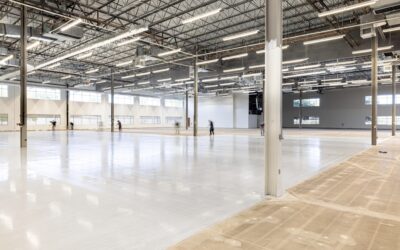
Polished concrete has surged in popularity for Houston distribution, automotive showrooms, and East End loft conversions. The total cost runs $4 to $9 per square foot depending on gloss level (typically 400, 800, 1500, or 3000 grit) and densifier specification.
The critical decision is the densifier — lithium silicate (Prosoco LS) for fast cure, sodium silicate for budget projects, or potassium silicate for warm humid conditions. Houston’s humidity makes the potassium and lithium options the better picks because they cure more predictably in 70 to 85 percent ambient RH.
Pros of Commercial-Grade Materials
Commercial-grade flooring carries warranty terms (10 to 20 years), wear ratings (commercial heavy, light, residential), and certifications (FloorScore, NSF, ADA slip resistance) that residential products skip. For Houston specifications, the difference matters because facility managers need predictable life-cycle costs.
Replaceability is the second major pro. Carpet tile lets you swap damaged squares in 30 minutes. Modular LVT pulls up without destroying adjacent boards. These features keep ongoing maintenance costs predictable across the asset life.
Cons and Houston-Specific Risks
Substrate moisture is the biggest failure mode in this market. Houston slabs often pump moisture for 60-plus days after pour, and existing buildings with poor vapor barriers test high year-round. Skip the moisture testing and you’ll be re-doing the floor inside 24 months.
Slab movement is the second issue. Expansive clay subsoil shifts seasonally, opening hairline cracks in concrete that telegraph through rigid LVT and tile. Spec flexible products or use crack-isolation membranes like Schluter Ditra under any rigid material.
How to Vet a Commercial Flooring Contractor in Houston
Spend 30 minutes on this before signing a contract.
- Verify Texas Department of Insurance bonding and current general liability ($1M minimum)
- Request three references from completed projects 3-plus years old, ideally in similar building types
- Confirm moisture testing protocol — ASTM F2170 probes, not calcium chloride domes
- Get manufacturer certification numbers (Karndean Authorized, Armstrong Approved, Interface ReEntry)
- Verify CFI (Certified Flooring Installer) credentials for lead installers
- Request a written warranty covering both labor and materials
Best Time of Year to Install
October through March is the sweet spot in Houston. Ambient humidity drops, slab moisture stabilizes, and HVAC systems can hold conditioned space during install. Summer installs work for sealed buildings but require temporary dehumidification during cure to hit adhesive and finish specifications.
Hurricane and Flooding Considerations
Houston’s hurricane history makes flood resilience a meaningful spec consideration. Polished concrete and porcelain tile survive flooding events without replacement. LVT, carpet tile, and rubber typically require replacement after any sustained water exposure even if they’re labeled waterproof — because the adhesive and substrate fail.
For ground-floor commercial spaces in flood-prone zip codes, weight the life-cycle math toward hard surfaces that survive water events. The 15 to 20 year ROI on porcelain or polished concrete typically beats two LVT replacement cycles triggered by flooding.
Final Notes for Houston Specifiers
Pick the material that matches traffic, moisture, and life-cycle requirements first, then optimize price. Test the substrate before issuing the bid spec. Verify the contractor’s commercial credentials. Done right, commercial flooring in Houston delivers 15 to 25 years of service. Done wrong, you’ll be replacing it in three.
Prefer to explore on your own?
See how new flooring looks in your actual room in seconds — free, no signup.
Try the free Floor Studio →