Standard residential vinyl will not survive the punishment that commercial environments dish out daily. Hundreds of footsteps per hour, rolling office chairs, heavy carts, and constant cleaning require a floor built for a different level of abuse. Commercial LVT flooring is engineered specifically for these conditions, with thicker wear layers, higher density cores, and commercial-grade warranties that residential products cannot match. Choosing the right commercial LVT saves facility managers thousands in replacement costs over a building’s lifecycle.
- What Makes Commercial LVT Different From Residential
- Top Commercial LVT Brands and Product Lines
- Glue-Down vs Click-Lock vs Loose-Lay for Commercial
- Wear Layer Thickness Guide for Different Spaces
- Maintenance and Lifecycle Costs
- Design Options for Commercial Spaces
- Installation Considerations for Occupied Buildings
What Makes Commercial LVT Different From Residential
The primary difference is the wear layer. Residential LVT typically has a 6 to 20 mil wear layer, while commercial-grade products start at 20 mil and go up to 40 mil or higher. That wear layer is the transparent urethane coating on top that resists scratches, scuffs, and stains. In a busy retail store or medical office, a 12 mil residential floor might show visible wear paths within 18 months. A 28 mil commercial floor handles the same traffic for 10-15 years.
Commercial LVT also undergoes different testing standards. Look for products that meet ASTM F1700 Type II standards, which certify the product for commercial use. Many commercial lines also carry FloorScore certification for indoor air quality, which matters in offices and healthcare settings where VOC emissions are regulated.
Top Commercial LVT Brands and Product Lines
Several manufacturers dominate the commercial LVT space, each with distinct strengths:
- Shaw Contract (Set in Stone, Baseline): One of the largest commercial flooring producers in North America. Their glue-down LVT lines offer 28 mil wear layers and come in wood, stone, and abstract patterns. Pricing runs $3.00 to $5.50 per sq ft for materials
- Mannington Commercial (Amtico, Realistique): Known for design-forward visuals and exceptional durability. Amtico products feature 30+ mil wear layers and are popular in upscale retail and hospitality. Budget $4.00 to $7.00 per sq ft
- Armstrong Flooring (Vero, Translations): Strong in healthcare and education markets with Diamond 10 surface technology that resists scuffs without waxing. Materials cost $2.50 to $5.00 per sq ft
- Tarkett (iD Inspiration, Starfloor): European quality with a wide range of commercial collections. Their loose-lay options simplify installation in occupied spaces. Expect $3.50 to $6.00 per sq ft
- Interface (Level Set, Textured Woodgrains): Known primarily for carpet tile, but their LVT lines integrate seamlessly with their modular carpet systems for mixed-material designs
Glue-Down vs Click-Lock vs Loose-Lay for Commercial
Installation method matters more in commercial settings than residential ones because the wrong choice leads to costly failures under heavy traffic.
Glue-down is the gold standard for most commercial installations. Full-spread adhesive bonds each tile or plank directly to the subfloor, preventing shifting, peaking, and edge curling under rolling loads. It handles heavy foot traffic, wheeled equipment, and temperature swings better than any other method. The downside is longer installation time and the need for professional installers.
Click-lock (floating) works in some commercial applications like small offices and break rooms but is generally not recommended for high-traffic retail or healthcare environments. Rolling loads from carts and chairs can stress the locking mechanisms over time, causing gaps.
Loose-lay is gaining traction in commercial renovations where minimizing downtime is critical. These heavy, dimensionally stable tiles grip the subfloor through weight and friction rather than adhesive. A retail store can be refloored section by section without closing, and individual damaged tiles can be swapped in minutes. Loose-lay products typically cost 15-20% more than comparable glue-down options.
Wear Layer Thickness Guide for Different Spaces
Not every commercial space needs the heaviest wear layer available. Matching the wear layer to the actual traffic level optimizes your budget:
- 20 mil: Light commercial use such as private offices, conference rooms, and low-traffic corridors. Suitable for spaces with fewer than 200 foot-traffic events per day
- 28 mil: Moderate commercial use including open-plan offices, small retail stores, restaurants, and classrooms. Handles 200-1,000 daily foot-traffic events
- 40 mil: Heavy commercial use such as hospital corridors, airport terminals, big-box retail, and warehouse showrooms. Built for 1,000+ daily foot-traffic events and rolling loads
Investing in a thicker wear layer than you need is rarely a waste because it extends the floor’s lifespan. However, paying for 40 mil in a private office that sees 10 people per day is an unnecessary expense.
Maintenance and Lifecycle Costs
One of the biggest advantages of commercial LVT flooring over alternatives like VCT (vinyl composition tile) or carpet tile is the drastically lower maintenance cost. VCT requires regular stripping and waxing, which costs $0.25 to $0.50 per square foot each time and needs to happen 3-4 times per year in high-traffic areas. Commercial LVT with a polyurethane finish needs only damp mopping and occasional machine scrubbing.
Over a 10-year lifecycle, the total cost of ownership for commercial LVT typically runs 30-40% lower than VCT despite higher upfront material costs. A 10,000 square foot office space might spend $8,000-$12,000 less on maintenance over a decade by choosing LVT over VCT. For facility managers evaluating total cost, this math makes commercial LVT an easy choice.
Design Options for Commercial Spaces
Gone are the days when commercial flooring meant bland beige tiles. Modern commercial LVT offers hundreds of designs including realistic wood grains, marble looks, concrete effects, and custom-printed patterns. Many manufacturers allow mixing tile sizes and patterns within a single installation for wayfinding, zoning, or branding purposes.
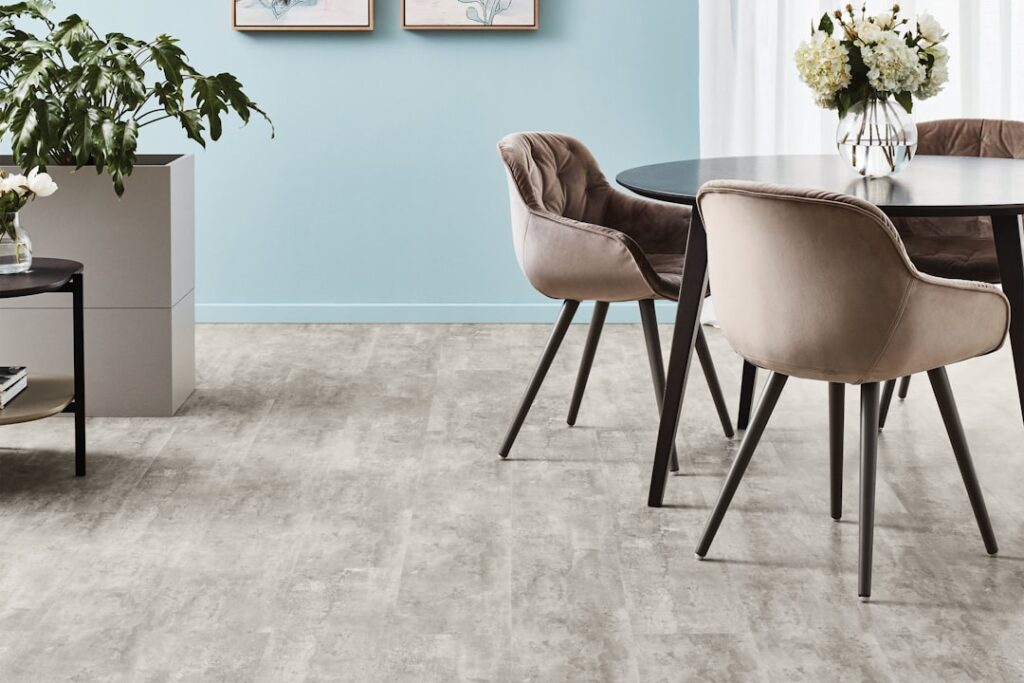
Wood-look planks are the most popular choice for offices and retail because they create a warm, inviting atmosphere that hard tile or VCT cannot match. Stone and concrete looks work well in modern lobbies and industrial-chic restaurant spaces. For healthcare environments, solid colors and subtle patterns hide dirt while maintaining a clean, clinical appearance. Some manufacturers offer custom color matching for brands that need their flooring to align with corporate identity guidelines.
Installation Considerations for Occupied Buildings
Replacing flooring in an operating business requires careful planning to minimize disruption. Work with your installer to develop a phased schedule that keeps as much of the space operational as possible. Most commercial LVT adhesives reach full cure within 24-48 hours, after which furniture can be moved back and foot traffic can resume.
Moisture testing is critical before any commercial LVT installation. Concrete slabs in commercial buildings often have higher moisture vapor emission rates than residential slabs due to size and age. ASTM F1869 (calcium chloride) and ASTM F2170 (relative humidity) tests should be performed before installation begins. If moisture levels exceed the manufacturer’s limits, you will need a moisture mitigation system at $1.50 to $3.00 per square foot before flooring goes down. Skipping this step voids warranties and leads to adhesive failure, bubbling, and mold growth underneath the flooring.
Prefer to explore on your own?
See how new flooring looks in your actual room in seconds — free, no signup.
Try the free Floor Studio →