Composite decking has overtaken wood for many homeowners because it resists rot, never needs staining, and lasts for decades. But the finished result depends heavily on which product you buy, and that starts with choosing among the many composite decking suppliers competing for your project. From national brands sold at big-box stores to specialty lumberyards and direct manufacturers, your source affects price, selection, warranty, and support. This guide explains the major suppliers, what to compare, and how to buy smart.
- Understanding What You Are Buying
- The Major Brands and Manufacturers
- Where to Actually Buy Composite Decking
- What Composite Decking Costs
- How to Choose the Right Supplier
- Ordering the Right Quantity
- Common Mistakes to Avoid
- Getting the Best Deal
- Evaluating Warranties Across Suppliers
- Timing Your Purchase and Delivery
Understanding What You Are Buying
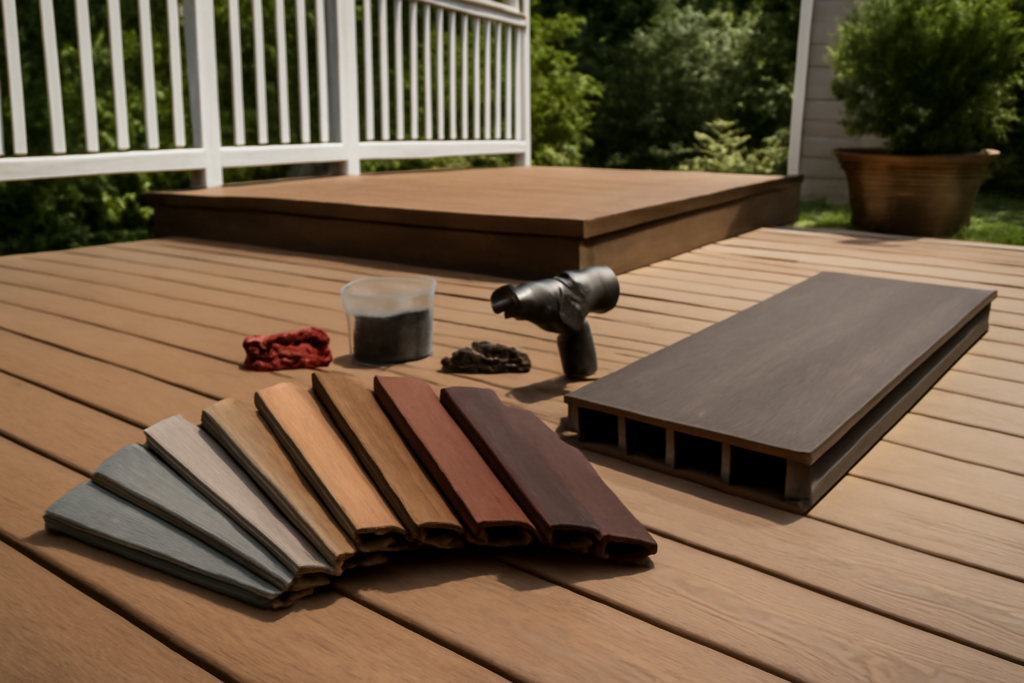
Composite decking blends recycled wood fibers and plastic into weather-resistant boards. Modern products are usually capped composite, meaning a durable polymer shell wraps the core to resist fading, staining, and scratching. A smaller category is PVC (fully plastic) decking, which is lighter and even more moisture-proof. Knowing whether a supplier sells capped composite, uncapped composite, or PVC helps you compare apples to apples, because uncapped older-style boards are cheaper but far more prone to fading and mold than today’s capped products.
The Major Brands and Manufacturers
A handful of manufacturers dominate the U.S. market, and most homeowners buy one of these lines:
- Trex: The best-known name, offering good-better-best tiers from Enhance to Transcend. Widely stocked at home centers and lumberyards, with strong warranties.
- TimberTech (AZEK): Highly regarded for premium capped polymer and composite boards with realistic looks and excellent fade resistance.
- Fiberon: A strong mid-to-premium option with a range of price points and good availability.
- Deckorators: Known for mineral-based composite boards that are strong and low-expansion.
- MoistureShield: Notable for boards rated for ground and water contact, useful for docks and unusual installs.
These brands set the market, and comparing their entry, mid, and premium lines is usually the core of the shopping process.
Where to Actually Buy Composite Decking
Suppliers fall into several channels, each with tradeoffs:
- Big-box home centers like Home Depot and Lowe’s stock popular Trex and TimberTech lines, offer competitive pricing, and are convenient, though selection of colors and premium tiers can be limited to what is on the shelf or special-order.
- Specialty lumberyards and decking distributors carry a deeper range of brands, colors, and matching accessories like fascia, hidden fasteners, and railing, plus staff who know the products. Prices can be comparable or better on full-project quantities.
- Direct-from-manufacturer or online dealers can offer full-line access and sometimes better pricing on large orders, but you handle freight and cannot inspect boards in person.
- Deck-building contractors often supply the material as part of an installed job, buying at trade pricing and passing through or marking up the cost.
What Composite Decking Costs
Material prices vary by brand tier. Entry-level capped composite runs about $3 to $6 per linear foot, or roughly $5 to $9 per square foot of decking material. Mid-range boards land around $6 to $9 per linear foot, and premium capped polymer lines like top TimberTech AZEK reach $9 to $15 per linear foot. Installed, a composite deck typically costs $30 to $60 per square foot including labor, substructure, railing, and fasteners. Remember to budget for the extras suppliers sell alongside the boards: hidden fastener systems, fascia boards, and matching railing can add 20 to 40 percent to a materials order.
How to Choose the Right Supplier
Beyond price, weigh several factors when picking a supplier:
- Selection and stock: Does the supplier carry the exact brand, line, color, and board lengths you want, or will key pieces be a long special order?
- Full system availability: Buying decking, fascia, railing, and fasteners from one source ensures color matching and simplifies warranty claims.
- Warranty support: Confirm the manufacturer warranty (often 25 to 50 years on fade and stain for premium lines) and that the supplier will help if a claim arises.
- Freight and lead time: Long composite boards are heavy and awkward; factor delivery cost and timing, especially for online orders.
- Expertise: A knowledgeable specialty dealer can flag installation details like expansion gaps and joist spacing that a general cashier cannot.
Ordering the Right Quantity
Calculate your material needs carefully before contacting suppliers. Measure the deck square footage, then add roughly 10 to 15 percent for cuts, waste, and any diagonal or picture-frame patterns, which consume more material. Note that composite decking usually requires closer joist spacing than wood, often 16 inches on center for perpendicular boards and 12 inches for diagonal layouts, which affects your substructure lumber order too. Ask the supplier to review your measurements; many offer takeoff help and will confirm board lengths that minimize waste.
Common Mistakes to Avoid
The biggest mistake is shopping on price alone and ending up with an uncapped or discontinued board that fades within a few seasons; always confirm the product is a current capped line. Another error is buying decking from one supplier and railing or fascia from another, then finding the colors do not match. Homeowners also frequently underorder and cannot get a matching dye lot later, so order the full quantity plus waste at once. Finally, do not overlook the fastener and substructure requirements specific to each brand; ignoring them can void the warranty.
Getting the Best Deal
To buy well, get quotes from at least two channels, such as a home center and a specialty distributor, on the exact same product and quantity. Shop end-of-season sales in fall when suppliers discount inventory. Ask about contractor or volume pricing if your order is large, and confirm whether delivery is included. Ordering a small extra quantity of the same dye lot up front is cheap insurance against future repairs that would otherwise be impossible to color-match.
Evaluating Warranties Across Suppliers
Warranty coverage is a major differentiator between products and worth close reading before you commit to a supplier’s line. Most quality capped composite boards carry a 25-year limited residential warranty against material defects, while premium capped polymer lines like top TimberTech AZEK products offer 30-, 50-year, or even lifetime fade-and-stain warranties. Pay attention to two separate promises: the structural warranty (against the board failing) and the performance warranty (against fading and staining), because cheaper products often have a shorter fade-and-stain term even if the structural term sounds long. Also confirm whether the warranty is transferable to a future homeowner, which adds resale value, and understand that warranties cover material only, not the labor to remove and reinstall, so professional installation records help support any future claim.
Timing Your Purchase and Delivery
Composite decking demand peaks in spring and early summer, when prices are highest and popular colors sell out or go on backorder. Buying in late fall or winter often means better pricing and full stock, and it gives you time to stage the project for spring construction. When you order, coordinate delivery carefully: composite boards are heavy, long, and best stored flat on a supported, level surface off the ground to prevent bowing before installation. Inspect every bundle on delivery for damage, color consistency across the dye lot, and correct quantity, and refuse or document any boards that are warped or mismatched. A supplier that delivers on schedule, in full, with consistent color is worth choosing even at a slightly higher price than one that leaves you waiting mid-project.
Choosing among composite decking suppliers comes down to matching the right brand and tier to your budget, then finding a source that stocks the full system, stands behind the warranty, and can deliver on time. Compare current capped products carefully, order the full project quantity at once, and lean on a knowledgeable supplier’s expertise. Do that, and your composite deck will look great and hold up for decades.