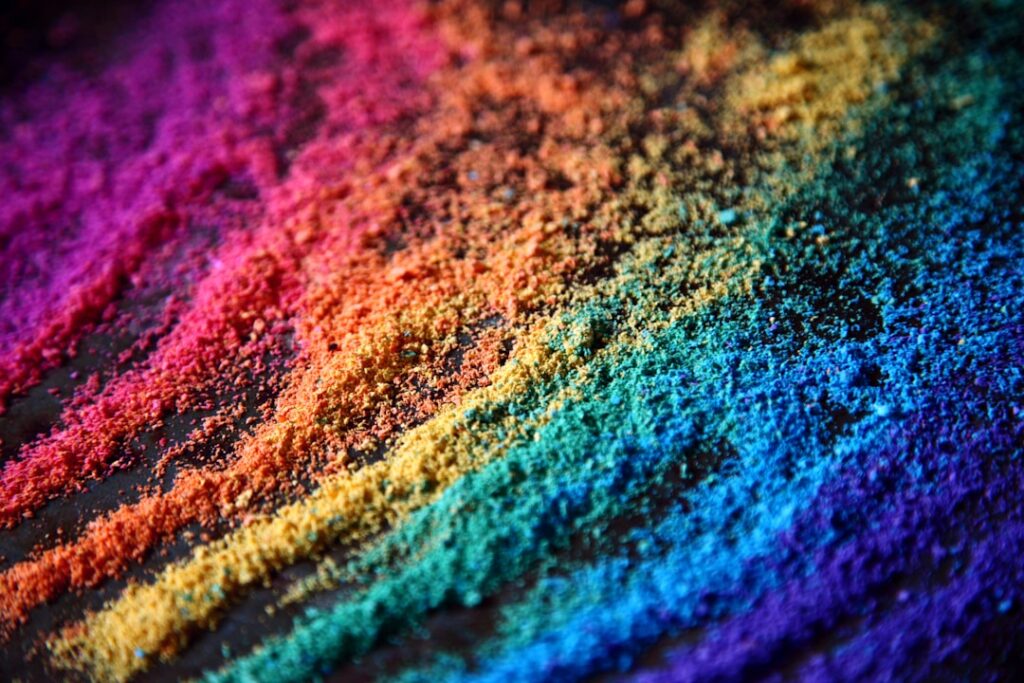
When a polished concrete floor glows turquoise or saturated crimson — colors no acid stain can produce — you are almost always looking at dye. Concrete dye powder is micronized pigment that dissolves into a solvent or water carrier and penetrates the pores of hardened concrete, delivering translucent, layerable color in a palette running from earth tones to true primaries. It is the colorist’s tool of the concrete world: fast, vivid, controllable — and famously unforgiving outdoors, where UV fades most dyes in a single sunny year. Here is how the chemistry works, where dyes belong, and the step sequence for applying them well.
- Dye vs Acid Stain vs Integral Color — One Paragraph
- How Dye Powder Works
- Solvent Carrier vs Water Carrier
- The Signature Move: Translucent Layering
- Where Dye Belongs: Interior Polished Floors
- The UV Limitation: Be Honest About Outdoors
- Application Steps
- Cost and Time for a Typical Project
- Brands Worth Knowing
Dye vs Acid Stain vs Integral Color — One Paragraph
Three coloring systems, three mechanisms, and they are not interchangeable. Acid stain is a chemical reaction: metallic salts in an acidic solution react with the concrete’s free lime to grow permanent mineral color in the surface — variegated, mottled, UV-stable, but limited to a palette of browns, tans, terra cottas, blue-greens, and blacks, and dependent on the slab’s chemistry, so results vary panel to panel. Integral color is pigment batched into the wet mix at the plant — uniform, permanent, colored full-depth, but muted (grays, buffs, reds) and decided before the pour. Dye is pure micronized pigment carried into the pores of cured concrete by a fast-evaporating liquid: no reaction, no waiting on chemistry, the truest and brightest colors of the three — and the least permanent under sunlight. Full comparisons of stain types and integral pigment live in their own guides; everything below is the dye lane.
How Dye Powder Works
Dye particles are ground to sub-micron size — dramatically finer than paint pigments or the particles in acid stain residue — which lets them ride the carrier down into capillary pores instead of sitting on the surface as a film. Because there is no chemical reaction, what you spray is essentially what you get, and it happens in minutes: the carrier flashes off and the color is in the concrete. Powders ship in small packets or jars that you mix into your chosen carrier on site, which is why pros favor them over premixed liquids — the same packet can be mixed strong or weak, in acetone or water, tuned to the job that day. Coverage typically runs 200 to 400 sq ft per mixed gallon per coat.
Solvent Carrier vs Water Carrier
- Acetone (solvent) carrier: The polished-floor standard. Flashes dry in 5 to 15 minutes, penetrates aggressively, produces the most vivid saturation, and lets crews dye and burnish the same day. Downsides: flammable (ventilate, kill pilot lights, no sparks), strong odor, and it shows every lap line if your spray technique wanders. VOC rules restrict solvent use in some states.
- Water carrier: Slower dry (30 to 60-plus minutes), lower odor, safer indoors, more working time to blend — and slightly softer, more muted color with marginally less penetration. The right call for occupied buildings, DIY first-timers, and anywhere flame risk is unacceptable.
Some products are dual-carrier (the same powder mixes into either); check the data sheet. Acetone itself costs $20 to $30 per gallon at the hardware store, and you will use more than you think.
The Signature Move: Translucent Layering
Dye’s translucency is a feature, not a bug. Because each coat tints rather than hides, colors build and mix optically on the floor the way watercolor builds on paper. Standard pro techniques: a base coat of a darker earth tone over the whole field, then a lighter or contrasting accent misted irregularly for depth; two dilute coats instead of one strong one for evenness; blending two dyes wet-in-wet at a transition for a gradient; or spot-shading around the perimeter to frame a room. The substrate always participates — trowel burnish marks, aggregate shadows, and old repairs read through the color, which is exactly the organic look buyers of dyed floors want. If a client wants flat, uniform, opaque color, stop and redirect them to a pigmented coating; dye will disappoint them every time.
Where Dye Belongs: Interior Polished Floors
The killer application is polished concrete — retail floors, restaurants, basements, lofts, garages-turned-gyms. In the polishing sequence, dye typically goes on after the 200- or 400-grit metal/resin step: the surface is open enough to accept it but refined enough not to grind the color away. The crew dyes, lets it flash, then continues polishing to 800 to 3,000 grit, driving the pigment deeper with each pass, and locks it down with a densifier and a guard product. Dye also excels on interior stamped overlays and microtoppings as an antiquing tint. Estimated material cost is modest: powder packets run $15 to $60 each and cover 200 to 400 sq ft mixed, so dye material for a 1,000 sq ft floor is often under $200 — labor and polishing are where the budget lives.
The UV Limitation: Be Honest About Outdoors
Most concrete dyes are organic pigments, and sunlight destroys them. An acetone-dyed patio can fade visibly in months and dramatically within a year or two — often shifting hue unevenly as some pigment components die first. Manufacturers are explicit: standard dyes are interior-only. If a project demands dye-like color outside, the honest options are (1) so-called UV-stable dye lines built on inorganic or hybrid pigments (Ameripolish SureLock UR exterior line and similar), which extend life but still soften over years of full sun; (2) acid stain or integral color for permanent exterior color in a narrower palette; or (3) a pigmented, UV-stable sealer or stain-coating. Under a covered porch with no direct sun, dyes survive far better — but sell the client on “years, not decades,” in writing.
Application Steps
- Prep: The slab must be clean, cured (28 days), and porous — no cure-and-seal membranes, old sealers, or glue residue. Test by dripping water: if it darkens the surface in under a minute, dye will penetrate. Grind or strip if not. Vacuum meticulously; dust under dye becomes permanent blotch.
- Mix: Add powder to carrier per data sheet (typically one packet per gallon), shake hard, and strain through a paint filter into an acetone-rated pump sprayer with a conical fine-mist tip. Mix only what the day needs.
- Test panel: Always. A closet corner or offcut slab, full sequence including sealer, approved by whoever writes the checks.
- Spray: Continuous overlapping circular or figure-eight motion, keeping a wet edge, 50 percent overlap, no stopping mid-panel. A helper with a microfiber pad can feather any pooling immediately. Two light coats, 15 to 30 minutes apart (acetone) or after full dry (water).
- Remove residue: Once dry, dry-buff or vacuum any surface powder — unbonded pigment left behind will track and smear under sealer.
- Protect: Seal or densify-and-guard the same day if possible. Unprotected dye wipes away with traffic and moisture. For polished work, continue the grit sequence and finish with stain guard; for un-polished floors, two coats of a compatible acrylic or urethane sealer.
Cost and Time for a Typical Project
For a 600 sq ft basement floor DIYed on ground, decently profiled concrete: two dye colors ($60–$120), 3 to 4 gallons of acetone ($75–$110), an acetone-rated sprayer ($60–$120), pads and filters ($30), and two coats of solvent acrylic sealer ($120–$200) — call it $350 to $580 in materials and a two-day weekend including prep and seal. Professionally dyed-and-polished floors run $4 to $8 per sq ft for a standard single-color polish and $6 to $12-plus with multi-color dye work, the dye itself being a rounding error inside the polishing labor. That asymmetry is the takeaway: dye is cheap, floors are not, and the money follows the surface prep and finishing rather than the color.
Brands Worth Knowing
The professional shortlist: Ameripolish (Classic Dye and SureLock lines — the polishing industry default, huge color range), Prosoco Consolideck GemTone (concentrates designed to pair with their densifiers), Butterfield Elements and Brickform DyeN’Seal, Smith Paints color floor dyes, and Kingdom Products Coloroll. Expect 20 to 60-plus standard colors per line, sample packets for test panels, and dual-carrier options in most. Buy from a decorative concrete supply house rather than a big box — you get the current data sheets, and the counter staff have usually dyed more floors than the internet has.