Once the roof is up, the real fun starts. The best covered patio ideas treat the space under the cover as a genuine room — with zones, lighting layers, textiles, and a focal point — instead of a slab where the grill lives. Below are 15 ideas you can mix and match, from weekend-budget upgrades to showpiece builds, each with a realistic cost note so you can plan the makeover in phases. (If you are still deciding on the structure itself — attached vs freestanding, materials, permits — start with the covered patio project guide and come back here for the styling.)
- 1. Put an Outdoor Kitchen Under the Roof
- 2. Anchor the Space with an Outdoor Fireplace
- 3. Hang Ceiling Fans (Yes, Plural)
- 4. Layer the Lighting
- 5. Add Outdoor Curtains
- 6. Build a Bar Counter on the Open Edge
- 7. Warm It Up with an Outdoor Rug
- 8. Mount the TV
- 9. Plank or Paint the Ceiling
- 10. Hang a Porch Swing or Daybed
- 11. Go Vertical with Greenery
- 12. Add a Privacy Wall That Doubles as Decor
- 13. Warm the Shoulder Seasons with Heaters
- 14. Zone It Like an Open-Concept Room
- 15. Finish the Floor
- Pulling a Look Together
- Phasing the Makeover on a Budget
1. Put an Outdoor Kitchen Under the Roof
Shelter transforms an outdoor kitchen from novelty to daily-use space: the grill master stays dry, cabinets and counters last years longer out of the sun, and a built-in run of grill, fridge, and prep counter turns dinner outside into the default. A modest built-in island with a drop-in grill runs $4,000 to $8,000; full kitchens with sink and bar seating climb past $15,000. One rule — keep the grill near the cover’s open edge and check clearance requirements, because smoke and radiant heat under a low solid roof need somewhere to go.
2. Anchor the Space with an Outdoor Fireplace
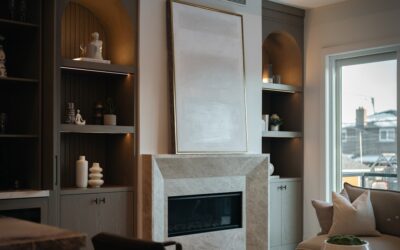
A masonry or prefab outdoor fireplace on the cover’s far wall gives the patio what every room needs: a focal point. It also stretches the season by two months on either end. Prefab gas units start around $3,000 installed; full masonry wood-burners run $8,000 to $20,000. Under a roof, gas is the practical pick — no ember risk, and most codes restrict wood-burning fireboxes under combustible covers.
3. Hang Ceiling Fans (Yes, Plural)
Nothing changes daily comfort per dollar like moving air. A damp-rated 60-inch fan drops perceived temperature 4 to 6 degrees and pushes mosquitoes off their flight paths. On covers longer than 14 feet, install two smaller fans instead of one large — even coverage beats a single windy spot. Budget $150 to $400 per damp-rated fan plus wiring.
4. Layer the Lighting
One flush-mount fixture makes a patio feel like a garage. Layer three sources instead: string lights or a dimmable ambient layer overhead, task lighting at the grill and bar, and low accents — sconces, step lights, lanterns — around the perimeter. Warm color temperature only (2700K); daylight-white LEDs murder the mood. A full lighting layer can be done for $200 to $600 DIY if the cover was wired during construction.
5. Add Outdoor Curtains
Weather-resistant curtain panels on a pipe or cable rod soften the structure, block low western sun, and screen the neighbor’s sightline — and they read instantly as “resort.” Sunbrella-type panels run $50 to $120 each; a full four-post wrap costs $300 to $700. Choose grommet tops that slide freely and tie-backs rated for wind, or the first storm will re-decorate for you.
6. Build a Bar Counter on the Open Edge
A 12-to-16-inch-deep counter along the cover’s open side — on the half wall, between posts, or as a pass-through from the kitchen window — adds seating for four without eating floor space. Granite remnants make this cheap: fabricators sell offcuts for $10 to $30 per square foot, and a post-to-post bar top can be done for under $500.
7. Warm It Up with an Outdoor Rug
A polypropylene rug zones the seating area, quiets the acoustics, and hides a tired slab for $100 to $300 in an 8×10. Under a solid cover, outdoor rugs last 4 to 6 years instead of the 2 they survive in open sun. Go bigger than instinct says — front legs of every seat should land on the rug.
8. Mount the TV
Under a solid, insulated cover you can mount a standard TV in a weatherproof enclosure or spend up on an outdoor-rated set (SunBrite, Samsung Terrace — $1,200 to $3,500). Position it out of direct afternoon sight lines to the west, add a soundbar rated for damp locations, and Sunday football moves outside from September through the playoffs.
9. Plank or Paint the Ceiling
Look up — the underside of the cover is a sixth surface most people waste. Tongue-and-groove pine or cedar planking ($3 to $7 per square foot DIY) turns an aluminum or framed cover into architecture. The Southern classic: paint it haint blue. Even simple beadboard panels with painted battens elevate the whole space.
10. Hang a Porch Swing or Daybed
If the cover’s framing was sized for it (verify — a swinging daybed needs 500-plus pounds of dynamic capacity into a beam or joists, never into panel roofing), a hanging daybed becomes the single most fought-over seat in the house. Swing beds run $600 to $2,000; a classic porch swing starts around $250.
11. Go Vertical with Greenery
Planters at the post bases with climbers (star jasmine, clematis), hanging baskets along the open edge, and a trellis panel screening the utility view — plants blur the line between structure and yard. Under a roof, choose shade-tolerant species for the inner zone and save the sun-lovers for the drip line. This trick works even harder on compact spaces; our small patio ideas roundup leans on vertical planting for exactly that reason.
12. Add a Privacy Wall That Doubles as Decor
One solid or slatted wall on the neighbor side — horizontal cedar slats, a stone veneer panel, or lattice with vines — converts an exposed cover into an outdoor room. Slat walls run $20 to $40 per linear foot DIY. Hang a mirror, metal art, or an outdoor-rated gallery wall on it and the “room” illusion completes.
13. Warm the Shoulder Seasons with Heaters
Ceiling- or wall-mounted electric infrared heaters ($150 to $600 each) mount flush under the cover, heat people rather than air, and carry none of the tip-over or clearance drama of propane mushrooms. Two 1,500-watt units cover a 12×14 seating zone into the 40s. Wire them on a wall switch or smart relay during construction if you can.
14. Zone It Like an Open-Concept Room
Covers 14×20 and larger should not be one big furniture puddle. Split the footprint: dining zone near the kitchen door, lounge zone around the fireplace or TV, and a bar or game ledge at the open edge. Use the rug, lighting, and planter placement to draw the lines. A defined 3-foot circulation path between zones keeps the space from feeling crammed even when every seat is full.
15. Finish the Floor
The slab is part of the design. Staining or stamping an existing gray slab ($4 to $12 per square foot) is the highest-visual-impact upgrade under a roof, where the finish is protected from UV and holds up beautifully — browse the technique menu in our decorative concrete guide. Porcelain pavers over the slab and interlocking deck tiles are the other two routes when you want texture underfoot without demolition.
Pulling a Look Together
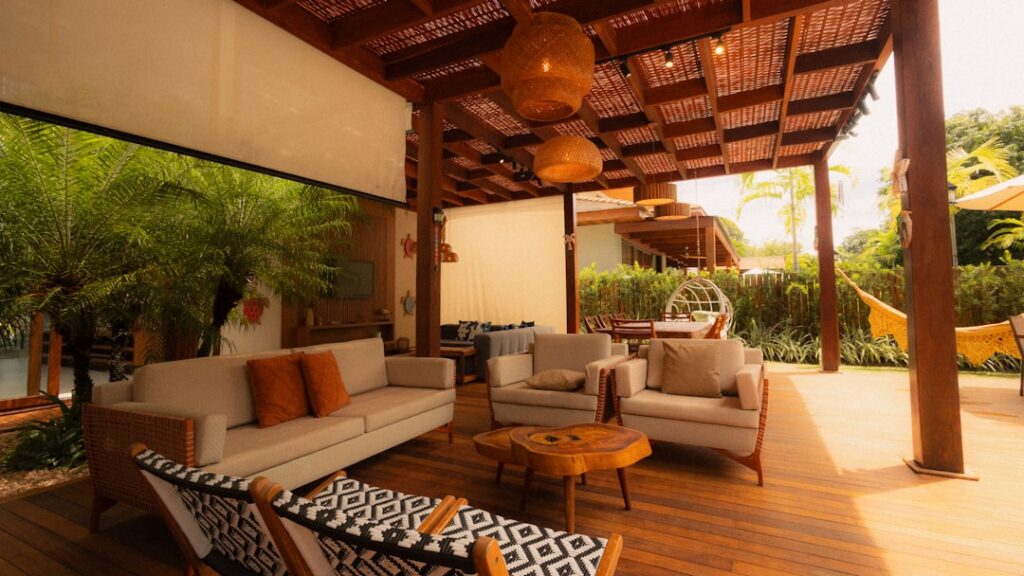
Ideas fail when they arrive one impulse purchase at a time. Pick a palette before you buy anything: two neutrals plus one accent color, repeated across cushions, rug, curtains, and planters, makes even budget pieces read as designed. Match your metals (all black hardware, or all bronze — not both), echo one interior material outside so the patio feels connected to the house, and leave at least a quarter of the floor plan empty. Restraint is the difference between “outdoor room” and “storage for outdoor furniture.”
Phasing the Makeover on a Budget
- Weekend one, under $500: string lights, outdoor rug, two planters, rearranged furniture into zones.
- Season one, $1,500–$3,000: ceiling fan, curtains, bar counter, heater.
- The big year, $5,000+: outdoor kitchen or fireplace, ceiling planking, floor finish.
Sequence matters only in one place: anything requiring wiring or framing reinforcement (fans, heaters, TV, swing bed) is far cheaper to rough in early. Everything else can layer in as budget allows — which is exactly how the best covered patios get built: one good idea per season until the roofed slab out-competes the living room.