
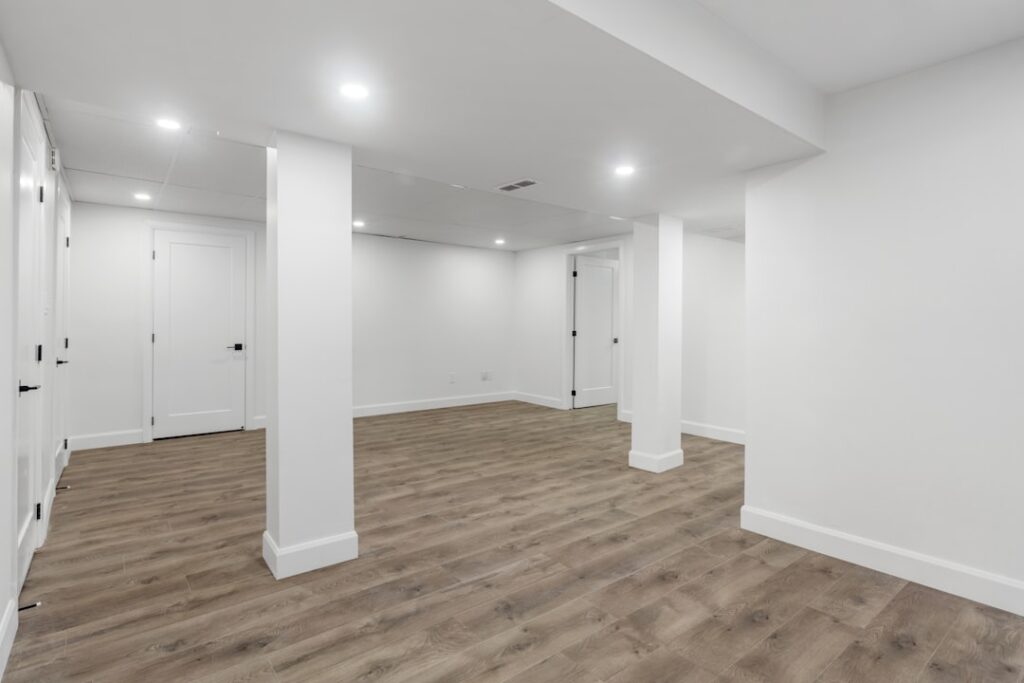
A basement has every disadvantage a cozy room should not have: low ceilings, poor light, cold floors, humidity, and the sound of a furnace 12 feet away. Yet finished correctly, it becomes the best room in the house — the one everyone ends up in. Good cozy basement ideas solve the environmental problems first and layer the comfort on top. Skip either half and the result is a decorated cave. Do both, and it feels like a hug the moment you walk down the stairs.
- Start With Warmth on the Floor
- Lighting Has to Do Double Duty
- Conquer Humidity Before It Ruins the Vibe
- Sink-In Seating
- Texture Layering
- Fireplace and Heat Features
- Walls, Ceilings, and Color Strategy
- Sound and Acoustics
- Functional Corners That Add Purpose
- Smart Touches That Finish the Room
- Bringing It All Together
Start With Warmth on the Floor
Concrete slab pulls heat straight out of the room and through your socks. Cover it, insulate it, or both. The simplest upgrade is a rigid-core waterproof vinyl plank (LVP) installed over 6 mil vapor barrier and an IXPE foam underlayment. Add 3/4 inch R-Max polyiso insulation panels below a plywood subfloor for genuinely warm feet. Electric radiant heat mats under engineered hardwood cost $6-$12 per sq ft all-in but transform the space.
Layer a thick wool area rug (8×10 at minimum) over the hard floor. Wool holds warmth, absorbs footfall noise, and survives spills far better than synthetic pile. Budget $400-$900 for a good wool rug; it lasts 25 years.
Lighting Has to Do Double Duty
A single overhead fixture in a basement feels like an interrogation room. Spread the light across three zones. Ceiling wash from 4-inch recessed LED cans at 3000K-2700K gives general brightness. Wall sconces or picture lights at eye level add depth and soften corners. A floor lamp and table lamp at seated height close the circuit and give a warm pool of light where you actually sit.
Use dimmers on every circuit. The basement should shift from bright daytime workspace to 30-percent evening cave with a single fader. Smart bulbs (Philips Hue, Lutron Caseta) automate the shift and store scenes for movie nights.
Conquer Humidity Before It Ruins the Vibe
Nothing kills coziness faster than that basement-musty smell. The fix is a dedicated 50-70 pint dehumidifier (Midea Cube, Honeywell) running at 45-50 percent RH. Expect $250-$450 for a quality unit. Drain the condensate into a floor drain or utility sink; a drain hose is far less annoying than emptying a bucket twice a day.
Seal any radon entry points, air-seal rim joists with closed-cell foam, and inspect exterior grading so water sheds away from the foundation. A dry basement smells neutral — a wet basement smells like a 1970s rec room no matter what you do inside.
Sink-In Seating
Basements call for furniture that invites slouching. Deep-seat sectionals (Lovesac Sactional, Interior Define Sloan, RH Cloud Couch) with 40-inch deep seat cushions outperform stiffer living-room pieces here. A 96-inch or larger sectional comfortably seats 4-6 adults for movie night. Bring in a pair of oversize armchairs (Article Ceni, West Elm Haven) and a large leather ottoman that doubles as a coffee table.
Texture Layering
- Chunky knit throw: chunky wool or chenille in a warm neutral
- Faux fur or sheepskin: one piece, draped or as a seat accent
- Boucle or velvet accent chair: contrasts flat-weave sofa upholstery
- Linen or heavyweight cotton pillows: mix patterns, sizes 20-24 inches
- Woven basket and natural fiber tray: breaks up hard surfaces
Fireplace and Heat Features
A full gas fireplace is the gold standard but needs venting and permits. An electric fireplace insert (Touchstone Sideline, Dimplex) gives 5,000-9,000 BTU of supplemental heat without any venting and installs in a weekend for $500-$1,500. Even the hardcore skeptics agree the ambient glow transforms basement mood.
For smaller budgets, a portable infrared tower heater ($80-$150) pointed into the seating area covers the cold-spot problem and runs quietly. An electric throw blanket with dual-zone heat (Sunbeam, Serta) adds the final layer of warmth for movie nights.
Walls, Ceilings, and Color Strategy
Paint walls in mid-to-deep warm tones — olive, terracotta, warm charcoal, muted navy. Bright white walls in a basement look clinical under LED. If the ceiling is exposed joist bays, paint everything (joists, ductwork, wiring) the same matte dark color. The ceiling visually disappears and the room feels taller. If the ceiling is drywalled and low, paint it the same color as the walls to blur the corner and trick the eye.
Sound and Acoustics
Bare drywall and concrete create a flat, echoey sound. A few acoustic interventions transform the space without building a theater. Heavy drapes on any egress windows, a floor-to-ceiling bookshelf filled with books and baskets, a large wall tapestry or upholstered headboard-style panel, and of course that big rug — each one eats reflections and warms the audio.
Functional Corners That Add Purpose
A cozy basement benefits from one or two dedicated micro-zones beyond the main seating area. Options include a built-in reading nook under the stairs, a wet-bar or coffee station with open shelves and warm task lighting, a gaming corner with a pair of swivel chairs, a small guest-bed alcove behind a curtain, or a wine room cooled to 55-60°F.
Smart Touches That Finish the Room
- A smart thermostat with a secondary sensor in the basement so the HVAC balances the zone
- A soundbar with dialog-boost mode for movie nights
- Wi-Fi mesh node down here — basement dead zones ruin streaming
- A battery-backup strip for the TV so a power blip does not dump the game
- Cordless window coverings — less cord clutter in a darker room
Bringing It All Together
Cozy comes from four compounding elements: warm floors, layered lighting, soft textiles, and controlled humidity. Get those right and almost any decor choice will feel inviting. A well-planned basement turns into the most-used room in a house within a single season, and the budget to get there is usually a fraction of a kitchen remodel.


