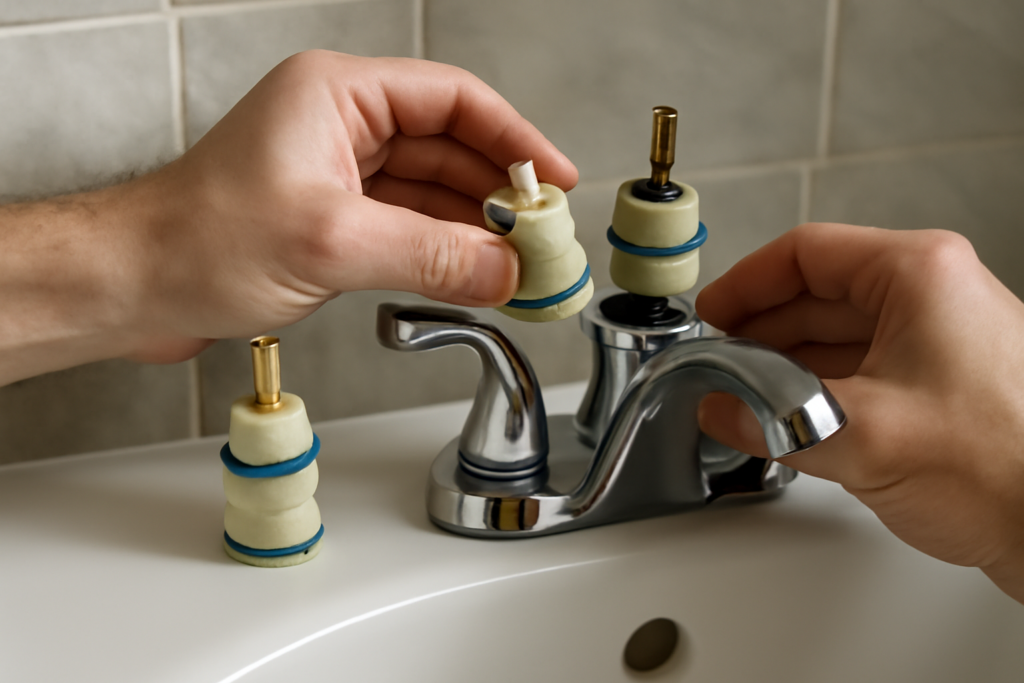
A dripping Delta is almost never a dead faucet — it is a $20 to $60 part. But walk into a plumbing aisle asking for a Delta faucet cartridge and you will face a wall of RP numbers that mean nothing without knowing which valve series lives inside your fixture. Delta has used several distinct valve platforms over 60-plus years, and the cartridges are not interchangeable. This guide teaches you to identify your series from the faucet itself, match it to the right RP part, and swap it without drama. Get the identification right and the repair is a 20-minute job; get it wrong and you make two more trips to the store.
- How Delta Cartridges Are Organized
- Identifying Your Series Without Paperwork
- What Makes the DIAMOND Seal Different
- Step-by-Step: Swapping a Shower Cartridge (RP46074)
- Springs and Seats: The Forgotten Fix
- Troubleshooting After the Swap
- How Long Cartridges Last and What Kills Them
- Buying Smart: Genuine vs Generic
- Tools Worth Having Before You Start
- The Bottom Line
How Delta Cartridges Are Organized
Delta’s replacement parts all carry RP numbers (“replacement part”), and the cartridge you need depends on the valve series, not the faucet’s style name. The families that matter:
- RP19804: the 1300/1400 Monitor series tub-shower cartridge (single lever, pre-2006 era)
- RP46074: the MultiChoice 13/14 series cartridge that replaced RP19804 in 2006-and-later valves
- RP32104: the 1700 series Monitor cartridge, for dual-function shower handles with separate volume and temperature control
- RP50587: the DIAMOND Seal cartridge in most modern single-handle kitchen and lavatory faucets
- RP1991: not a cartridge at all but the classic two-handle stem unit, sold in pairs for older washerless two-handle faucets
- RP61: the “ball” era part — pre-cartridge Delta single-handles used a rotating ball with springs and seats (RP4993 spring kit)
Write the RP number on painter’s tape inside the vanity or sink cabinet after any repair. Your future self will thank you.
Identifying Your Series Without Paperwork
Most people have no model number, so identify from physical clues. On showers: pull the handle and escutcheon. A 13/14 series valve has a single cartridge with a visible spline stem; if the faucet was installed after roughly 2006 and the valve body says MultiChoice, you need RP46074. A 1700 series handle rotates for temperature and pulls out or has a second control for volume — that is RP32104 territory. On sinks: a modern single-handle Delta that sweeps smoothly side to side is almost certainly DIAMOND Seal (RP50587); a vintage single-handle where the handle arcs over a dome cap is the old ball design; and any two-handle Delta where each handle turns 90 degrees runs RP1991-style stems.
When in doubt, pull the old part and bring it to the counter, or photograph it next to a tape measure. Delta’s customer service (1-800-345-3358) can also identify a valve from a photo and will often ship the cartridge free under warranty to original owners.
What Makes the DIAMOND Seal Different
Delta’s modern cartridge deserves its reputation. The DIAMOND Seal valve embeds industrial diamonds in one of its ceramic discs, so the discs polish rather than score each other with every use — Delta rates the design for five million cycles, roughly 100 years of household duty. Just as important, the cartridge integrates the water inlets so supply water never touches the brass body, eliminating the internal wear paths that killed older designs. In practice, when a DIAMOND Seal faucet drips it is usually debris caught in the discs, and sometimes flushing the cartridge solves it without replacement. These cartridges are faucet-family-specific in stem length, so match the RP number to your faucet model on Delta’s parts site rather than assuming one RP50587 fits all.
Step-by-Step: Swapping a Shower Cartridge (RP46074)
- Kill the water — whole house, or the shower’s integral stops if the valve has them — then open the valve to drain pressure.
- Remove the handle set screw (1/8-inch hex on most trims) and pull the handle, then unscrew the escutcheon.
- Pry off the retaining clip with needle-nose pliers and keep it — new cartridges often ship without one.
- Pull the old cartridge straight out. Scale-welded cartridges respond to a gentle rocking motion; never lever sideways against the brass body.
- Note the hot side. The cartridge installs with “hot” markings left on standard plumbing; reversed installs are the classic cause of backwards handles.
- Grease the O-rings with silicone plumber’s grease, seat the new cartridge, replace the clip, and reassemble.
Sink cartridges follow the same rhythm minus the wall: handle, bonnet nut, cartridge, clip. Total time, 20 to 30 minutes.
Springs and Seats: The Forgotten Fix
On older ball-style and some cartridge-era Delta sinks, the actual sealing surfaces are two small rubber seats sitting on springs down in the valve body — part RP4993. A drip on these faucets is cured for $6 by replacing seats and springs, not the ball or cartridge. Fish the old ones out with a pencil tip, stack the new spring inside the seat on the pencil, and press each into its pocket. If your two-handle faucet drips, resurface or replace the RP1991 stems and their seats together; replacing one without the other invites a repeat drip within months.
Troubleshooting After the Swap
A fresh cartridge usually ends the story, but three post-swap symptoms come up often enough to prepare for. Reversed hot and cold means a 13/14-series cartridge went in rotated 180 degrees — pull it and re-seat with the “hot side” mark oriented per the instruction sheet rather than re-plumbing anything. Reduced flow after replacement is nearly always debris knocked loose during the job now lodged in the aerator or shower head; unscrew and rinse the screen before blaming the new part. And a persistent drip with a brand-new genuine cartridge points below the cartridge on older sink valves — the seats and springs (RP4993) that the cartridge presses against, which should be replaced as a set with any cartridge on those designs.
Temperature limit is the adjustment everyone forgets. Delta shower cartridges include a rotational limit stop — the plastic toothed ring on the stem — that caps how far the handle can swing toward hot. Factory setting is conservative, so if your new cartridge delivers lukewarm showers, pull the handle and rotate the limit ring a tooth or two hotter, testing as you go. Aim for 120°F maximum at the head; a meat thermometer in a cup under the spray settles the argument.
How Long Cartridges Last and What Kills Them
Delta’s modern cartridges are rated far past normal life, so premature failures almost always trace to water conditions. Hard water past 10 grains per gallon scales the discs and O-rings; a whole-house softener doubles practical cartridge life. Sediment after municipal line work is the other killer — when a utility flushes hydrants on your street, run the tub spout (no aerator, no cartridge restriction) for two minutes before using mixing faucets. Homes on wells should treat a $30 whole-house sediment filter as faucet insurance. With decent water, a DIAMOND Seal cartridge in a kitchen faucet is realistically a 15-to-25-year part.
Buying Smart: Genuine vs Generic
Generic cartridges cost half as much and are usually worth avoiding here, for one reason: Delta’s lifetime warranty means original owners get genuine cartridges free by phone, and even purchased genuine parts carry tighter disc tolerances than the knockoffs. Expect $25-$45 for RP46074, $30-$60 for RP50587 variants, and under $15 for seats-and-springs kits. These principles — and the anatomy shared by every brand’s valves — are covered in our broader faucet cartridge guide if you are diagnosing a mixed-brand house.
Tools Worth Having Before You Start
The full kit for any Delta cartridge job fits in one hand: a 1/8-inch hex key for handle set screws, adjustable pliers with taped jaws for bonnet nuts, needle-nose pliers for retaining clips, silicone plumber’s grease, and a flashlight. Add a $12 plastic cartridge puller if the faucet predates 2010 or lives with hard water — scale-seized shower cartridges have broken more stems under channel-lock enthusiasm than any other cause, and the puller extracts them straight and intact. A towel over the drain catches the set screw that otherwise disappears down it, a lesson everyone learns exactly once.
The Bottom Line
Identify the series first, buy the matching RP number, and any Delta faucet cartridge swap is squarely a DIY job: 20 minutes, hand tools, no plumber. The drip stops, the handle glides again, and the fixture is good for another decade or three. Few repairs in a house return so much for so little.