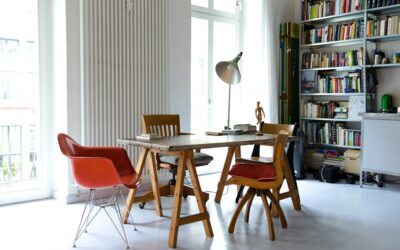
The flooring aisle at any big-box store has 200+ products, and almost every one of them is right for some room and wrong for others. Choosing among different kinds of flooring isn’t about ranking materials — it’s about matching the material to the specific demands of the room, the household, and the budget. This guide is a decision framework rather than a category catalog: how to pick the right flooring for each space rather than just listing what exists.
Start with Three Questions
For every room, answer three questions before looking at flooring products:
- How wet does the floor get? Standing water from showers and laundry leaks rules out hardwood and laminate. Daily splashes from kitchens reduce hardwood options to engineered with proper subfloor prep.
- How heavy is the foot traffic? Front entries, mudrooms, and kitchens demand 30+ mil wear layers and high Janka hardness. Bedrooms and offices can use thinner products that wouldn’t survive an entry.
- How long will you live with this floor? A 5-year hold favors lower-cost options; a 25-year hold pays back premium materials.
The answers eliminate 70% of the catalog before you compare any specific products.
Decision Matrix by Room
| Room | Best | Acceptable | Avoid |
|---|---|---|---|
| Front entry / foyer | Tile, stone | LVP commercial-grade | Carpet, hardwood (climate-dependent) |
| Living room | Hardwood, LVP | Carpet, laminate | — |
| Dining room | Hardwood, tile | LVP | Carpet |
| Kitchen | Tile, LVP, engineered hardwood (premium) | — | Solid hardwood, carpet, laminate |
| Primary bath | Tile, LVP (waterproof) | — | Hardwood, laminate, carpet |
| Powder room | Tile, vinyl, painted concrete | — | Carpet |
| Primary bedroom | Hardwood, carpet, LVP | Laminate | Tile (cold) |
| Kids’ bedroom | Carpet, LVP, cork | Laminate, hardwood | Tile |
| Office | Hardwood, carpet, cork | LVP, laminate | Tile |
| Basement | LVP, tile, sealed concrete | Carpet (low-moisture only) | Hardwood, laminate |
| Mudroom | Tile, LVP commercial | — | Hardwood, laminate, carpet |
| Laundry | Tile, LVP, sheet vinyl | — | Hardwood, laminate, carpet |
| Garage | Sealed concrete, epoxy, rubber | — | Standard residential flooring |
Choose by Lifestyle
Material durability rankings shift based on what’s happening in the home:
- Active families with kids and pets — LVP, tile, sealed hardwood with high wear-layer or Janka rating; avoid soft species (pine, cherry) and matte hardwood finishes that show every scratch
- Empty nesters — broader options, premium hardwood, high-end natural stone all viable
- Frequent entertainers — entry mudroom protection, kitchen tile, dining hardwood that takes traffic
- Renters preparing for sale — neutral mid-range LVP, beige carpet in bedrooms, basic tile in baths — easy to update later
Choose by Budget
Per sq ft installed costs to plan around:
| Tier | Range | Categories |
|---|---|---|
| Budget | $2-5 | Sheet vinyl, basic carpet, peel-stick tile |
| Entry | $4-8 | Mid-tier LVP, basic laminate, builder-grade tile |
| Mid-range | $7-13 | Quality LVP, mid-tier laminate, ceramic tile, basic engineered hardwood |
| Premium | $12-25 | Premium hardwood, porcelain tile, designer LVP |
| High-end | $20-50+ | Custom hardwood, natural stone, designer porcelain, parquet |
| Luxury | $50+ | Marble, custom mosaics, reclaimed wood, leather, terrazzo |
Most homeowners do mid-range overall with one or two splurges in highest-impact rooms (kitchen tile, primary bath, entry foyer).
Lifetime Cost
Total cost over a 30-year ownership horizon shifts the math significantly. Annualized costs:
- $3 per sq ft carpet at 10-year life = $0.30 per sq ft per year
- $5 per sq ft laminate at 20-year life = $0.25 per sq ft per year
- $10 per sq ft LVP at 25-year life = $0.40 per sq ft per year
- $15 per sq ft engineered hardwood at 50-year life with one recoat = $0.32 per sq ft per year
- $20 per sq ft tile at 75-year life = $0.27 per sq ft per year
The cheapest material isn’t always the cheapest over decades. Tile and hardwood frequently beat LVP and laminate on lifetime cost when full lifecycle is calculated.
Aesthetic Coordination
Modern open-floor-plan homes increasingly use one flooring throughout the main level — typically wide-plank LVP or hardwood across kitchen, living, and dining. Visual continuity matters when rooms aren’t separated by walls.
For traditional homes with clearly defined rooms, mixing materials by room is appropriate: hardwood in living, tile in foyer and kitchen, carpet in bedrooms. The transition strips become design elements rather than awkward gaps.
Subfloor Considerations
Existing subfloor type affects flooring options:
- Concrete slab — no solid hardwood without an extensive moisture barrier system; engineered hardwood, LVP, tile, and laminate all work
- Plywood/OSB — broadest compatibility with all flooring types
- Existing tile — can be left in place if flat, providing solid base for LVP or laminate
- Existing hardwood — usually best to refinish rather than cover; if covering, requires 1/4-inch underlayment
Subfloor flatness matters more than substrate type for most modern flooring. The TCNA tolerance for tile is 1/8 inch over 10 feet; for LVP and laminate it’s 3/16 inch over 10 feet.
Final Decision Framework
For each room, work through:
- Eliminate inappropriate categories (carpet in bath, hardwood in basement, etc.)
- Filter remaining options by budget tier
- Compare lifetime cost across 2-3 finalists
- Order samples and view in actual room lighting
- Verify warranty terms and installation requirements
Done methodically, the right flooring choice for any room becomes obvious. The mistake most homeowners make is reversing the order — picking a beautiful product first, then trying to retrofit it to a room where it doesn’t belong.
Prefer to explore on your own?
See how new flooring looks in your actual room in seconds — free, no signup.
Try the free Floor Studio →