Most people think epoxy flooring is one thing: that shiny gray garage coating. In reality, the different types of epoxy flooring range from paper-thin protective coatings to quarter-inch industrial mortar systems, each engineered for a specific balance of durability, looks, and cost. Choosing the wrong type for your space means a floor that either fails under load or costs far more than the job needed. This guide walks through the main systems, what they cost, and where each one belongs.
- What Epoxy Flooring Actually Is
- Self-Leveling Epoxy
- Epoxy Flake (Chip) Flooring
- Metallic Epoxy
- Epoxy Mortar Flooring
- Quartz-Filled Epoxy
- Anti-Static (ESD) Epoxy
- How to Choose the Right Epoxy Type
- Water-Based vs. Solvent-Based vs. 100% Solids Epoxy
- How Long Epoxy Flooring Lasts
- DIY Kits vs. Professional Installation
- Making the Final Decision
What Epoxy Flooring Actually Is
Epoxy is a two-part thermosetting resin: you mix a resin with a hardener, and a chemical reaction cures it into a rigid, durable plastic bonded to the concrete below. Unlike paint, which sits on top and wears off, epoxy chemically hardens into a thick, seamless surface that resists chemicals, abrasion, and moisture.
The differences between systems come down to thickness, fillers, and finishes. A thin coating might be 10 to 20 mils, while a heavy-duty mortar system can be a full 1/4 inch or more. That range is why epoxy shows up everywhere from home garages to hospital operating rooms.
Self-Leveling Epoxy
Self-leveling epoxy is a smooth, seamless system poured over concrete to create a level, glossy surface. It flows out to fill minor cracks and low spots, producing a clean, uniform floor typically 2mm or thicker.
It is a favorite for garages, basements, kitchens, and commercial showrooms where you want a durable, easy-to-clean surface with a polished look. Expect roughly $3 to $7 per square foot installed. Because it hides small imperfections and comes in many colors, it is one of the most popular residential choices.
Epoxy Flake (Chip) Flooring
Flake floors broadcast colored vinyl chips into a wet epoxy base coat, then seal them under a clear topcoat. The result is a speckled, terrazzo-like surface that hides dirt and imperfections while adding slip resistance from the subtle texture.
- Look: Decorative multi-color speckle, fully customizable to match a color scheme.
- Best for: Garages, basements, mudrooms, and commercial spaces wanting durability plus style.
- Cost: Roughly $4 to $9 per square foot installed.
- Bonus: The flakes camouflage dust, minor scratches, and tire marks.
Flake systems are the go-to for homeowners who want their garage or basement to look finished rather than industrial.
Metallic Epoxy
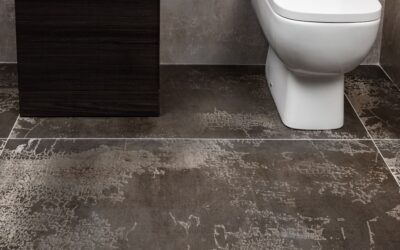
Metallic epoxy blends metallic pigments into the resin, which are then manipulated with solvents, torches, and tools to create swirling, three-dimensional effects that resemble lava, marble, or flowing water. No two floors are identical.
This is the premium decorative option, used in retail showrooms, restaurants, and high-end living spaces and basements where the floor is a design centerpiece. It runs about $7 to $15 per square foot installed because it is labor-intensive and requires an experienced applicator. It delivers dramatic looks but shows scratches more than a flake floor, so it suits lower-abrasion spaces.
Epoxy Mortar Flooring
Epoxy mortar is the toughest system, made from epoxy resin mixed with graded sand or quartz aggregate to form a thick, dense, impact-resistant surface. It can be built up to 1/4 inch or more and even used to patch damaged concrete before other coatings.
This is industrial-grade flooring for warehouses, manufacturing plants, loading docks, and commercial kitchens that see heavy machinery, forklifts, and constant abuse. It is the most expensive at roughly $5 to $12 per square foot or more, but nothing else takes that level of punishment.
Quartz-Filled Epoxy
Quartz-filled epoxy combines high-performance resin with stained quartz grains to create a decorative yet extremely durable and slip-resistant floor. It balances the toughness of a mortar system with a more attractive, colored finish.
You will find it in spaces that need both hygiene and grip: locker rooms, restrooms, commercial kitchens, and lobbies. Cost typically lands around $5 to $10 per square foot installed. The textured surface makes it one of the safest wet-area options.
Anti-Static (ESD) Epoxy
Electrostatic dissipative epoxy is a specialized system that controls static electricity buildup, protecting sensitive equipment and preventing sparks. It incorporates conductive materials and is grounded during installation.
Its use is niche but critical: electronics manufacturing, server rooms, laboratories, hospitals, and any facility handling flammable materials or static-sensitive components. Because of the engineering involved, it is among the pricier systems, often $6 to $12 per square foot or higher.
How to Choose the Right Epoxy Type
Match the system to how the space is used, not just how it looks. Start with the demands of the room:
- Home garage or basement: Flake or self-leveling epoxy gives durability, easy cleaning, and good looks at a reasonable cost.
- Decorative living or retail space: Metallic epoxy for a showpiece, if abrasion will be light.
- Wet or slip-prone areas: Quartz-filled epoxy for grip and hygiene.
- Heavy industrial traffic: Epoxy mortar for maximum toughness.
- Static-sensitive environments: Anti-static ESD epoxy.
Also weigh the concrete’s condition and moisture level, since all epoxy needs a properly prepped, dry, degreased slab to bond. A moisture test is worth doing before any pour.
Water-Based vs. Solvent-Based vs. 100% Solids Epoxy
Beyond the decorative systems, epoxy is also classified by its formulation, and this affects durability, thickness, and odor. Water-based epoxy is the thinnest and most DIY-friendly, with low odor and easy cleanup, but it produces a thinner film that suits light-duty residential floors rather than heavy traffic. It is the common choice for a weekend garage kit.
Solvent-based epoxy penetrates and bonds well and lays down a tougher film, but it carries strong fumes and requires good ventilation and care during application. The premium option is 100 percent solids epoxy, which contains no carriers that evaporate, so it cures into the thickest, hardest, most durable film in a single coat. It is what professionals use for high-performance industrial and commercial floors. As a rule, water-based is fine for a light home garage, while 100 percent solids is worth the cost where the floor takes real abuse.
How Long Epoxy Flooring Lasts
Longevity varies with the system and the traffic. A quality residential garage floor with a flake or self-leveling system typically lasts 10 to 20 years before it needs a refresh, while heavy industrial mortar floors in constant use may need recoating sooner in the highest-wear lanes. The single biggest factor is not the epoxy itself but the concrete prep beneath it.
Epoxy is only as durable as its bond to the slab. A floor applied over unground, sealed, greasy, or damp concrete will peel and bubble within months no matter how premium the product, while the same epoxy over properly ground, clean, dry concrete lasts for a decade or more. That is why professionals spend most of a job on grinding, moisture testing, and priming rather than on the pour itself. If you take one thing from comparing the different types of epoxy flooring, let it be that preparation determines lifespan more than the label on the pail.
DIY Kits vs. Professional Installation
Home-center epoxy kits make a garage floor look like an easy weekend project, and for a basic water-based coating over a well-prepped slab, a careful DIYer can get a good result. These kits typically cost $50 to $200 and cover a one or two-car garage, though the thin film they produce is less durable than a professional system. The catch is that success still hinges on grinding and cleaning the concrete properly, which most kits underemphasize.
Decorative metallic pours, thick 100 percent solids systems, and industrial mortar floors are a different story and belong to professionals. These require precise mixing ratios, fast working times, moisture mitigation, and finishing techniques that are hard to learn on your own floor. A botched metallic pour or a coating applied over damp concrete peels within months, turning a cheap kit into an expensive redo. As a rule, DIY the simple garage coating if you are handy, and hire out anything decorative or high-performance where the cost of failure is high.
Making the Final Decision
The different types of epoxy flooring exist because no single formula fits every job. A homeowner finishing a garage wants flake or self-leveling epoxy; a designer creating a statement lobby reaches for metallic; a factory floor demands mortar. Identify your traffic level, moisture exposure, slip requirements, and budget first, then pick the system that matches. Get that alignment right, prep the concrete properly, and epoxy delivers a seamless, long-lasting floor built for exactly how you use the space.