
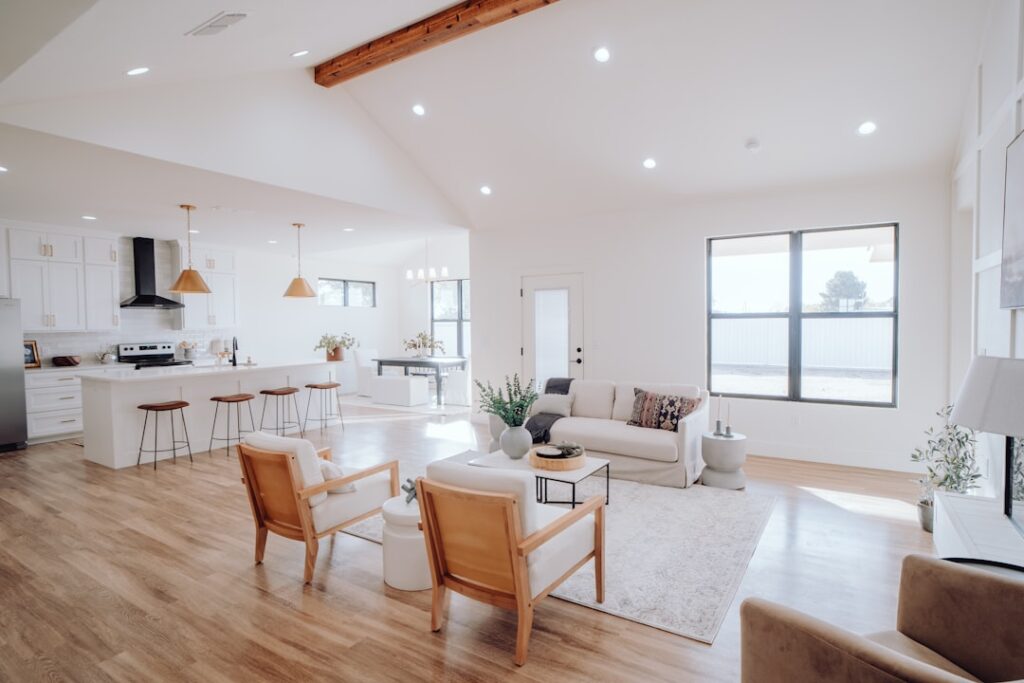
Homeowners across Birmingham, Wolverhampton, Coventry, and the broader West Midlands are asking sharper questions about what’s actually under their feet — adhesives, finishes, raw material sourcing, and whether the FSC stamp on the box means anything. Eco-friendly flooring west midlands has gone from a niche request to a mainstream specification, and the local supplier base has responded with cork, bamboo, reclaimed oak, linoleum, and low-VOC luxury vinyl options. This buying guide breaks down what’s worth your money and what’s marketing.
- What Actually Qualifies as Eco-friendly
- The Best Eco-friendly Options Locally Stocked
- Pricing Reality in the West Midlands Market
- Reclaimed Oak: The Local Hero
- What to Avoid That's Marketed as Eco
- Installation Methods That Stay Green
- Questions to Ask Your West Midlands Supplier
- What Local Showrooms Should Be Able to Demonstrate
What Actually Qualifies as Eco-friendly
“Sustainable” is a slippery word. A meaningful eco-friendly floor checks at least three of the following boxes: rapidly renewable raw material, low-emission adhesives and finishes, third-party certification, recyclability at end of life, and minimal transport footprint. Bamboo grows back in 5 to 7 years versus 60-plus for oak. Cork is harvested without cutting the tree. Reclaimed timber skips the harvest entirely. FloorScore, GreenGuard Gold, and FSC certifications are the labels worth checking on the spec sheet.
Beware vague claims like “natural” or “green” with no certification to back them. Ask your supplier for the FloorScore number on the carton — legitimate products print it.
The Best Eco-friendly Options Locally Stocked
West Midlands suppliers carry a reasonable range of genuinely sustainable products. The following types appear most often in showrooms across Solihull, Stourbridge, and West Bromwich:
- FSC-certified bamboo: Strand-woven planks rate up to 3,000 on the Janka scale, harder than red oak. Expect £35 to £55 per square meter.
- Cork tiles and planks: Amorim and Wicanders dominate the category. Warm underfoot, naturally antimicrobial, £30 to £60 per sq m.
- Reclaimed oak: Salvaged from Victorian factories and barns across the Midlands. £65 to £120 per sq m depending on width and grade.
- Marmoleum (linoleum): Forbo’s flagship, made from linseed oil, pine rosin, and jute. £40 to £55 per sq m.
- Low-VOC LVT: Karndean’s K-Wave and select Amtico ranges carry FloorScore certification. £35 to £70 per sq m.
Pricing Reality in the West Midlands Market
Eco-friendly does not automatically mean expensive, but it rarely competes with bottom-tier laminate at £8 per square meter. Realistic supply-only budgets land in these tiers:
- Budget eco: £25 to £40 per sq m — entry bamboo, cork tiles, mid-range Marmoleum
- Mid-range: £40 to £70 per sq m — strand-woven bamboo, premium cork, FloorScore LVT
- Premium: £70 to £150 per sq m — wide-plank reclaimed oak, bespoke cork, hand-finished engineered
Installation across the West Midlands runs £15 to £30 per square meter for click-lock floating systems, and £30 to £50 per sq m for glue-down or solid timber that needs nailing. Underlay adds £4 to £10 per sq m — natural rubber and recycled felt are the genuinely sustainable choices.
Reclaimed Oak: The Local Hero
The West Midlands has a deep industrial heritage, and that means a steady supply of salvageable timber. Suppliers in Walsall, Smethwick, and the Black Country source oak beams from demolished factories, school floors from Victorian board schools, and barn timbers from rural Worcestershire. The wood arrives with nail holes, saw marks, and patina that no factory finish can replicate.
Expect 100-year-old quartersawn oak to cost £85 to £130 per square meter. The cost reflects the labor of de-nailing, kiln drying to stabilize moisture content to 8 percent, and machining tongue-and-groove edges. Properly sourced reclaimed oak is one of the lowest-embodied-carbon flooring options on the market, and it ages into something money can’t buy new.
What to Avoid That’s Marketed as Eco
Several products get the green halo without earning it. Bamboo from non-FSC sources often uses urea-formaldehyde adhesives that off-gas for years. “Wood-look” vinyl with no FloorScore certification typically contains phthalate plasticizers and emits VOCs well above acceptable indoor air quality thresholds. Cheap cork from unverified sources may be reconstituted with high-VOC binders rather than the natural suberin that makes cork special.
Engineered wood is a mixed bag. Quality engineered floors from European mills use formaldehyde-free PVA adhesives and carry CARB Phase 2 or E1 certification. Budget engineered from unmarked Asian sources can emit significant formaldehyde for 12-plus months. Ask for the emission class — E1 is acceptable, E0 is excellent.
Installation Methods That Stay Green
The eco credentials of your flooring can be undone by the installer’s adhesive choice. Solvent-based contact adhesives emit hundreds of grams of VOCs per liter. Specify a low-VOC water-based adhesive like Stauf SPU-460 or Mapei Ultrabond ECO 975 — both certified under EC1 Plus. For floating floors, use a natural rubber or recycled felt underlay rather than the standard foam, which is petroleum-based and non-recyclable.
If you’re doing a complete subfloor renovation, consider lime-based screed instead of standard cement. Lime sequesters carbon as it cures and is fully biodegradable. Cost premium runs roughly 15 percent over standard sand-cement screed, and local lime suppliers in Shropshire deliver across the West Midlands.
Questions to Ask Your West Midlands Supplier
Before signing a quote, get specifics. Ask for the FloorScore or FSC certificate number. Ask where the product is manufactured — Portuguese cork from Amorim, German engineered from Haro, and British-made Marmoleum from Kirkcaldy all have shorter supply chains than Asian imports. Ask about adhesive emission ratings. Ask whether the installer can provide certified low-VOC products. And ask about end-of-life take-back schemes — Forbo runs a Marmoleum reclamation program, and several engineered timber suppliers will recycle off-cuts.
What Local Showrooms Should Be Able to Demonstrate
A genuine eco-flooring specialist in the West Midlands should be able to walk you through certification paperwork on the spot — not “we’ll email it next week” but a binder with FSC chain-of-custody documents, FloorScore reports, and EPDs (Environmental Product Declarations) for the specific SKUs in their range. If a supplier struggles to produce these documents, that’s a flag.
The best independent showrooms in Birmingham, Solihull, and Stourbridge typically stock at least three eco categories: bamboo, cork, and either Marmoleum or reclaimed timber. Many also offer hemp underlay, natural latex underlay, and water-based finishes for site-applied work. Ask whether they can supply small samples in your actual room lighting before you commit. Eco-flooring choices that look beautiful under 4000K showroom LEDs sometimes read warmer or cooler than expected in real homes, and small samples cost the supplier nothing but save thousands in regret.
The greenest floor is the one you specify carefully and install with the right materials, not the one with the prettiest leaf on the packaging.
Prefer to explore on your own?
See how new flooring looks in your actual room in seconds — free, no signup.
Try the free Floor Studio →

