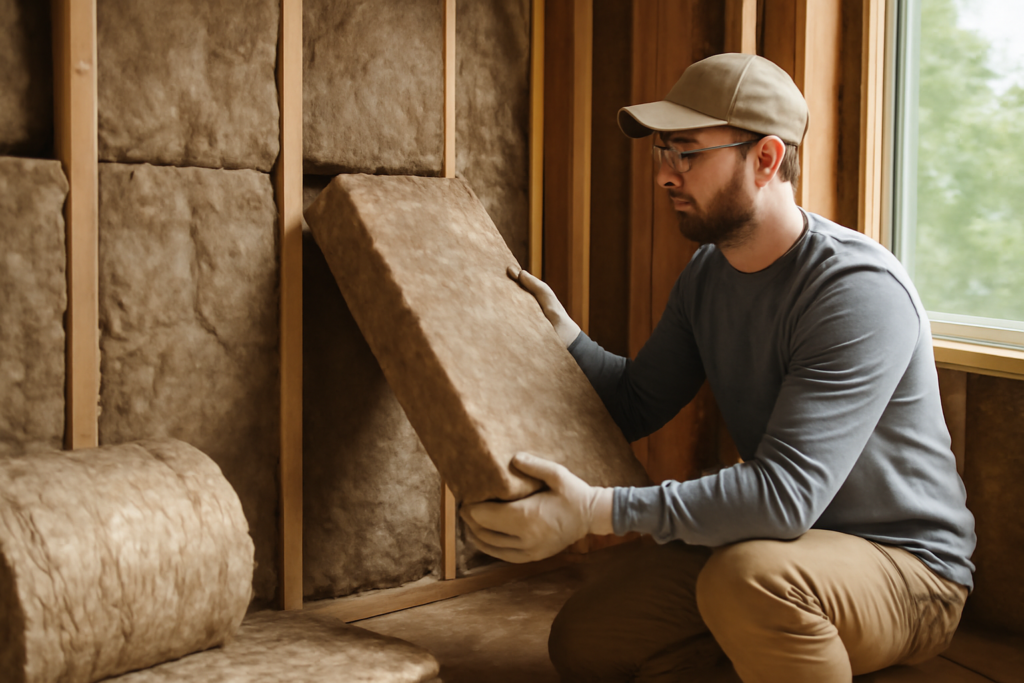
If you have opened a wall lately and found brown fiberglass instead of the usual pink or yellow, you have likely met Knauf’s flagship product. EcoBatt insulation is a fiberglass batt that swaps the traditional formaldehyde-based binder for a plant-derived one called ECOSE Technology, which is what gives it that natural brown color. It performs like standard fiberglass on R-value while cutting the harsh chemistry, and it has become one of the most widely spec’d batts in residential and commercial construction. Here is what it actually is, how it rates, and where it makes sense.
What EcoBatt Is Made Of
EcoBatt is manufactured by Knauf Insulation from sand and a high percentage of recycled glass, spun into fine glass fibers just like conventional fiberglass. The difference is the binder that holds those fibers together. Instead of phenol-formaldehyde, Knauf uses ECOSE Technology, a bio-based binder made from rapidly renewable plant materials with no added formaldehyde, phenol, acrylics, or artificial dyes. The absence of dye is why the batt is brown rather than the pink or yellow you associate with other brands. That brown color is not a coating; it is simply the natural look of glass fiber without pigment.
EcoBatt R-Values
EcoBatt comes in the same R-value lineup as standard fiberglass batts, sized to fit common framing cavities:
- R-13: 3.5-inch batt for 2×4 walls
- R-15: 3.5-inch high-density batt for 2×4 walls where you want more R in the same depth
- R-19: 6.25-inch batt for 2×6 walls and floors
- R-21: 5.5-inch high-density batt for 2×6 walls
- R-30: for floors and cathedral ceilings
- R-38: for attics and floors
On a per-inch basis EcoBatt delivers about R-3.0 to R-4.3 depending on the density, right in line with the fiberglass category. The R-13 and R-15 options are the workhorses for exterior walls, while R-38 handles attic floors. Knauf also offers unfaced and kraft-faced versions, the kraft facing acting as a vapor retarder where code requires one.
The Formaldehyde-Free Advantage
The headline benefit is indoor air quality. Traditional fiberglass used formaldehyde-based binders that could off-gas, and the raw fibers were notoriously itchy to handle. EcoBatt’s ECOSE binder contains no added formaldehyde, and installers frequently report it is softer and less irritating to cut and handle than older pink or yellow batts. It is GREENGUARD Gold certified for low chemical emissions, which matters for schools, healthcare, and anyone sensitive to indoor pollutants. For a material you seal inside your walls for decades, cleaner chemistry is a genuine selling point.
Where EcoBatt Fits Best
EcoBatt is a general-purpose batt, so it goes anywhere fiberglass batts belong:
- Exterior walls — R-13 or R-15 in 2×4 framing, R-19 or R-21 in 2×6.
- Attic floors — R-30 or R-38 batts laid between or across ceiling joists.
- Floors over unconditioned space — R-19 to R-30 batts supported between floor joists above crawl spaces or garages.
- Interior walls — unfaced batts for sound damping between rooms.
- Rim joists and band areas — cut to fit for a quick thermal and air detail.
Because it installs like any batt, it suits DIYers doing a basement finish or a garage conversion, and it is equally at home in new construction where crews want a low-irritation product that meets green building requirements.
How It Compares to Other Batts
Against standard fiberglass, EcoBatt matches R-value and beats it on chemistry and handling comfort, usually at a similar price. Against mineral wool such as Rockwool, EcoBatt is lighter, cheaper, and easier to compress into odd cavities, but mineral wool wins on fire resistance, sound damping, and water shedding. Against spray foam, EcoBatt is far cheaper and DIY-friendly but does not air-seal, so a batt job needs separate air sealing and careful fitting to perform well. For most walls and attics on a normal budget, EcoBatt hits the value sweet spot.
What It Costs
EcoBatt is priced comparably to other name-brand fiberglass batts, roughly $0.50 to $1.20 per square foot depending on R-value and facing, sold in bags covering a set square footage. An R-15 2×4 wall runs on the lower end; R-38 attic batts cost more per square foot because there is more material. For a typical 10×12 room’s worth of exterior wall, expect to spend well under $150 in materials. That affordability, combined with DIY installability, is a big reason it shows up in so many projects.
Installation Tips for Full Performance
Batts only reach their rated R-value when installed carefully, and this is where many jobs fall short. Cut each batt to fit the cavity exactly rather than stuffing an oversized piece, which compresses it and lowers the R-value. Split the batt around wires and boxes instead of compressing it in front of them, so it fills the full depth. Leave no gaps at the top and bottom plates. Because fiberglass does not stop air movement, seal the framing penetrations with caulk or foam before insulating, and use a proper vapor retarder facing where your climate zone requires it. Wear gloves, long sleeves, and eye protection even though EcoBatt is less itchy than older products.
Facing Options and Vapor Control
EcoBatt comes unfaced and kraft-faced, and choosing correctly depends on your climate and assembly. Kraft-faced batts have a paper layer coated with asphalt that acts as a Class II vapor retarder, and the facing goes toward the warm-in-winter side of the wall, meaning the interior in most of the country. That kraft face slows moisture from migrating into the wall cavity and condensing. Unfaced batts have no vapor retarder and are used where you do not want to trap moisture, such as interior partition walls, or where a separate vapor control layer like a smart membrane or poly sheet is installed. In hot, humid southern climates the vapor strategy flips, and many builders skip interior vapor retarders entirely. When in doubt, check your local code and climate zone, because putting a vapor retarder on the wrong side of a wall can trap moisture and cause the very rot you are trying to prevent.
Sustainability Credentials
Beyond the formaldehyde-free binder, EcoBatt carries a genuine environmental story. It is manufactured with a high recycled glass content, diverting bottle glass from landfills, and the ECOSE binder is derived from rapidly renewable plant sources rather than petrochemicals. Knauf reports significantly lower embodied energy and emissions in the ECOSE manufacturing process compared with traditional binders. For projects chasing LEED points or meeting green building programs, EcoBatt’s GREENGUARD Gold certification and recycled content contribute toward material and indoor air quality credits. If sustainability is part of your buying decision and not just performance and price, EcoBatt gives you a defensible, certified choice without stepping up to a premium natural product like sheep’s wool or denim, which cost considerably more per square foot.
How It Handles Moisture and Fire
Like all fiberglass, EcoBatt is non-combustible glass fiber, so it does not fuel a fire and carries a strong flame-spread rating, though it lacks the extreme heat resistance of mineral wool. On moisture, fiberglass does not absorb water into its fibers, but a soaked batt loses R-value while wet and can stay damp longer than mineral wool because it holds water between fibers rather than shedding it. That means EcoBatt performs best in dry, well-detailed assemblies with proper air and vapor control, and it is not the first pick for chronically damp locations like uncovered crawl spaces, where mineral wool or closed-cell foam handle intermittent wetting better. In a normal, dry wall or attic, though, its moisture behavior is a non-issue and matches every other fiberglass product on the market.
Is EcoBatt Worth It?
For anyone insulating walls, floors, or attics who wants proven fiberglass performance without the formaldehyde and the itch, EcoBatt insulation is an easy recommendation. It delivers the standard R-13, R-15, R-19, R-21, R-30, and R-38 options at competitive prices, installs like any batt, and carries green certifications that satisfy modern building programs. It will not air-seal a leaky house or match spray foam’s R per inch, so pair it with diligent air sealing for best results. Within its category, though, it is one of the cleanest and most user-friendly batts you can buy, and the natural brown color is a fair sign you are getting the better chemistry.
For a typical homeowner insulating a basement finish, a garage conversion, or an attic, EcoBatt hits the practical sweet spot of proven performance, clean chemistry, easy DIY installation, and a fair price. Buy the R-value that matches your framing, choose faced or unfaced based on your climate’s vapor strategy, install it snugly with no gaps or compression, and pair it with careful air sealing of the framing penetrations. Do that and you get the full rated R-value from a product that will sit quietly in your walls for the life of the house without off-gassing formaldehyde into the rooms you live in.