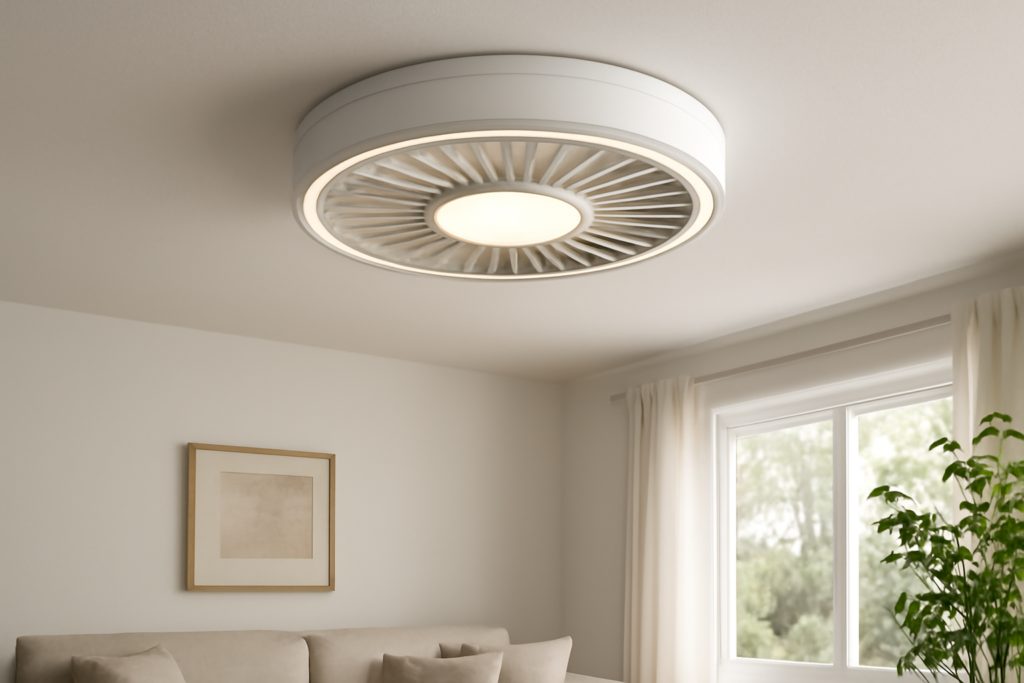
Spinning blades seven feet over a bunk bed make a lot of parents nervous — and in a loft, an RV, or a basement with a 7-foot ceiling, code will not even let a conventional fan hang. An enclosed ceiling fan answers both problems by wrapping the blades entirely inside a housing, usually behind a diffuser or drum shade, so the fixture reads as a flush ceiling light that happens to move air. The category has exploded alongside “fandeliers” and low-profile living, but the airflow physics have limits worth understanding before you buy.
What Counts as an Enclosed Fan
True enclosed fans hide the blades completely. Most use short acrylic or ABS blades — sometimes retractable, sometimes fixed — spinning inside a drum, globe, or box housing with an integrated LED panel behind a frosted diffuser. From below, you see a 12-to-20-inch flush-mount light fixture; only the airflow and a soft whir reveal the fan. Common formats include the drum-shade style (fabric or metal drum, fan concealed above the diffuser), the low-profile “socket fan” that screws or mounts where a flush light was, and enclosed bladeless-look rings. Sizes run small — 12 to 24 inches across versus 44 to 60 for standard fans — which is exactly why they fit where standard fans cannot.
Enclosed vs. Caged: Not the Same Thing
Shoppers constantly cross-shop these terms, and the difference matters. A caged ceiling fan surrounds open blades with a wire or metal cage — industrial styling, full-size open airflow, and finger protection that is partial at best, since a pencil (or a small finger) still fits through most cages. An enclosed fan seals the blades behind a solid or finely perforated housing: nothing reaches them, period. If your goal is a farmhouse look, buy caged; if your goal is genuine touch safety over a bunk or in a playroom, or the lowest possible profile, enclosed is the only version that actually delivers it. Similarly, so-called bladeless ceiling fan models are usually enclosed fans by another name — hidden blades pushing air through a ring or slot — rather than truly blade-free.
Where Enclosed Fans Earn Their Keep
- Low ceilings: code requires 7 feet of clearance under fan blades. Enclosed flush units hang just 6 to 10 inches, making them the legal option for 7-and-7.5-foot basements and attic rooms.
- Bunk beds and lofts: the classic use case — a teenager sitting up in a loft bed cannot hit an enclosed blade.
- RVs, tiny homes, and boats: compact 12V and 120V enclosed fans handle vibration and tight headroom.
- Closets, laundry rooms, pantries: air circulation in small windowless rooms where a big fan is absurd.
- Style-first bedrooms: drum-shade fandeliers give people who hate the look of fans a fixture that passes as a chandelier.
Enclosed models also solve the swaying-ceiling problem in mobile and modular homes, since their light weight (5–15 pounds) stresses the box far less than a full-size fan.
The Airflow Trade-Off, In Numbers
Physics collects its fee. Short blades inside a housing simply cannot move what open 52-inch blades move: most enclosed fans deliver 800–2,500 CFM versus 4,000–6,000 for a standard fan. The housing also redirects some airflow sideways, so the felt breeze is gentler and more diffuse. In a 10 x 10 bedroom with the door open, a good 2,000-CFM enclosed fan keeps air comfortably stirred and lets you raise the thermostat a couple of degrees; in a 300 sq ft family room it will feel decorative. Two spec-sheet rules protect you: insist on a published CFM number (silence usually means a bad one), and favor DC motors, which hold their own at low speeds where enclosed fans live most of their life. Noise deserves attention too — blades close to a housing can generate more air noise per CFM, so check reviews for high-speed whoosh if you are a light sleeper.
Models and Prices Worth Knowing
At the entry level ($80–$150), Amazon-native brands like Ohniyou and DLLT sell 13-to-20-inch enclosed flush fans with tri-color LEDs and remotes — fine for closets and rentals, but verify ETL/UL listing. The mid-range ($150–$350) is the sweet spot: the Hunter Trimaran-style enclosed models, Fanimation’s Gleam, and Quorum’s drum-enclosed units offer better motors and dimmable, color-selectable LED panels. At the top ($350–$700), Fanimation and Craftmade fandeliers with retractable enclosed blades and Modern Forms’ smart flush fans add app control and legitimately good light quality. For RVs and marine use, look at 12V-specific enclosed fans from Caframo. Whatever the tier, favor replaceable LED drivers — an integrated light is the whole fixture, and a dead driver on a sealed cheap unit means replacing everything.
Installation Notes
Enclosed fans install like flush-mount lights with one critical exception: they are still fans, so they still require a fan-rated ceiling box, not a plastic light box — vibration loosens light-box mounts over time even under a 9-pound unit. Most models wire to a single switch leg and rely on a remote for speed and light control, which makes them easy retrofits for existing flush-light locations; if you want wall control, buy a model with an RF wall controller rather than trying to use a standard fan-speed dimmer, which will damage DC motors. Cleaning is the recurring chore people forget to plan for: the diffuser needs to come down once or twice a year, because enclosed housings collect dust and dead bugs on top of the panel where you can see them backlit. Check how the shade removes — tool-free twist-lock beats fiddly clips on a ladder.
Light Quality: Half the Purchase
Because most enclosed fans replace a room’s primary flush-mount light, the LED spec deserves as much scrutiny as the airflow. Look for at least 1,500–2,000 lumens for a bedroom (3,000+ if it is the only fixture in a larger room), a color rendering index (CRI) of 90 or better so skin and wood tones read true, and selectable color temperature — the 3000K/4000K/5000K tri-color switch common on these units is genuinely useful, with 3000K right for bedrooms and 4000K for laundry and work spaces. Dimming compatibility is the trap: most enclosed fans dim through their own remote, not a wall dimmer, and putting one on a legacy dimmer causes flicker and driver damage. If the fixture will live in a bathroom or over a shower-adjacent space, add a damp rating to the checklist; steam kills bargain LED drivers fast.
Small-Room Strategy: Fan Placement and Door Gaps
Enclosed fans do their best work as circulation aids rather than primary cooling, and small-room physics rewards a little strategy. In a windowless office or nursery, run the fan on low continuously rather than high intermittently — steady gentle mixing keeps temperature and CO2 stratification down with less noise. Pair it with a door undercut or a louvered door so air can actually exchange with the hallway; a sealed room just stirs the same warm air. In summer, an enclosed fan directly over the bed at its lowest speed is often more comfortable than a standard fan across the room, precisely because the diffuse, low-velocity air does not create the direct draft that bothers light sleepers. And in winter, if the model reverses, low-speed reverse pulls warm ceiling air down the walls — worth having in an 8-foot bedroom over electric baseboard heat.
Bottom Line
An enclosed ceiling fan trades raw airflow for safety, headroom, and disguise — a fair trade in bunk rooms, low basements, RVs, and small bedrooms, and a poor one in large living spaces. Buy a DC-motor model with a published CFM above 1,500, a fan-rated box behind it, and a diffuser you can remove without swearing, and you get moving air in rooms that could never legally or safely host open blades — plus a light fixture good enough to justify the ceiling spot it occupies.