
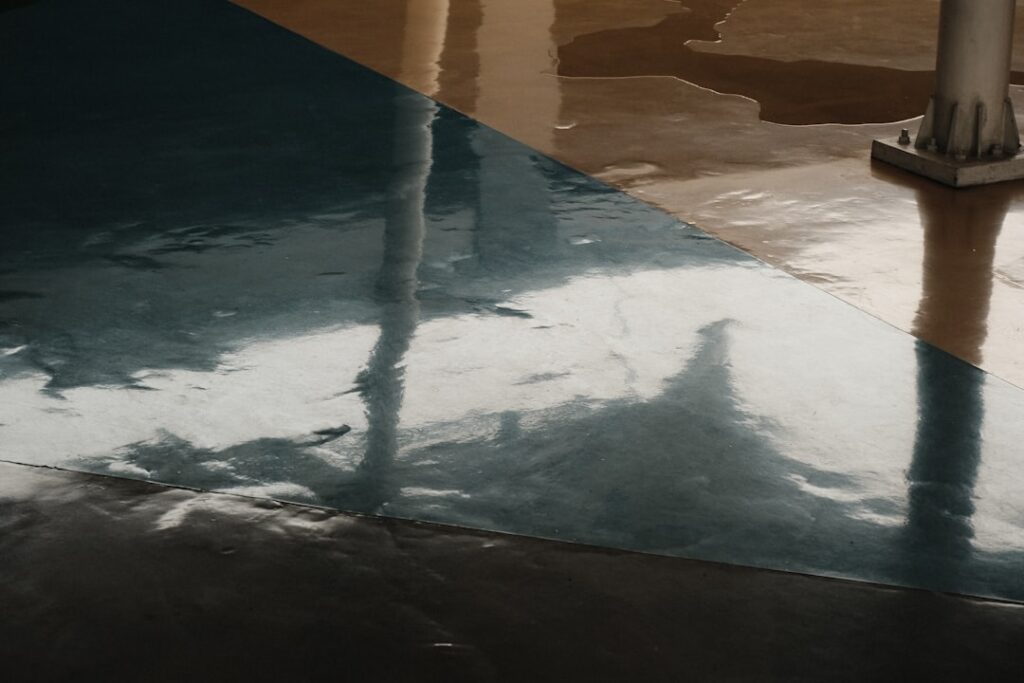
The reason commercial kitchens, parking garages, and pharmaceutical plants all use the same coating is no accident. Epoxy flooring waterproof systems form a continuous, seamless membrane that water simply cannot penetrate, even under standing puddles or hose-down cleaning. Bring that same chemistry into a residential garage, basement, or laundry room and you get a floor that shrugs off everything a homeowner can throw at it for 10 to 20 years. The catch is in the prep work, where most DIY installs fail.
Why Epoxy Counts as Waterproof
Epoxy is a two-part thermoset polymer. Resin and hardener mix in a precise ratio, react chemically, and cure into a continuous plastic-like film with no seams, no grout lines, and no gaps. Water has nowhere to enter, which is fundamentally different from “water-resistant” coatings that resist surface penetration but still allow vapor through.
True waterproof epoxy systems also include moisture-vapor barrier primers (like Sika MVP or Tnemec Dura-Shield) that block hydrostatic pressure from below. This combination is what allows epoxy to work over below-grade concrete that would destroy most other floor coatings.
Pros of Waterproof Epoxy Floors
The advantages stack up across multiple categories. Performance: epoxy resists chemicals, oils, hot tire pickup, and surface abrasion at industrial levels. Durability: 15 to 20 year service life is realistic with proper care. Cleanability: hose-down cleaning is supported. Aesthetics: solid color, flake, or metallic options give design flexibility no other coating matches.
- Truly waterproof seamless film blocks water and vapor
- Chemical resistance handles oil, gasoline, and most household chemicals
- 15 to 20 year lifespan in residential garage applications
- Compressive strength of 8,000 to 12,000 psi exceeds bare concrete
- Easy to clean, supports pressure washing for outdoor-adjacent installs
Cons You Need to Know
The biggest downside is application sensitivity. Epoxy demands a thoroughly prepared concrete surface (CSP 3 profile minimum), correct moisture content (under 4 percent), and tight temperature/humidity control during application. Skip any of those steps and the coating peels in months, not years.
Epoxy is also slippery when wet, especially the high-gloss residential garage versions. Anti-slip aggregate added to the topcoat solves this but reduces sheen. UV exposure ambers most epoxy products, so direct sunlight installations should use a polyaspartic or urethane topcoat over the epoxy base.
The Three Main Epoxy System Types
Different rooms need different chemistries. Picking the right one matters more than picking the right brand within a chemistry.
100 Percent Solids Epoxy
Industrial-grade epoxy with no solvent carriers. Build thickness ranges from 8 to 25 mils per coat, providing the toughest coating available. Best for garages with heavy vehicle traffic, basements with moisture issues, and any commercial application. Typical cost: $5 to $12 per square foot installed.
Water-Based Epoxy
Easier to apply and clean up, with thinner build (2 to 4 mils per coat). Good for occasional-use garages, basements without moisture problems, and DIY installations. Lower chemical resistance than 100 percent solids. Typical cost: $3 to $6 per square foot installed.
Metallic Epoxy
A 100 percent solids system with reflective pigments that creates a marbled, three-dimensional look. Premium aesthetic for finished basements, retail spaces, and showroom garages. Typical cost: $8 to $15 per square foot installed.
Surface Preparation: The Make-or-Break Step
Surface prep is where 80 percent of failures originate. Concrete must be mechanically profiled, not just etched with acid. Diamond grinding to a CSP 3 profile (similar to coarse sandpaper) is the standard for residential garage applications.
- Repair all cracks with epoxy crack filler
- Diamond grind the floor to CSP 3 profile
- Vacuum thoroughly with HEPA shop vac
- Test concrete moisture content with a calcium chloride test
- Apply moisture vapor barrier primer if MVP test shows over 3 lb/1000 sq ft/24 hr
- Apply base coat within manufacturer-specified recoat window
- Broadcast color flake or aggregate while base coat is wet
- Apply topcoat for chemical resistance and UV stability
Best Brands and Products
Three brands lead the residential market. Rust-Oleum EpoxyShield Garage Floor Kit is the bestselling DIY option, available at most home centers for $80 to $130 covering 250 sq ft. ArmorPoxy and Epoxy-Coat from Citadel are mid-tier professional kits delivering 100 percent solids performance for serious DIYers. For premium installations, Sherwin-Williams General Polymers and Sika offer commercial-grade systems through pro distribution.
For a typical 2-car garage (450 sq ft), expect $200 to $500 in materials for DIY or $1,500 to $4,000 for professional installation depending on system type.
Maintenance and Care
Daily care is minimal. Sweep or dust mop weekly. Damp mop monthly with a pH-neutral cleaner. Clean oil spills within 24 hours to prevent staining of the topcoat. Reapply a maintenance topcoat every 5 to 7 years in heavy-use garages to maintain chemical resistance and gloss.
Hot tire pickup, where rubber tire compounds soften the epoxy and lift it when the car cools, is the most common failure on cheap kits. Premium 100 percent solids systems and polyaspartic topcoats eliminate this issue entirely.
DIY vs Professional Application
The choice depends on substrate condition and final expectations. DIY kits work fine for clean, dry, never-coated concrete in moderate climates. Total project time is 2 to 4 days including cure intervals. Material cost runs $200 to $500 for a 2-car garage.
Professional installation is the right call for substrates with prior coatings, moisture issues, or commercial-grade durability requirements. Pros bring diamond grinders, moisture meters, and quality control that DIY kits cannot match. Cost runs $4 to $12 per square foot installed but delivers commercial-grade performance and warranty backing.
Is Epoxy Right for Your Project
Choose epoxy flooring waterproof systems for garages, basements, mudrooms, laundry rooms, and any utility space where water, chemicals, or heavy use are routine. Skip it for living rooms and bedrooms where warmth and softness matter more than durability. Done with proper prep, epoxy is the most cost-effective long-term floor for the rooms where it belongs.


