A leaking pipe at midnight, a cracked plastic fitting, or a stripped bolt hole can all be fixed with one inexpensive product that fits in a drawer. Epoxy putty is a moldable, two-part repair compound that you knead together by hand and shape into place, where it hardens into a tough, durable bond on metal, plastic, wood, ceramic, concrete, and more. Unlike liquid glues, it fills gaps and holds shape, making it ideal for repairs that need bulk and strength. This guide covers how epoxy putty works, where to use it, how to apply it, and the safety basics every user should follow.
Part of our Epoxy, Concrete & Garage Floors guide — explore the full guide →
What Epoxy Putty Is
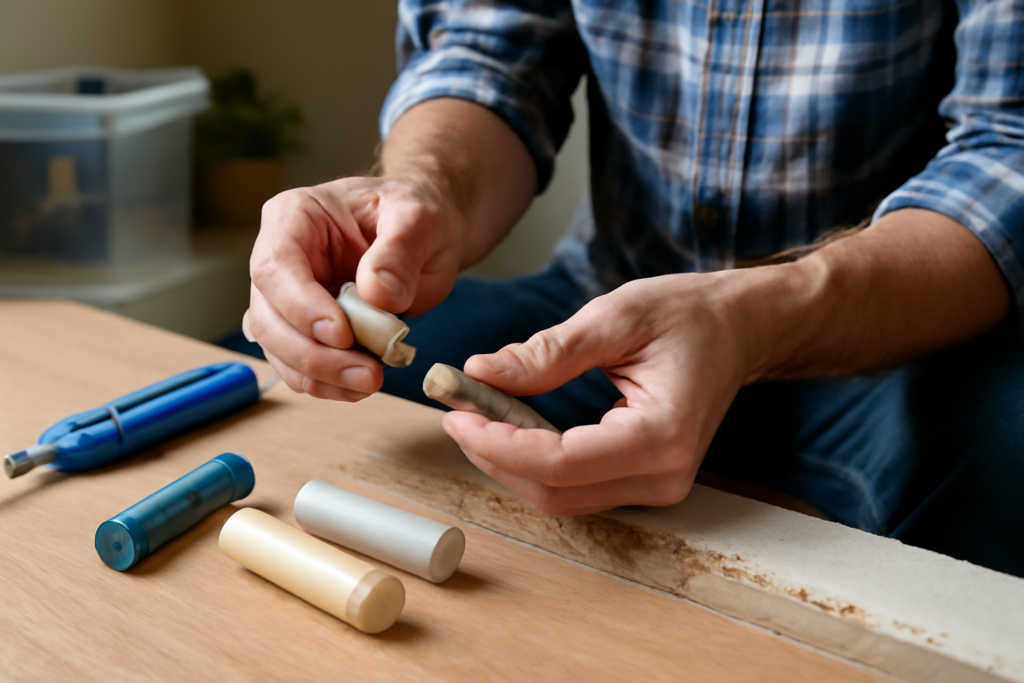
Epoxy putty is a two-component adhesive in a dough-like form. The two parts, a resin and a hardener, are commonly sold as a single stick with an outer layer and an inner core, or as two separate pieces. When you cut off a portion and knead the two parts together until uniform in color, a chemical reaction begins that cures the soft putty into a rock-hard solid within minutes to an hour, depending on the product. Once mixed, it can be shaped, pressed into cracks, or molded around an object before it sets.
Common Uses
- Plumbing repairs: Sealing pinhole leaks, cracks in pipes, and damaged fittings. Some formulas can even be applied to damp surfaces or stop minor active leaks.
- Filling holes and gaps: Repairing stripped screw holes, rebuilding missing chunks, and filling cracks in wood or masonry.
- Bonding dissimilar materials: Joining metal to plastic, ceramic to stone, and other mixed-material repairs.
- Rebuilding worn parts: Restoring threads, edges, and broken corners on tools and hardware.
- Household fixes: Repairing garden tools, statues, tile, and outdoor fixtures.
Types of Epoxy Putty
Several specialized formulas exist for different jobs.
- General-purpose: Bonds a wide range of materials for everyday repairs.
- Waterproof and plumbing grade: Designed to cure in wet conditions and resist water, ideal for pipes and pools.
- Wood epoxy putty: Color-matched and sandable, made for filling and rebuilding wood.
- Metal-filled: Contains metal particles for strong, machinable repairs on steel and aluminum.
- High-temperature: Formulated to withstand heat for engine and exhaust-area repairs.
How to Apply Epoxy Putty
- Read the directions. Check the manufacturer’s instructions for the specific cure time and any surface requirements.
- Prep the surface. Clean and dry the repair area, removing rust, grease, and loose material. Roughen smooth surfaces lightly for better grip.
- Cut and mix. Slice off the amount you need and knead the two parts together until the color is completely uniform, with no streaks.
- Apply quickly. Work the putty into the crack, hole, or joint and shape it before it begins to harden, usually within a few minutes.
- Smooth it. Wet a gloved finger or tool with a little water to smooth the surface if the formula allows.
- Let it cure. Allow the full cure time before sanding, drilling, painting, or putting the repair into service.
Safety First
Epoxy putty is easy to use, but it is still a chemical product, so basic precautions matter.
- Wear gloves. Use disposable gloves to keep uncured resin off your skin, which can cause irritation or, with repeated exposure, sensitization.
- Ventilate. Work in a well-ventilated area to avoid breathing fumes, especially in enclosed spaces.
- Protect your eyes. Wear safety glasses when sanding or grinding cured putty.
- Avoid food contact. Do not use standard epoxy putty on surfaces that touch food or drinking water unless the product is specifically certified for that use.
- Wash up. Clean hands and tools before the putty cures, and keep the product away from children and pets.
Tips for a Strong Repair
A few habits improve results. Always clean and rough up the surface first, since putty bonds best to a clean, slightly abraded area. Mix only as much as you can apply within the working time, because once the reaction starts you cannot stop it. Keeping a small dish of water nearby helps smooth and shape the putty and keeps it from sticking to your gloves. For load-bearing or pressurized repairs, wait the full cure time and, where appropriate, treat the fix as temporary until a permanent repair can be made.
Epoxy Putty vs Liquid Epoxy
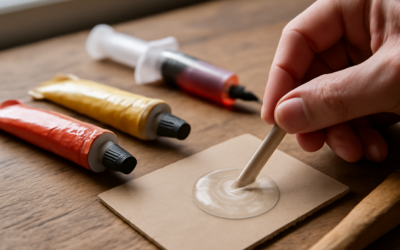
Both are two-part epoxies, but they suit different jobs. Liquid epoxy and epoxy glue flow into thin gaps and bond flat surfaces tightly, making them ideal for gluing two clean pieces together or coating a surface. Epoxy putty, by contrast, holds its shape, so it fills voids, bridges gaps, rebuilds missing material, and can be molded around irregular objects. Use liquid epoxy when you need a thin, strong bond line between mating parts, and reach for putty when the repair needs bulk, shape, or gap-filling. For a cracked pipe you can wrap putty around, putty wins; for laminating two flat panels, liquid epoxy is better.
Sanding, Drilling, and Painting
One of epoxy putty’s strengths is that once fully cured it behaves like a hard solid. You can sand it smooth, drill and tap it for screws, file it to shape, and paint over it to match the surrounding surface. Wait for the full cure before machining, since working it too soon clogs sandpaper and can crack the bond. When sanding, wear a dust mask and eye protection, because cured epoxy dust is an irritant. After shaping, clean the surface and apply a primer if needed before painting for the best adhesion and a seamless repair.
Storage and Shelf Life
Epoxy putty keeps well if stored properly. Reseal the package tightly after cutting off what you need, and keep it in a cool, dry place away from direct sunlight and heat, which can start to cure the product prematurely. Stored correctly, most epoxy putty sticks last a year or more. If the putty has hardened in the package or no longer kneads smoothly, it has gone past its usable life and should be replaced. Keeping a fresh stick on hand means you are always ready for a sudden leak or break.
Limitations to Keep in Mind
Epoxy putty is strong, but it is not a cure-all. It works best on small to medium repairs rather than large structural failures. A patched pipe under high pressure or a heavily loaded part should be properly replaced when possible, with putty serving as a stopgap. Flexible surfaces that move or vibrate constantly can eventually crack a rigid putty repair. And for surfaces in constant contact with potable water or food, only use a product certified for that purpose.
Final Thoughts
Epoxy putty is one of the most versatile repair products a homeowner can keep on hand, capable of sealing leaks, filling holes, and rebuilding broken parts across nearly every common material. Choose a formula suited to your job, prep the surface well, mix thoroughly, and respect the cure time. Just as important, wear gloves, ventilate the space, and protect your eyes. Used correctly, a single stick of epoxy putty can rescue a project or stop a leak when nothing else is within reach.