
If you manage a lab, cleanroom, electronics assembly line, or data center, static electricity is not a nuisance — it is a threat to expensive components and, in some environments, to safety. That is why anti-static flooring exists, and why buyers spend real money on it. Understanding ESD flooring cost means looking past the sticker price per tile and accounting for grounding, subfloor prep, testing, and the specific dissipation performance your facility actually requires.
ESD stands for electrostatic discharge, and ESD flooring is engineered to conduct or dissipate static charges safely to ground rather than letting them build up on people and equipment. In this guide I break down what each type of anti-static floor costs, what drives those prices, and where facilities routinely under- or over-spend. My aim is to give you realistic numbers so you can budget a project that passes testing the first time.
What “ESD Flooring” Actually Means
Before pricing anything, it helps to understand the two performance categories, because they cost differently. “Static-dissipative” flooring has higher electrical resistance and bleeds charges away slowly and safely — this is the most common requirement for electronics work. “Conductive” flooring has lower resistance and moves charges to ground faster, and it is specified where even brief static buildup is unacceptable, such as munitions handling or certain semiconductor processes. Conductive materials generally cost more because they contain more conductive additives like carbon or metallic particles.
The right specification is driven by standards such as ANSI/ESD S20.20, which defines resistance ranges your floor must meet. This matters for budgeting because a floor that merely “reduces static” is far cheaper than one certified to a measured resistance-to-ground range and tested on installation. Never buy on the anti-static label alone; buy to the ohm-range your process demands, and price accordingly.
ESD Vinyl Tile Cost
ESD vinyl tile is the workhorse of anti-static flooring and often the most cost-effective certified option. Material costs typically run from about $4 to $9 per square foot, with installed prices landing around $8 to $14 per square foot once you include conductive adhesive, copper grounding strips, and labor. It comes in standard tiles and roll goods, installs over most level subfloors, and is popular in electronics manufacturing and server rooms because it balances performance, appearance, and price.
The hidden cost with ESD vinyl is the conductive adhesive and grounding network, which you cannot skip. Standard flooring glue insulates the tile and defeats the entire system, so a specialized conductive adhesive plus a grid of copper grounding strips is mandatory. Budget for professional installation here — a beautiful ESD vinyl floor that fails its resistance test because of the wrong adhesive is an expensive lesson I have watched facilities learn the hard way.
ESD Epoxy and Coating Cost
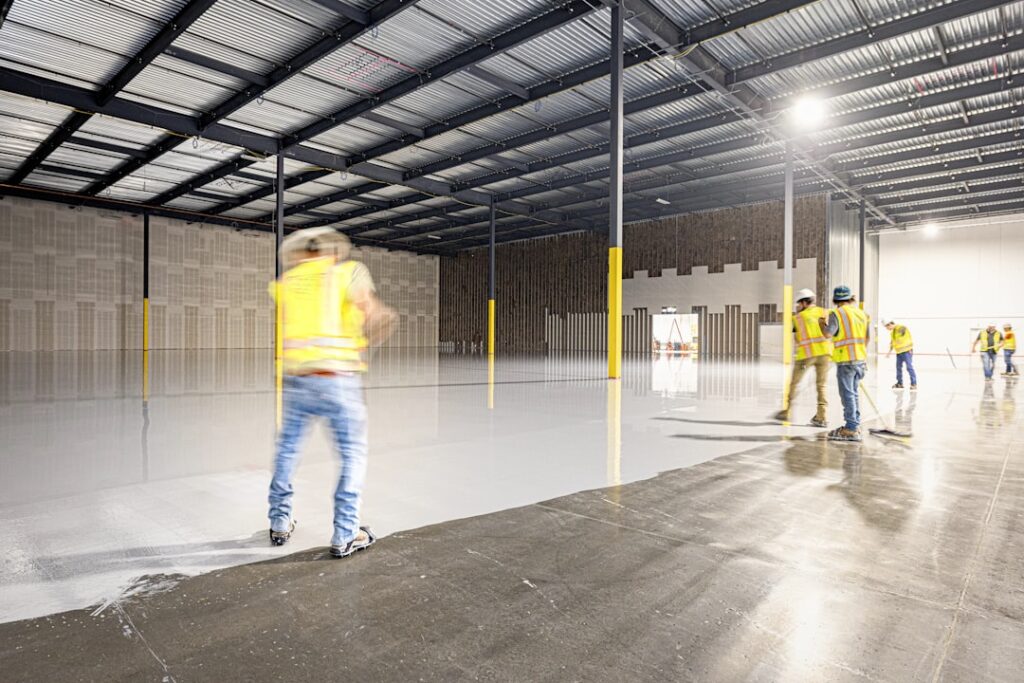
ESD epoxy is a seamless, poured coating favored in cleanrooms, pharmaceutical spaces, and heavy-traffic industrial floors where a jointless, chemical-resistant surface matters. Installed cost generally ranges from about $6 to $15 per square foot, though multi-coat conductive systems with heavy prep can climb higher. The number swings widely because epoxy performance depends almost entirely on the number of coats, the conductive primer, and the embedded copper grounding grid.
Surface preparation is the make-or-break cost with epoxy. The concrete must be shot-blasted or diamond-ground to the right profile, cracks repaired, and moisture tested — and on a rough or contaminated slab, prep can equal or exceed the coating cost itself. When a contractor quotes you a suspiciously low epoxy number, it usually means thin prep, and thin prep leads to delamination. For long-term value, pay for proper slab preparation up front rather than recoating a failed floor in two years.
ESD Rubber and Conductive Flooring Cost
ESD rubber flooring is the comfort premium of the category. It cushions standing workers, deadens noise, and offers excellent slip resistance, which makes it common in labs and electronics benches where staff stand for long shifts. Expect roughly $7 to $16 per square foot installed, placing it at the upper-middle of the ESD cost range. The trade-off for that comfort and durability is a higher material price than vinyl.
Fully conductive systems — whether specialized conductive tile, rubber, or high-spec epoxy engineered to the lowest resistance ranges — sit at the top of the price ladder, frequently $12 to $20 or more per square foot installed. They carry more conductive additives, tighter manufacturing tolerances, and stricter installation and testing requirements. You pay this premium only when your process genuinely demands conductive-range performance, so confirm the specification before you budget at this tier.
The Grounding System: A Cost You Cannot Skip
Here is the point most first-time buyers miss: the floor material is only half the system. An ESD floor works only when it is tied to earth ground through a proper grounding network. That means copper grounding strips laid under the flooring, connections to the building’s electrical ground, and grounding blocks or plates at defined intervals. This adds material and labor cost that a naïve per-square-foot comparison ignores entirely.
Grounding typically adds a few hundred to a few thousand dollars depending on room size and layout, and it is non-negotiable — an ungrounded ESD floor is just an expensive regular floor. I always tell facilities to quote the complete system: material, conductive adhesive or primer, grounding hardware, installation, and post-installation resistance testing. Comparing a “floor-only” price against a “complete-system” price is the single most common source of budget confusion in this category.
Hidden Costs and Long-Term Ownership
Beyond installation, ESD flooring carries ownership costs worth budgeting. Resistance performance must be verified periodically — many facilities test annually or per audit requirements — and some floor types need special conductive maintenance products. Ordinary floor wax or standard cleaners can insulate the surface and quietly push a compliant floor out of spec, so you may pay a premium for approved ESD-safe cleaning products and trained maintenance.
Testing and certification are also part of true cost. Expect to pay for a qualified technician to perform resistance-to-ground and point-to-point measurements at installation and to document compliance for audits. These are modest line items compared to the flooring itself, but skipping them undermines the whole investment. A floor that cannot prove its performance on paper is a liability in any regulated or quality-audited environment.
Room Size, Layout, and Access Costs
The per-square-foot numbers tell only part of the story, because total project cost scales with room size and site conditions in ways that surprise buyers. Larger installations often earn a lower per-foot rate thanks to labor efficiency, while small rooms carry a higher effective cost because setup, grounding termination, and testing are largely fixed regardless of area. A tidy 200-square-foot server room can cost more per foot than a 5,000-square-foot production floor for exactly this reason.
Access and downtime add real dollars too. Installing ESD flooring in an active facility often means off-hours or phased work to keep operations running, and that scheduling premium shows up in the labor line. Rooms full of racks, benches, or equipment that must be moved, protected, or worked around slow installation and raise cost. When you gather quotes, describe your site honestly — a bare, empty slab prices very differently from a live, congested floor.
How to Budget Your ESD Flooring Project
To estimate your ESD flooring cost realistically, start with the specification — dissipative or conductive, and the required ohm range — then choose the material family that meets it at the lowest reasonable price. For most electronics and server environments, ESD vinyl tile delivers certified performance at the best value. Reserve rubber for comfort-critical standing areas and epoxy for seamless cleanroom or heavy-industrial demands. Conductive systems belong only where the specification truly calls for them.
Then add the pieces buyers forget: conductive adhesive or primer, the copper grounding network, subfloor prep, professional installation, and post-install testing. As a working rule, a complete, certified ESD floor lands somewhere between $8 and $20 per square foot installed, with vinyl at the low end and high-spec conductive systems at the top. Budget the whole system, insist on testing, and you will get a floor that protects your equipment and passes its audit the first time — which is the only ESD flooring cost that truly pays off.
Prefer to explore on your own?
See how new flooring looks in your actual room in seconds — free, no signup.
Try the free Floor Studio →

