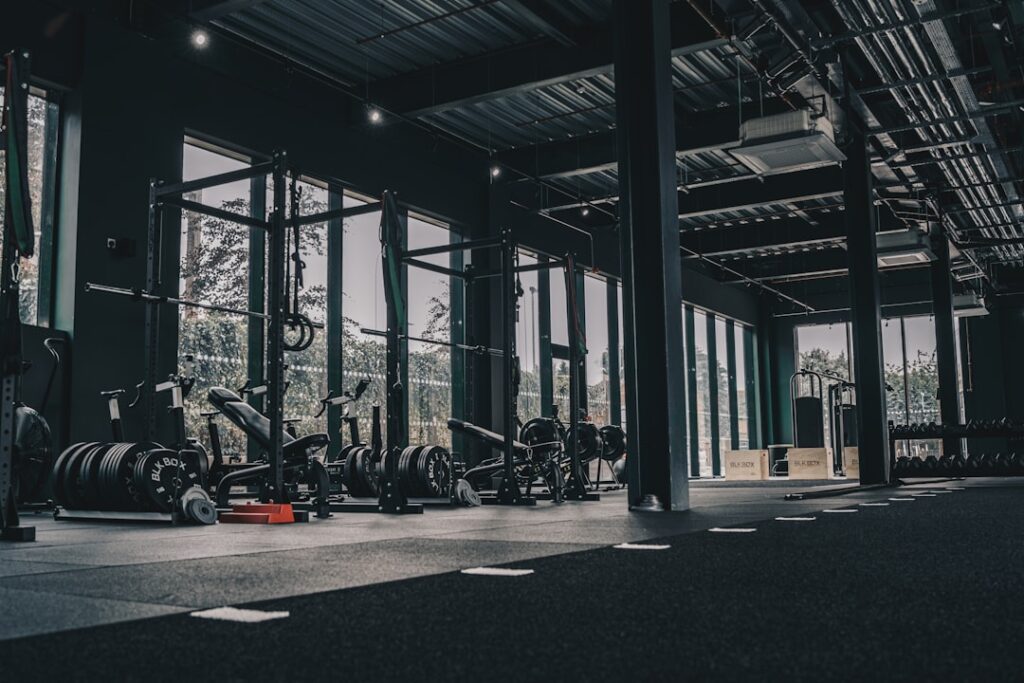
Most home gyms get built on either the wrong thickness rubber or the wrong rubber compound entirely. 8mm rubber flooring sits at the sweet spot for residential gyms, basements, and light commercial fitness rooms. It absorbs the impact of a dropped 45 lb plate from waist height, protects the subfloor from gouges, and rolls out flat without curling at the edges. Go thinner at 6 mm and you risk subfloor damage; go thicker at 12 mm or 3/8 inch and you pay 50 to 80 percent more for marginal performance gains a homeowner will never notice.
What 8mm Actually Protects Against
An 8mm (5/16 inch) rubber mat absorbs the impact energy from a 45 lb plate dropped from 36 inches, a 50 lb dumbbell dropped from waist height, and the daily abuse of a treadmill or rower at 250 lb capacity. Shock attenuation testing per ASTM F355 shows 8 mm rubber reduces peak impact force by 35 to 55 percent compared to bare concrete.
For Olympic lifting, plyometric drop boxes, and commercial CrossFit gyms, step up to 12 mm or 3/4 inch rubber. For home garages with light to moderate strength training, cardio equipment, and yoga, 8 mm is the right call every time.
Recycled SBR vs. EPDM Compound
The cheap stuff is recycled SBR rubber from car tires, ground into 1 to 4 mm crumb and bound with polyurethane. SBR rubber runs $2 to $4 per sq ft, smells strongly for the first 30 to 90 days, and shows fading after 3 to 5 years of UV exposure. EPDM rubber is virgin synthetic, colored throughout, and resists fading and odor. EPDM runs $5 to $9 per sq ft.
Most home gyms use SBR with a 10 to 20 percent EPDM color fleck for aesthetics. This blend balances cost and appearance and is the most common product at Greatmats, Rubber-Cal, and IncStores.
Rolls vs. Tiles vs. Interlocking
Rolled rubber comes in 4 ft wide rolls up to 50 ft long, perfect for large gym floors where seams are minimized. Square rubber tiles at 4 x 4 ft cover medium spaces with minimal seams and easier handling (4×4 tiles weigh 35 to 50 lbs each). Interlocking puzzle tiles at 24 x 24 inches or 36 x 36 inches install with no adhesive and are easiest for DIY but show seam separation over time under heavy equipment.
For a 400 sq ft garage gym, rolled rubber gives the cleanest look and the most stable surface. For a 150 sq ft basement workout corner, interlocking tiles work fine and let you move the floor if you relocate.
Cost Per Square Foot
SBR rolled rubber at 8 mm runs $2.50 to $4.50 per sq ft. Premium SBR with EPDM fleck adds $1 to $1.50 per sq ft. Full EPDM 8 mm rubber tops out at $7 to $10 per sq ft. Add $50 to $150 for polyurethane adhesive or $30 to $80 for double-sided seam tape on a typical home gym install.
A 500 sq ft garage gym in 8 mm SBR with EPDM fleck lands between $1,800 and $3,000 in materials, plus $150 to $400 in install supplies if you DIY.
Subfloor Prep and Install Method
The subfloor must be flat to 1/8 inch over 10 feet, clean, and dry. ASTM F1869 calcium chloride test on slab confirms moisture below 3 lbs per 1,000 sq ft per 24 hours. Vacuum thoroughly and wipe with denatured alcohol to remove dust.
For permanent installs, full-spread polyurethane adhesive like Roberts 7350 or Henry 663 applied with a 1/16 x 1/16 x 1/16 inch trowel gives the cleanest result. For temporary or rental-friendly installs, double-sided seam tape every 3 feet at perimeters and butt seams holds the floor in place under heavy use. Avoid full-spread tape; it transfers residue to the slab when the floor comes up.
Slip Resistance and Drainage
8mm rubber typically tests at 0.65 to 0.80 wet DCOF per ANSI A326.3, well above the 0.42 threshold for slip-resistant flooring. Smooth-surface rubber drains poorly; textured or ribbed surfaces handle sweat and spilled water better. For home gyms with shower or pool access, choose textured EPDM rubber with a ribbed back for airflow.
Pros and Cons
- Pros: $2.50-$10 per sq ft, excellent shock absorption, slip-resistant, easy DIY with rolls or interlocking tiles, 15-25 year lifespan
- Cons: heavy rolls hard to handle solo, SBR smells for 30-90 days, fades over time without UV stabilizers, not suited for Olympic lifting alone
Cleaning and Maintenance Routine
Sweep or vacuum 8 mm rubber daily with a soft-bristle vacuum head; rotating beater bars can scuff EPDM color flecks over time. Damp-mop weekly with a pH-neutral cleaner like Rejuvenate Floor Cleaner or Bona Stone, Tile and Laminate. Avoid solvents, bleach, citrus cleaners, and high-pH degreasers; all four break down the polyurethane binder that holds rubber crumb together. For sweat and protein-shake spills, immediate wipe-down prevents staining. Deep clean twice a year with a low-foam neutral cleaner using a soft brush or auto-scrubber.
UV Exposure and Outdoor Use
Standard SBR rubber fades and chalks under sustained UV exposure. For garage gym floors near open garage doors or outdoor patio gym setups, choose UV-stabilized EPDM rubber rated for exterior use. Brands like Roppe Rubber and Greatmats sell UV-resistant grades at a $1 to $3 per sq ft premium over interior-only product. Standard interior rubber installed in a sun-baked garage will fade noticeably within 24 to 36 months.
How to Spec Your 8mm Rubber Order
Measure the room and add 5 to 8 percent for waste and trim. Choose roll, tile, or interlocking based on the install method that fits your skill and the room’s geometry. Specify SBR with EPDM fleck for the cost-performance balance. Order the polyurethane adhesive at 1 gallon per 80 to 100 sq ft, and pick up a 100 ft tape measure plus a sharp utility knife with at least a dozen fresh blades; rubber dulls blades fast. Unroll rolled rubber and let it rest flat in the install space for 48 to 72 hours before adhering, which lets the curl relax. Followed step by step, an 8mm rubber flooring install gives you a gym-grade surface that survives years of barbell abuse and protects whatever sits underneath.
Prefer to explore on your own?
See how new flooring looks in your actual room in seconds — free, no signup.
Try the free Floor Studio →