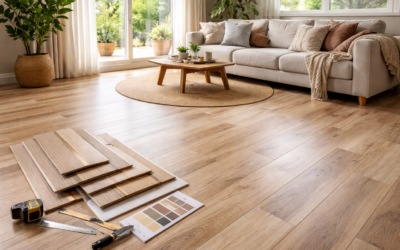
The marketing for 8mm vinyl flooring implies thicker is automatically better, and that is half-true at best. Total plank thickness is one of five spec numbers that actually determine performance, and 8mm products span a wide quality range depending on what is layered into those millimeters. After installing more than 60 vinyl floors at thicknesses from 2mm to 9mm, I can tell you exactly when 8mm earns its premium and when you are paying for marketing.
What 8mm Vinyl Flooring Actually Is
An 8mm rigid-core vinyl plank is built in five layers from bottom to top: an attached underlayment pad (typically 1mm IXPE or cork), a stone-plastic composite (SPC) or wood-plastic composite (WPC) core, a printed decorative film, a clear wear layer, and a UV-cured topcoat. The 8mm dimension typically counts the attached pad. Without the pad, the plank measures 7mm.
SPC dominates the 8mm category in 2026 because the dense limestone-PVC core (around 1.85 g/cm3) provides better dent resistance than WPC (around 1.0 g/cm3). Major brands marketing 8mm SPC include Coretec Plus HD, Mohawk SolidTech Plus, Shaw Floorte Pro, NuCore, and LifeProof.
Where 8mm Vinyl Belongs
The thicker format earns its place in:
- Whole-home installations where consistent feel matters across rooms
- Open-concept spaces with longer runs and thermal movement
- Homes with mid-century or older subfloors that telegraph imperfections
- Rentals and second homes wanting maximum durability per replacement cycle
- Light commercial spaces — offices, boutiques, salons
It is overspecified in tight budgets where 5mm rigid-core delivers most of the same performance, and underspecified in heavy commercial settings that need 9mm or higher with thicker wear layers.
Why Total Thickness Is Not the Full Story
The number that actually predicts long-term durability is the wear layer, not the total thickness. Wear layer is the clear top film that protects the printed pattern. Thickness ranges from 6 mil (residential light) to 30 mil (commercial heavy). An 8mm plank with a 12 mil wear layer will scuff faster than a 5mm plank with a 22 mil wear layer.
For 8mm products, look for minimum 20 mil wear layer for residential, 28 mil for light commercial, and 40 mil for heavy commercial use. Sub-15 mil 8mm products exist and should be avoided regardless of total thickness.
The Pros That Justify 8mm
The thicker format delivers four real benefits over 5mm to 6mm options. First, sound dampening — the attached IXPE or cork pad combined with the dense core reduces footfall noise by 5 to 10 dB compared to thinner products. Important for upstairs bedrooms and apartment installations.
Second, subfloor forgiveness. 8mm rigid-core handles up to 3/16-inch dips over 10 ft span without telegraphing. Older homes with uneven plywood or wavy concrete benefit. Third, click integrity. Thicker locking edges resist fatigue better, leading to fewer separations over time. Fourth, comfort underfoot. The thicker pad and core give a slight giving feel that thinner LVP cannot replicate.
The Cons and Trade-offs
The thicker format has limits. Transitions become more visible at doorways to other flooring types, often requiring T-molding instead of simple reducer trim. Door clearance can be a problem — interior doors may need to be cut down 3/8 inch or more.
Cost is the obvious trade-off. 8mm SPC runs $3.50 to $7.50 per sq ft for materials, compared to $1.80 to $4.00 for 5mm. On a 1,500 sq ft installation, that is a $2,500 to $5,000 difference. Half of that gap can be invested in a thicker wear layer instead, which often delivers more durability per dollar.
SPC vs WPC at 8mm
Both core types appear in the 8mm category. SPC (stone-plastic composite) is denser, harder, and more dent-resistant — the right choice for kitchens, entryways, and high-traffic zones. WPC (wood-plastic composite) is softer underfoot, warmer, and quieter — a fit for bedrooms and dens where comfort matters more than dent resistance.
If you cannot decide, default to SPC. The dent resistance advantage outweighs WPC’s comfort edge in most real-world applications.
Cost Breakdown
Realistic 2026 installed pricing for 8mm vinyl flooring:
- Builder-grade 8mm SPC, 12 mil wear layer: $3.50 to $5 per sq ft
- Mid-tier 8mm SPC, 20 mil wear layer: $5 to $7.50 per sq ft
- Premium 8mm SPC, 28 to 40 mil wear layer: $7 to $11 per sq ft
- Premium 8mm WPC: $6.50 to $10.50 per sq ft
Pro installation typically adds $1.50 to $3.50 per sq ft. Most rigid-core LVP is genuinely DIY-friendly with a tapping block, pull bar, and miter saw.
Installation Notes
Acclimate planks 48 hours at the home’s permanent setpoint, ideally 65°F to 85°F. Subfloor must be flat to 3/16 inch over 10 ft and clean. Concrete subfloors do not need a vapor barrier with most attached-pad 8mm products, but always confirm in the manufacturer specs.
Maintain a 1/4 to 3/8 inch expansion gap at all walls and fixed objects. Do not exceed 30 ft uninterrupted run length without a transition strip — thermal expansion across longer runs can pop click-locks.
Wear Layer and Warranty Reality
Manufacturers warrant 8mm rigid-core LVP for 25 years to lifetime in residential service. Read the fine print: most warranties cover wear-through (the pattern showing through the wear layer) but exclude scratches, dents, and surface scuffing. The functional service life of 8mm products with proper wear layer runs 18 to 25 years in residential use, 8 to 12 in commercial.
Maintenance Routine
8mm vinyl is genuinely low-maintenance. Sweep or vacuum daily, damp mop weekly with a manufacturer-approved cleaner like Bona Pro Series Hard-Surface Floor Cleaner or Better Life Floor Cleaner. Avoid steam mops, abrasive cleaners, and soap-based products that leave residue. Felt pads on furniture and walk-off mats at exterior doors prevent most scratching.
Is 8mm Vinyl Flooring Worth It
For whole-home installations, open-concept spaces, and any project where sound, comfort, and subfloor forgiveness matter, 8mm vinyl flooring earns its premium over thinner options. Pair the thicker total dimension with a 20 mil or thicker wear layer to ensure the durability matches the cost. Skip 8mm in budget projects where 5mm rigid-core delivers acceptable results, and step up to 9mm or 10mm for heavy commercial or hospitality settings. Spec it correctly and 8mm vinyl flooring delivers two decades of comfortable, durable service in exchange for a few hours of upfront layout work.
Prefer to explore on your own?
See how new flooring looks in your actual room in seconds — free, no signup.
Try the free Floor Studio →