Walk into a flooring showroom and you’ll see LVT priced anywhere from $1.50 to $9 per square foot. The single biggest driver of that spread isn’t brand or style—it’s LVT flooring thickness. A 2mm glue-down tile and a 6mm rigid core plank are technically both LVT, but they perform on completely different planets. Picking the wrong thickness for your subfloor or traffic level guarantees failure within 3 years. This guide breaks down every common thickness, what each is good for, and where to spend versus save.
What Thickness Actually Measures
LVT total thickness includes everything from the bottom backing layer to the top wear layer. The four main components are the backing (0.5 to 1.5mm), the rigid or flexible core (1.5 to 5mm), the printed design layer (0.1 to 0.3mm), and the wear layer (6 to 30 mil, where 1 mil = 0.0254mm).
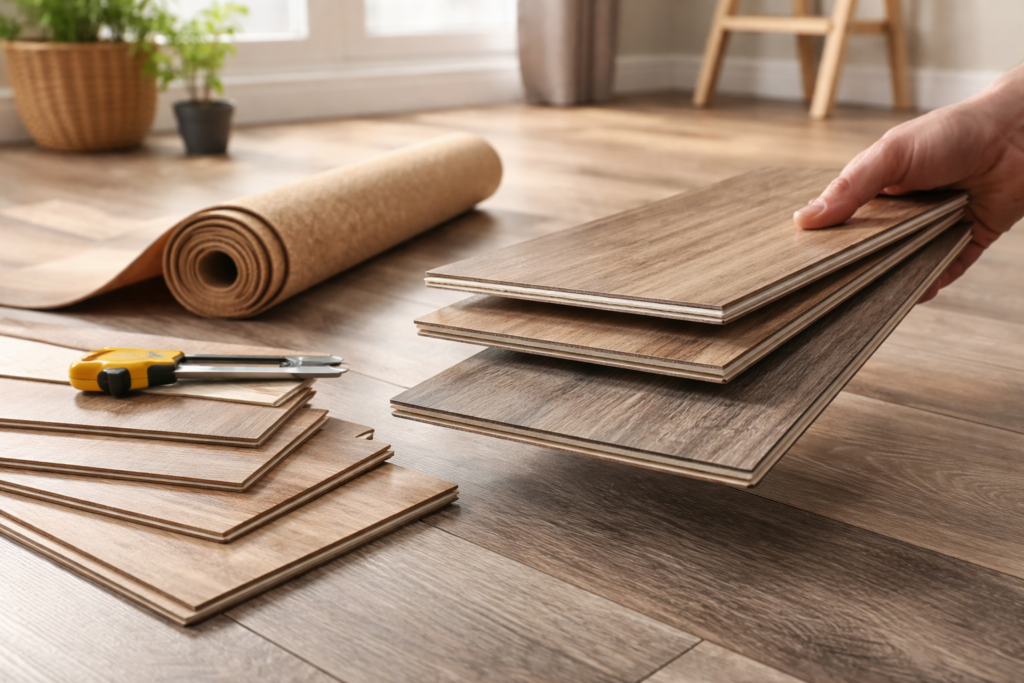
Total thickness ranges from 2mm budget glue-down tile to 8mm premium rigid core. Two products with identical 5mm total can have wildly different durability based on how those millimeters are allocated.
2mm Glue-Down LVT
The thinnest commercial-style product. Tiles measure 12 by 24 inches or 18 by 24 inches. Cost runs $1.50 to $3 per square foot. Wear layers typically 12 to 20 mil.
Best use: commercial office, retail, basement bathrooms with perfectly flat concrete subfloor. The thinness means zero bridging of subfloor imperfections—anything above 1/16 inch out of plane will telegraph through. Requires full-spread adhesive at $30 to $50 per gallon and a 100-lb floor roller.
3mm and 4mm Glue-Down
The sweet spot for commercial spec. Karndean Designflooring, Mannington Commercial, and Armstrong Migrations sit here. Cost runs $3 to $6 per square foot. Wear layers up to 30 mil.
Slightly better tolerance for minor subfloor flaws but still demands prep. The extra thickness provides better acoustic performance and feels more substantial underfoot. Lifespan in heavy commercial traffic: 15 to 20 years with proper maintenance.
5mm Rigid Core (SPC/WPC)
The current residential standard. COREtec Pro Plus, Shaw Paragon, and Mohawk SolidTech ship at 5mm total with click-lock edges. Cost runs $3 to $6 per square foot. Wear layers 12 to 22 mil.
- Subfloor tolerance: Bridges dips up to 3/16 inch over 10 feet
- Acoustic performance: IIC 50+ ratings with attached underlayment
- Waterproof core: SPC (stone polymer composite) or WPC (wood polymer composite)
- Installation: Floating, no glue, click-lock
This is the right pick for 80% of residential whole-home installs.
6mm to 8mm Premium Rigid Core
The premium tier. Karndean LooseLay Longboard, COREtec Pro Plus HD, and Mannington Adura Max ship at 6 to 8mm total. Cost runs $5 to $9 per square foot. Wear layers 20 to 30 mil.
The extra thickness provides three measurable benefits. Acoustic insulation improves another 3 to 5 IIC points. Subfloor tolerance increases to 1/4 inch over 10 feet. The plank feels substantially more like real hardwood underfoot. Justified for upper-floor condos, master bedrooms, and homes where the floor has minor subfloor issues you don’t want to address.
Wear Layer: The Number That Matters Most
Total thickness gets the marketing attention, but wear layer determines lifespan. Wear layer is measured in mils (thousandths of an inch). Industry standards:
- 6 to 8 mil: Light residential, bedrooms, closets—5 to 10 year lifespan
- 12 mil: Standard residential, all rooms—10 to 15 years
- 20 mil: Premium residential, light commercial—15 to 20 years
- 22 to 30 mil: Heavy commercial, hospitality—20+ years
A 5mm plank with a 6 mil wear layer will wear through faster than a 4mm plank with 20 mil. Always check the wear layer spec on the product data sheet.
Cost vs. Thickness
For a 1,000-square-foot home, here’s what you’ll spend on materials by thickness tier. 2mm glue-down: $1,500 to $3,000 plus $400 in adhesive. 5mm rigid core: $3,000 to $6,000 with attached pad. 8mm premium rigid core: $5,000 to $9,000. Installation labor runs $1.50 to $4 per square foot for click-lock and $2.50 to $5 for glue-down.
The premium for 8mm over 5mm rarely justifies itself unless you have specific acoustic or subfloor problems. Most homeowners are better served by buying 5mm with a high wear layer than 8mm with a low one.
How to Choose for Your Project
Three questions determine the right thickness. First, what’s the subfloor like? Perfectly flat concrete tolerates 2mm. Plywood with minor variations needs 5mm or thicker. Second, how much traffic? Bedrooms with carpet replacement can use 5mm with a 12 mil wear layer. High-traffic kitchens demand 20 mil minimum. Third, what’s above and below? Second-floor installs over occupied space need 5mm+ for sound control.
Common Mistakes
Three errors recur. Buying 2mm glue-down for a residential whole-home install (wrong product, telegraphs every flaw). Choosing 8mm premium for a basement (the moisture risk is the same as any rigid core—thickness doesn’t help). Ignoring wear layer in favor of total thickness (the cheap-but-thick product will fail first). Match LVT flooring thickness to your actual subfloor, traffic, and budget and you’ll get 15+ years of clean performance from a product that costs a fraction of hardwood.
Prefer to explore on your own?
See how new flooring looks in your actual room in seconds — free, no signup.
Try the free Floor Studio →