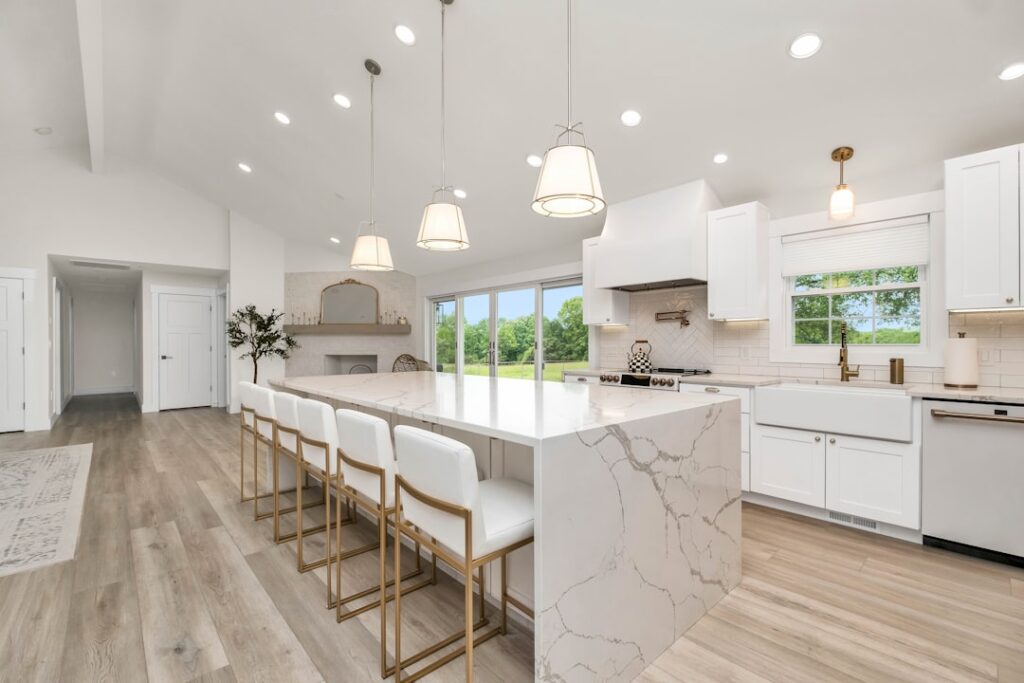
Putting a farmhouse sink in island is one of the most photographed kitchen moves of the last decade. It looks like a magazine spread, makes the island the true workhorse of the room, and frees up perimeter counter for prep and appliances. Done right, it works beautifully for the next 30 years. Done wrong, you fight cabinet sag, plumbing access nightmares, and water splashing onto bar stools. Here is how to plan it like a pro.
Why It Works in an Island
An island sink puts the cleanup zone at the center of activity. The cook can wash and rinse while talking to guests, kids can rinse hands without crossing the cooking triangle, and dishes get loaded into a dishwasher mounted to the right or left of the basin. The National Kitchen and Bath Association’s (NKBA) kitchen planning guidelines specifically call out island sinks as a strong layout for open-concept homes.
The farmhouse style — with its tall apron front exposed below the counter — also adds a focal point that a standard drop-in or undermount lacks. It signals craft, weight, and intentional design.
Pick the Right Sink Size
Most farmhouse sinks for island installations run 30 to 36 inches wide. Anything smaller looks underwhelming in a typical 7- to 10-foot island. Common dimensions:
- 30 inches: Fits a 33-inch base cabinet, smallest practical size
- 33 inches: Most popular, fits a 36-inch sink base, room for one large pan
- 36 inches: Premium choice, requires a 39-inch cabinet, double-bowl available
- 42 to 48 inches: Custom builds only; needs heavy reinforcement
Single-bowl is the right call for most farmhouse sinks. A 33-inch single basin gives you full-size cookie sheets, roasting pans, and even small grill grates room to soak. Double-bowl farmhouse sinks split the workspace and lose that advantage.
Cabinet Reinforcement Is Mandatory
A loaded farmhouse sink weighs 100 to 250 pounds depending on the material. Fireclay sinks like Whitehaus or Rohl average 180 pounds dry. Cast iron from Kohler and stainless from Kraus run lighter, 60 to 120 pounds, but still need support.
The standard sink base needs custom modification:
- Cut the front rail to drop the sink into the cabinet opening
- Install a plywood subdeck — minimum 3/4-inch — across the cabinet bottom
- Add 2×4 ledger boards on both sides screwed into the cabinet sides
- For fireclay or cast iron, add steel angle iron underneath for long-term sag prevention
Most cabinet manufacturers including Kraftmaid, Diamond, and Decora sell farmhouse-ready sink bases pre-modified. Add about $200 to $400 to a standard sink base. Worth it.
Plumbing Rough-In for Island Installation
Island sinks bring a unique plumbing challenge: the drain has no nearby wall for a standard vent. The Uniform Plumbing Code (UPC) and most jurisdictions following the International Plumbing Code (IPC) section 916 require an island loop vent or an air admittance valve (AAV).
An island loop vent rises from the drain, loops up to the underside of the countertop, and drops back down into a horizontal vent line that ties to a stack in a nearby wall. Done with copper or PVC, it is unobtrusive and code-compliant in every US state. Studor and Oatey AAVs are accepted in 47 states and skip the loop, but check local code before you specify one — California allows them with restrictions, and some local jurisdictions still prohibit them entirely.
Supply lines for hot and cold water run through the slab or up through a floor joist bay into the island base. Plan a clean-out access in the cabinet kick plate for future service. A $15 louvered grille at the toe-kick is cleaner than cutting a hole on demand later.
Counter Overhang and Splash Considerations
Set your countertop slab so it overhangs the apron front by 3/4 to 1 inch. Too little overhang exposes the sink rim to standing water; too much looks awkward and shadows the front.
Watch the sink-side overhang of the island where bar stools sit. Plan at least 18 inches between the sink basin and any stool seating to keep splash off guests. If your island is under 8 feet long, consider relocating the sink toward one end and reserving the other for seating only.
Cost Breakdown for the Project
Adding a farmhouse sink to an island during a remodel typically lands between $2,800 and $7,500. Here is the typical breakdown:
- Farmhouse sink (Kraus, Ruvati, Kohler, Rohl): $400 to $2,200
- Custom sink base cabinet or modification: $200 to $800
- Reinforcement framing and plywood: $75 to $200
- Plumbing rough-in and island vent: $600 to $1,800
- Faucet (Moen, Delta, Kohler, Brizo): $200 to $1,200
- Garbage disposal (InSinkErator Evolution): $150 to $450 installed
- Countertop cutout for sink: $150 to $400
- Labor and installation: $800 to $1,500
If the island is being built from scratch, the incremental cost over a standard countertop-only island is roughly $2,000 to $3,500.
Material Choices for the Sink Itself
- Fireclay (Whitehaus, Rohl Shaws): Classic white look, chip-resistant when hit but cracks on direct heavy impact. $700 to $2,200.
- Cast iron with enamel (Kohler Whitehaven): Heavy and durable, enamel chips with very hard impacts. $700 to $1,800.
- Stainless steel (Kraus, Ruvati): Lighter, less expensive, modern look. $400 to $1,200. 16 to 18 gauge is the sweet spot.
- Copper (Sinkology, Native Trails): Antimicrobial, develops natural patina. $700 to $2,500.
- Concrete and stone: Custom only, $1,800 to $5,000.
Common Mistakes to Avoid
Do not skip the reinforcement. A sagging farmhouse sink will crack a quartz or granite countertop within five years. Do not place the sink directly under a pendant light without considering splash patterns on glass — most installers offset the pendant by 6 to 8 inches. Do not undersize the disposal; the InSinkErator Evolution Compact 3/4 HP handles fibrous waste better than the 1/2 HP entry models.
Avoid drop-in farmhouse-style sinks that screw to the underside of the countertop. They look the same in photos but the seam collects grime and the sink is only as strong as the silicone bead under the counter.
Final Word
A farmhouse sink in island is one of the few kitchen design moves that improves both daily function and resale value. Spend the extra money on reinforcement and proper venting, pick a 33- or 36-inch single-bowl in a durable material, and the result will look as good in year 20 as it did the day you opened the cabinet doors.