
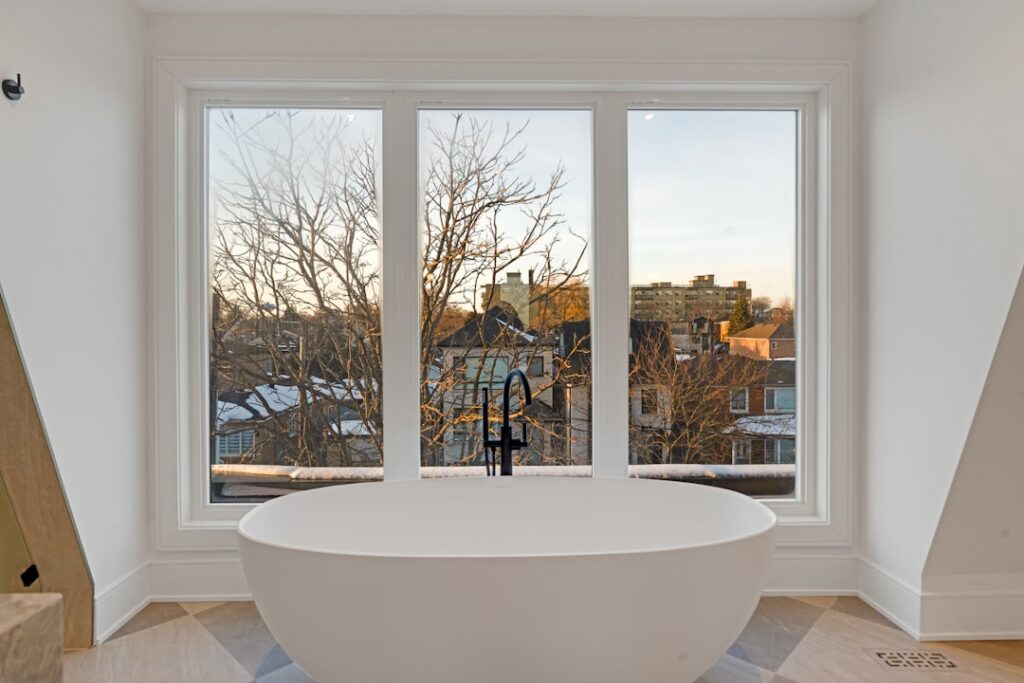
Real farmhouses from the 1890s had one claw-foot tub, a painted wood floor, and a wash basin. Modern designers borrowed the visual language and added things like heated tile, rainfall shower heads, and smart mirrors. A farmhouse style bathroom done well looks lived-in and timeless; done poorly it looks like a Pinterest collage printed onto drywall. The difference comes down to material authenticity, restrained color, and a handful of non-negotiable details.
Part of our Bathroom Remodeling & Flooring guide — explore the full guide →
Core Elements That Define the Style
Five elements appear in virtually every farmhouse bathroom: shiplap or beadboard wall paneling, an apron-front or pedestal sink, matte black or oil-rubbed bronze fixtures, white subway or hex tile, and at least one piece of reclaimed or rough-sawn wood. Hit all five and the style reads clearly. Skip more than two and it starts looking like generic cottage design.
Texture matters more than color in this aesthetic. A matte white tile wall next to rough wood shelves against a warm-white painted beadboard ceiling creates visual interest without introducing bold color. The palette stays neutral: whites, warm grays, tobacco browns, muted sage or navy as accents.
Flooring Choices That Hold Up
Penny-round ceramic tile in matte white with dark grout is the single most popular farmhouse bathroom floor right now, running $7 to $14 per square foot installed. Hex tile in black or slate gray with white grout is the second option, giving the same period-correct look with different geometry.
Wide-plank wood-look luxury vinyl plank is a practical alternative for budget-conscious remodels. Brands like COREtec Pro Plus and Karndean Van Gogh offer 9-by-60-inch waterproof planks at $3.50 to $6 per square foot that look convincingly like reclaimed oak. True hardwood does not belong in a bathroom no matter how much you love the look; humidity cycling cups and cracks it within a few years.
Vanities and Sink Options
An apron-front fireclay sink mounted in a furniture-style vanity is the classic farmhouse combination. The Kohler Whitehaven 30-inch apron sink at around $700 is the benchmark for single-bowl units, and a 48-inch double-bowl farmhouse vanity from Signature Hardware runs $1,800 to $2,800 depending on wood species.
Pedestal sinks work well in powder rooms where storage is not essential. The Kohler Memoirs Stately pedestal at $520 has the classic scalloped silhouette. For larger master baths, a 60 or 72-inch double vanity with turned legs, distressed finish, and a Carrara marble or butcher-block top anchors the room. Expect to spend $2,000 to $5,000 on a quality vanity of that size.
Tub and Shower Configurations
A freestanding claw-foot or slipper tub is the farmhouse statement piece. The Cheviot Regal double-ended claw-foot at $2,200 and the Signature Hardware Randolph at $1,400 are both 61 inches long and fit a standard tub alcove if you skip the surround. Add floor-mounted tub filler plumbing (budget $400 to $800 for the fixture plus $600 to $1,200 for rough-in labor).
Walk-in showers lean farmhouse with a white subway tile wall, a wood-look plank tile floor, matte black fixtures, and a single glass panel rather than a full enclosure. Skip the rainfall-only head. A practical setup runs a handheld on a slide bar plus a 2.5 GPM wall-mount head, because washing a kid or a dog in a rainfall-only shower is miserable.
Wall Treatments and Trim
Horizontal shiplap to 48 inches, painted Benjamin Moore Simply White or White Dove, with painted drywall above is the cleanest and most affordable approach at roughly $4 to $8 per square foot installed. Full-wall shiplap feels heavy-handed unless the ceilings are 10 feet or higher.
Beadboard wainscoting is the lower-cost alternative at $3 to $6 per square foot and works equally well for the style. Cap both with a flat 1×4 poplar board stained dark walnut or left raw for contrast against the white paneling. That dark cap rail is the detail that shifts the look from generic cottage to intentional farmhouse.
Lighting That Supports the Aesthetic
Black metal sconces flanking a mirror at 66 to 72 inches off the floor are the dependable farmhouse choice. The Hinkley Lighting Sullivan at $180 each and the Capital Lighting Homeplace at $110 both work. Over a double vanity, run two sconces over each sink rather than a single long bar fixture.
A single black or bronze chandelier over the tub is the hallmark farmhouse move. The Quorum Salento 5-light at $400 or a small Currey & Company iron chandelier at $700 to $1,200 both deliver. Confirm your local code permits a chandelier over a tub (usually requires 8 feet of vertical clearance and a wet-rated fixture within 3 feet of the tub edge).
Plumbing Fixtures and Hardware
Matte black and oil-rubbed bronze dominate, with unlacquered brass gaining ground in transitional farmhouse designs. Mixing two finishes (matte black fixtures with unlacquered brass cabinet hardware, for example) reads more designed than matching everything.
Cross-handle faucets are more period-correct than lever handles. Delta Trinsic with black finish at $280, Kingston Brass Heritage at $150, and Rohl Perrin & Rowe at $650 to $1,200 cover the budget spectrum. Match shower, tub, and sink fixtures within the same room unless you are intentionally mixing metals.
Budget Expectations for a Full Remodel
A modest farmhouse style bathroom remodel (tub replacement, new vanity, tile floor, paint, and fixtures) runs $8,000 to $15,000 in most US markets. A gut-and-replace down to the studs, including new plumbing rough-in, new drywall, custom tile shower, and premium fixtures, ranges from $25,000 to $55,000 depending on the region and finish level.
Contractors in high cost-of-living areas like the Northeast or West Coast will quote 30 to 50 percent higher. Get three detailed bids that itemize every fixture and labor component. Bids that are just a single lump-sum number hide inevitable upcharges and change orders.


