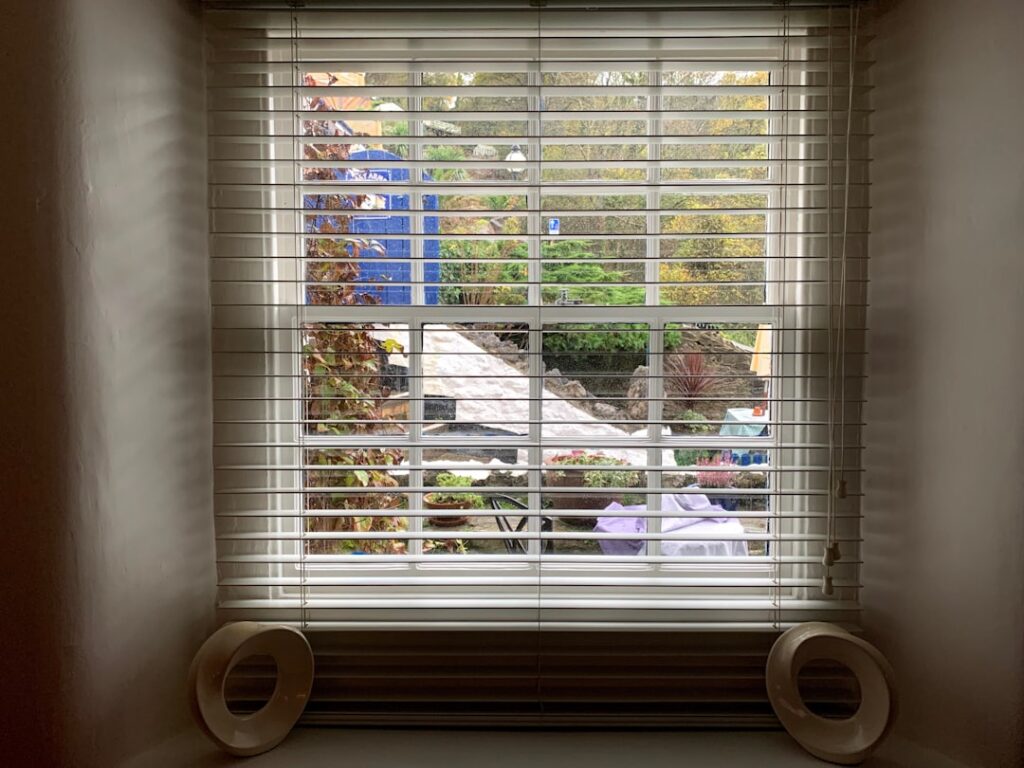
If you have ever watched real wood blinds bow and discolor over a steamy shower or a sink full of dishes, you already understand why faux window blinds exist. Faux wood blinds mimic the look of painted or stained basswood but are built from PVC or a wood-composite blend, so they shrug off humidity that would ruin the real thing. I steer clients toward faux in kitchens, baths, laundry rooms, and any sunny window where a solid-wood slat would eventually warp. They are not perfect for every room, but for wet or high-heat spaces the value is hard to beat.
Part of our Windows & Doors guide — explore the full guide →
What Faux Wood Blinds Are Made Of
Faux wood blinds come in two main builds. Solid PVC (vinyl) slats are fully synthetic, completely waterproof, and the least expensive option on the shelf. Wood-composite slats blend recycled wood fiber with a poly resin, so they feel a touch more like real wood and resist sag a little better across wide openings.
Both types carry a factory paint or laminate finish, most often in bright white, off-white, or a handful of stained wood tones. Because the color is baked in rather than hand-stained, faux blinds hold their finish under UV far better than a stained basswood slat, which can yellow or fade on a south-facing window within a few years.
Faux Wood vs Real Wood
The choice usually comes down to environment and budget. Real basswood is lighter and available in richer stains, so it flatters a formal living room or a dry bedroom. Faux wins nearly everywhere moisture, heat, or price is a factor.
- Moisture: Faux resists humidity, splashes, and steam; real wood warps and can delaminate.
- Weight: Real wood is lighter, so it suits very wide windows better.
- Cost: Faux runs roughly $20 to $60 for stock sizes; real wood often costs 40 to 80 percent more.
- Fade resistance: Faux holds color under strong sun; wood stains can lighten over time.
- Cleaning: Faux wipes down with a damp cloth; wood should stay mostly dry.
In short, if the window sees water or harsh afternoon sun, faux is the practical pick. If you want the warmth of a deep walnut stain in a dry room and weight is a concern, real wood still earns its place.
Where Faux Blinds Work Best
Bathrooms are the classic case. A window three feet from a shower gets hit with humidity every morning, and PVC faux blinds handle that without warping or spotting. Kitchens are next; grease and steam collect on any window covering near the range, and faux slats wipe clean with a degreaser and a damp rag.
Laundry rooms, mudrooms, basements, and sunrooms round out the list. Anywhere the covering faces temperature swings or moisture, faux earns its keep. The one place I hesitate is a very wide picture window, because faux slats are heavier than wood and a fully raised stack gets bulky.
Weight and Wide Windows
The one real drawback of faux is heft. A PVC slat is denser than basswood, so a fully raised faux blind on a tall window stacks heavier and pulls harder on the lift cord. On a 60-inch-wide by 60-inch-tall opening, a 2-inch faux blind can weigh 12 to 18 pounds, which is manageable but noticeably heavier than the wood equivalent.
For windows wider than about 72 inches, split the opening into two blinds under a shared valance rather than hanging one massive unit. Two blinds share the weight, raise more easily, and let you leave one side down for privacy while opening the other. Composite faux (the wood-resin blend) sags less than pure PVC across a wide span, so if you must cover a big window with a single blind, spend up for composite and ask for a reinforced headrail.
Slat Sizes and How They Look
Slat width changes both the view and the feel of the room. The two common sizes are 2 inch and 2.5 inch, with a slimmer 1 inch available for narrow or shallow windows.
A 2-inch slat is the everyday standard. It gives a clean view through when open, stacks tightly, and suits most rooms. Step up to a 2.5-inch slat and you get a bolder, more architectural look with slightly fewer slats blocking the glass, which flatters larger windows. Choose a matching valance to hide the headrail, and decide between a routed slat (small cord holes that let a little light through) or a routeless slat that blocks nearly all light for better bedroom darkening.
What Faux Window Blinds Cost
Price depends on size, material, and whether you buy off-the-shelf or custom. Stock faux wood blinds at a home center commonly run $20 to $60 for standard window sizes in white or a basic wood tone. Custom-cut blinds, wider windows, cordless lift, and premium finishes push the number higher.
- Stock PVC blinds: $20 to $50 per window.
- Composite faux wood: $40 to $90 per window.
- Custom-sized faux blinds: $60 to $180 per window.
- Cordless or motorized lift: add $30 to $150.
For a typical home doing five or six windows, plan on roughly $150 to $500 for stock faux blinds and $400 to $1,000 if you go custom with cordless lifts. Cordless is worth the upcharge in any home with kids or pets, and many stock blinds now ship cordless by default to meet current safety standards.
Measuring and Installing Faux Blinds
Faux blinds are one of the easier coverings to hang yourself, and the whole job takes about 20 minutes per window with a drill and a level. First decide on inside or outside mount. Inside mount needs at least 2 to 2.5 inches of frame depth for the headrail to sit flush; measure the width at the top, middle, and bottom and use the narrowest figure, then measure the height on both sides and the center.
Outside mount hides a shallow or out-of-square frame and blocks more light. Add about 1.5 to 3 inches of overlap on each side and 2 to 3 inches above the opening. Mount the brackets into the frame or into wall studs, snap the headrail in, clip on the valance, and you are done. For a routine standard-size window, factory inside-mount deductions handle the fit automatically, so you order the exact opening size and the manufacturer trims the blind to sit cleanly inside.
Cleaning and Maintenance
This is where faux really shines, because upkeep is nearly effortless. Dust the slats weekly with a microfiber cloth or a vacuum brush attachment, running along each slat rather than across it. For kitchen grease or bathroom film, wipe the slats with a cloth dampened in warm water and a drop of dish soap, then dry them so no streaks set.
Heavily soiled PVC blinds can even be taken down and rinsed in a bathtub or laid on a towel outside and hosed gently, something you would never do with real wood. Let them dry fully before rehanging. Avoid abrasive scrubbers, which dull the finish, and check the lift cord and tilt wand once a year so a worn mechanism does not leave a heavy blind stuck halfway.
One more tip: in a bathroom, tilt the slats fully open after a shower so trapped moisture between the slats can evaporate instead of sitting on the finish. It is a small habit, but it keeps the headrail mechanism from corroding and stops any faint water spotting on the slats over the years.
Pros, Cons, and the Bottom Line
Weigh the tradeoffs before you buy. On the plus side, faux blinds are affordable, waterproof, fade-resistant, and simple to clean, which makes them the default choice for the wettest, sunniest rooms in the house. On the downside, they are heavier than real wood, the stack is bulkier on tall windows, and the finish options are more limited than a custom wood stain.
For most homeowners furnishing a kitchen, bath, or sun-baked family room, the math is easy. Well-made faux window blinds deliver the wood look, survive years of steam and sunlight, and cost a fraction of the alternatives, which is exactly why they hang in more American windows than any other blind on the market.