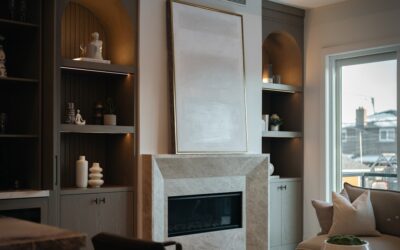
Painting all four walls dark green almost always feels like you’re inside a closet. Painting one of those walls dark green and leaving the other three in soft white turns the space into a magazine shot. That’s the entire principle behind feature walls — concentrate visual interest on a single surface so the rest of the room can breathe. The trick is picking the right wall, the right material, and the right amount of contrast. Get any of those wrong and a feature wall reads as random rather than intentional.
- Which Wall to Pick
- Color: The Cheapest Option
- Wallpaper for Real Pattern Impact
- Wood Slat and Plank Walls
- Stone Veneer and Brick
- Tile-Clad Accent Walls
- Wainscoting, Board and Batten, and Picture Molding
- Built-In Bookcases and Storage Walls
- Mural and Hand-Painted Walls
- Common Design Mistakes
- Lighting Your Accent Surface
- Rooms Where the Treatment Works Best
- Budget Reality
Which Wall to Pick
The feature wall should be the wall your eye lands on first when you enter the room. Usually that’s the wall opposite the doorway, behind a major architectural element (fireplace, headboard, sofa), or anchoring a focal piece of furniture. Avoid picking a wall with three windows on it — the openings break up the visual impact and the treatment looks chopped. Avoid the wall directly behind a TV unless the wall treatment is supposed to frame the screen.
Color: The Cheapest Option
Paint costs $40 to $60 a gallon and a single accent wall takes one quart. Stick with a color that’s already pulled from somewhere else in the room — a throw pillow, a rug, a piece of art — so the wall feels connected rather than dropped in. Saturated colors (deep green, navy, terracotta, charcoal) read more sophisticated than light pastels for a feature treatment. Use eggshell or satin sheen, never flat — flat shows every imperfection in raking light.
Wallpaper for Real Pattern Impact
Modern peel-and-stick wallpaper has come a long way from the bubble-prone product of 2015. Brands like Tempaper, Chasing Paper, and Spoonflower offer designer prints at $40 to $80 per roll covering about 30 to 60 sq ft. A single accent wall typically uses 2 to 3 rolls. Removable formats let renters or commitment-phobic homeowners try bold patterns without the regret. Traditional pasted wallpaper still looks better up close but requires more skill to install seamlessly.
Wood Slat and Plank Walls
Vertical wood slats over a dark felt backer (the Scandinavian look) became popular for good reason — they add architectural depth, absorb sound, and read modern without feeling cold. Premade panels run $25 to $45 per square foot installed. DIY with poplar 1x2s on a black-painted plywood backer drops cost to $8 to $12 per square foot. Reclaimed wood plank walls and shiplap installations land in similar price ranges depending on material sourcing.
Stone Veneer and Brick
For a fireplace wall or a serious anchor in a living room, stone veneer at $8 to $20 per square foot installed delivers presence no paint can match. Manufactured veneer (lighter, easier to install) and natural stone veneer both work over a properly prepared substrate. Thin brick veneer hits a similar price range and lends itself to industrial and farmhouse looks. Both materials reward professional installation — sloppy mortar joints kill the effect.
Tile-Clad Accent Walls
Large-format porcelain tile, zellige, or hand-painted ceramic tile creates striking accent walls in bathrooms and kitchens but works in living rooms too. Behind a freestanding tub or as a kitchen backsplash that wraps the entire wall, tile delivers durability that paint and paper can’t match. Costs run $7 to $25 per square foot installed depending on tile choice and substrate prep. Use a registered tile setter — bad joint work shows up worse on a feature wall than anywhere else.
Wainscoting, Board and Batten, and Picture Molding
Architectural treatments using paint and trim alone create custom-looking accent surfaces for under $200 in materials. Vertical battens spaced 14 to 18 inches apart over a smooth backer, painted in a single color, deliver that “old house with money” look at almost any budget. Picture molding grids (rectangular boxes formed from thin trim) add formality without crowding the room. These treatments work especially well in dining rooms, primary bedrooms, and entryways.
Built-In Bookcases and Storage Walls
The most functional accent treatment is one that does work. A floor-to-ceiling built-in bookcase, a paneled storage wall in a primary bedroom, or a floating-shelf installation behind a sofa adds character while solving a real storage problem. Custom built-ins run $250 to $500 per linear foot installed; IKEA hacks using BILLY or BESTÅ units bring cost down to $80 to $150 per linear foot for a similar look.
Mural and Hand-Painted Walls
Large-scale wallpaper murals (custom-printed scenes, abstract art, vintage maps) cost $200 to $1,200 for a typical 8-by-10 foot wall and deliver impact no other treatment matches. Hand-painted murals from a local artist run $1,500 to $6,000 depending on scale and detail. This is the highest-impact, highest-investment accent option and probably overkill for anything but a primary living space or kid’s room.
Common Design Mistakes
The fastest way to ruin feature walls is to overdo the contrast or pick a treatment that fights the rest of the room.
- Don’t paint the only wall with windows — it fragments the look
- Don’t pick a color from outside the existing palette unless you’re starting fresh
- Avoid bold patterns in small rooms under 100 sq ft — it overwhelms the space
- Don’t add another bold element (gallery wall, oversized art) to an already strong accent treatment
- Skip glossy finishes — they bounce light and emphasize wall imperfections
Lighting Your Accent Surface
The treatment is only half the equation — lighting completes it. Wall washers, picture lights, or recessed cans angled at 30 degrees from the wall bring out texture and shadow. Avoid lighting that sits flush against the wall (no good shadow), or lighting that shoots straight down (creates harsh hot spots). LED strip lighting tucked behind floating shelves or above a built-in adds drama at low cost.
Rooms Where the Treatment Works Best
Living rooms with a fireplace, primary bedrooms behind the headboard, dining rooms behind the sideboard, home offices behind the desk, and entryways that need to make an impression are the natural fits. Bathrooms and kitchens benefit from tile-based accents behind tubs, vanities, or ranges. Hallways and kid’s rooms work for renter-friendly peel-and-stick treatments.
Budget Reality
You can do a paint accent in a Saturday for $30. You can do a peel-and-stick wallpaper wall in an afternoon for $150. A wood slat wall costs $400 to $800 in materials for a typical accent wall. Tile and stone projects run $500 to $2,500 installed. Budget what you have, pick the treatment that matches, and resist the temptation to add a second accent in the same room. Restraint is what makes the wall feel intentional.