The word “finesse” gets attached to flooring collections that emphasize finer surface texture, tighter beveling, and more nuanced color blending than the flat printed boards stacked at most warehouses. Finesse flooring typically describes mid-tier LVP and engineered wood collections from regional distributors and a handful of national lines, with wear layers in the 12 to 20 mil range and pricing between $2.49 and $5.29 per square foot. The category sits above contractor-grade vinyl but below true premium brands like Karndean and Mannington Adura. If you want a sophisticated visual without paying $7-plus per square foot, this is the lane.
- What Defines a Finesse-Grade Floor
- Pros That Justify the Mid-Tier Price
- Cons to Weigh Before Committing
- Pricing Across the Finesse Tier
- How Finesse Compares to Other Tiers
- Best Rooms for Finesse Flooring
- Installation Best Practices
- Brand-Spotlight: Common Finesse Lines
- Maintenance That Preserves the Visual
- Final Buying Checklist
What Defines a Finesse-Grade Floor
Three traits separate finesse collections from generic LVP and laminate. First, multi-pass digital printing creates 18 to 24 unique plank faces per box instead of the four or six in budget lines, which kills the repeating-pattern look across a room. Second, embossed-in-register (EIR) texture aligns the surface grain with the printed image — run your fingernail across a knot and you actually feel it. Third, micro-beveled or hand-scraped edges replace the squared-off chamfer common in entry-level products.
The boards tend toward 7″ to 9″ widths and 48″ to 60″ lengths, with click-lock systems licensed from Unilin or Valinge. Cores are typically rigid SPC for waterproof claims or HDF for laminate finesse lines.
Pros That Justify the Mid-Tier Price
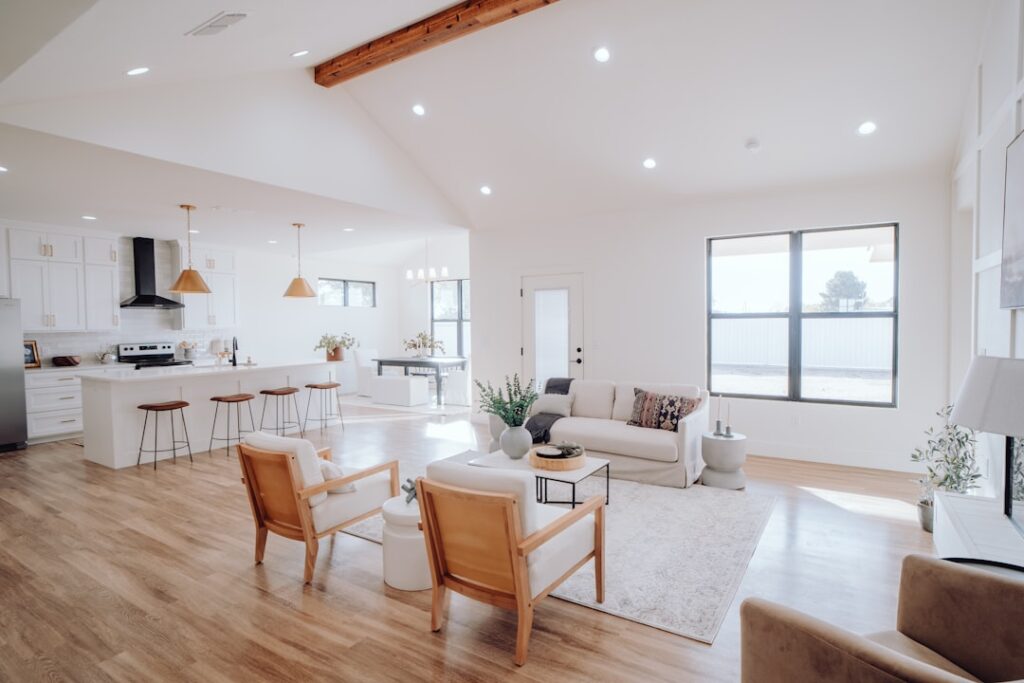
The visual upgrade is the headline. Designers and listing photographers can spot generic LVP at 10 feet — repeating planks, glossy bevels, that plastic look across a wide room. Finesse-grade product photographs like real hardwood because the printing and texture catch light unevenly across the face.
Durability also steps up. Most finesse LVP runs 20 mil wear layers backed by 25-year residential warranties. AC4 finesse laminates handle commercial light traffic. That’s enough margin for kitchens with dogs, kids, and dropped pots without watching the finish dull in two years.
Cons to Weigh Before Committing
Mid-tier pricing means mid-tier warranty service. Most finesse lines route claims through the selling dealer rather than a national brand desk, which slows replacement when something fails. The lifetime structural warranty often shrinks to a prorated value after year five.
Color consistency across dye lots is another issue. If you reorder six months later to extend into another room, expect a noticeably different shade. Order 12 percent overage at the start and store the extra cartons flat in conditioned space.
Pricing Across the Finesse Tier
Budget for the all-in cost, not just the box price. Underlayment, transitions, and labor stack up fast.
- Finesse LVP (12 mil wear, SPC core): $2.49 to $3.49 per square foot
- Finesse LVP (20 mil wear, SPC core): $3.79 to $4.99 per square foot
- Finesse engineered hardwood (2-3mm veneer): $4.49 to $5.29 per square foot
- Finesse laminate (12mm AC4 with EIR): $2.79 to $3.89 per square foot
- Pro install labor: $1.95 to $3.75 per square foot
- Underlayment and trim: $0.45 to $0.85 per square foot
How Finesse Compares to Other Tiers
Against contractor-grade LVP at $1.29 to $1.79 per square foot, finesse products double the wear layer, triple the visual variety, and add EIR texture. The price gap is usually $1.50 to $2.50 per square foot — meaningful on 1,500 square feet, but worth it if you’re staying more than five years.
Against premium lines like COREtec Plus HD and Mannington Adura Max, finesse collections come in $1 to $2 per square foot cheaper but trail on locking system stiffness, edge detailing, and color depth. The premium tier is the right call for whole-house remodels you plan to keep for 15 years. Finesse hits the sweet spot for single-room upgrades, rentals, and resale-focused projects.
Best Rooms for Finesse Flooring
Kitchens, dining rooms, and main living areas benefit most because the surface texture and visual variety read on camera and from a distance. Bedrooms are also a strong fit — the upgrade cost is small per square foot, and the warmer-feeling hand-scraped surfaces beat slick budget LVP.
Avoid full bathroom installs unless the product carries a written wet-area warranty (most do not, even with SPC cores). Powder rooms and laundry areas are usually fine because spills are smaller and shorter-duration.
Installation Best Practices
Acclimate boxes flat-stacked in the install room for 48 hours at 65 to 85 degrees Fahrenheit with 30 to 50 percent relative humidity. Test concrete subfloors with an ASTM F2170 probe — readings over 75 percent RH require a moisture mitigation primer.
Leave a 5/16″ expansion gap at every wall, transition, and fixed cabinet. Stagger end joints at least 8″ board to board. For runs longer than 30 feet in any direction, add a T-molding transition to prevent peaking. Use a tapping block — never a hammer directly on the tongue.
Brand-Spotlight: Common Finesse Lines
Regional distributors carry private-label finesse collections that mirror specs from Mohawk SolidTech Plus, Shaw Floorte Pro, and Mannington Adura Rigid. Ask your dealer to show the wear layer in mils, core thickness in millimeters, and the AC rating if it’s laminate. Verify FloorScore and CARB Phase 2 certification on the box. These three numbers tell you more than the brand name ever will.
Maintenance That Preserves the Visual
The textured EIR surface needs slightly different care than smooth-faced floors. Vacuum twice weekly with a hard-floor brush attachment to clear debris from the embossed grooves. Damp mop weekly with a neutral pH cleaner (Bona Pro, Pallmann Clean Strong, or Stone Tile Cleaner from the manufacturer). Avoid steam mops, which drive moisture through click-lock seams.
Place felt pads under all furniture legs and use floor protectors under wheeled office chairs. For pet households, trim nails monthly to minimize surface scratching on the wear layer.
Final Buying Checklist
Pick a finesse line when you want visible visual upgrade without premium pricing, when the install area is mostly dry living space, and when you’re comfortable buying through a dealer rather than a big-box. Get the wear layer, AC rating, certification numbers, and warranty terms in writing before you pay. Done right, finesse flooring delivers 80 percent of the premium look at 60 percent of the premium cost.
Prefer to explore on your own?
See how new flooring looks in your actual room in seconds — free, no signup.
Try the free Floor Studio →