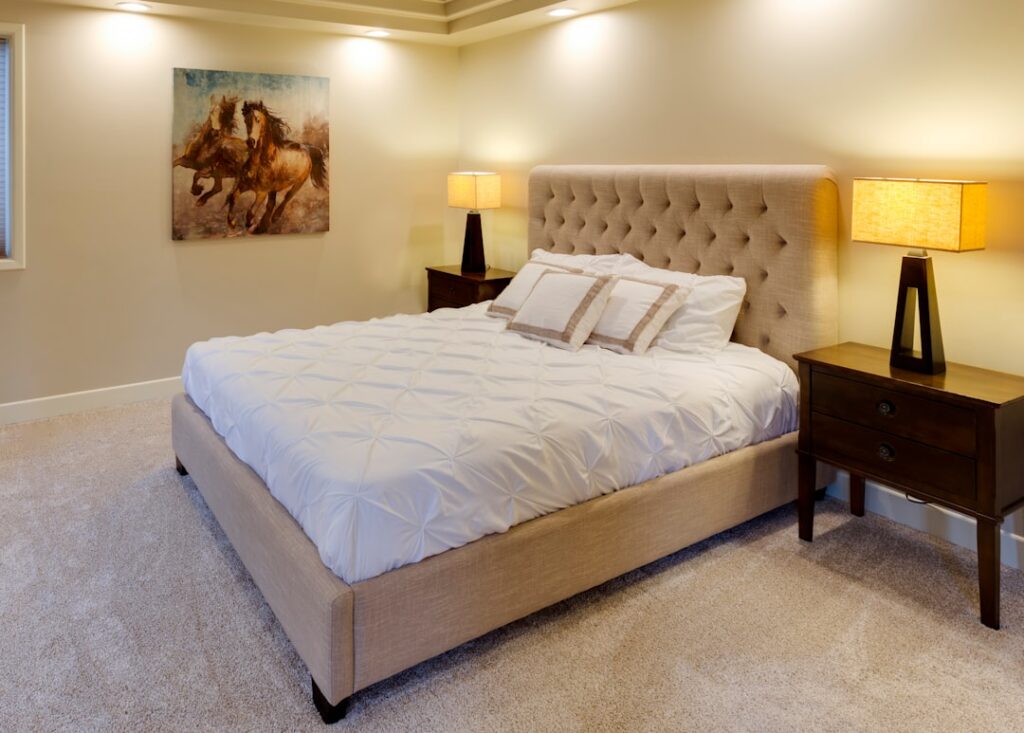
Fitted carpet — also called wall-to-wall carpet — is carpet that is cut, stretched, and secured to cover the entire floor of a room from one wall to another. Unlike area rugs that sit on top of existing flooring, fitted carpet becomes the floor itself, installed over a cushioned underlay and held in place by tack strips along the room’s perimeter.
- What Is Fitted Carpet?
- Fitted Carpet vs. Loose-Lay Rugs and Carpet Tiles
- The Installation Process Step by Step
- How to Measure for Fitted Carpet
- Underlay Guide: Types and Recommendations
- Cost Breakdown for Fitted Carpet
- Pros and Cons of Fitted Carpet
- Choosing the Right Carpet for Each Room
- Frequently Asked Questions
Despite the rise of hard-surface flooring, fitted carpet remains one of the most popular flooring choices for bedrooms, living rooms, and stairs. It delivers unmatched comfort underfoot, excellent acoustic performance, and a warmth that hard floors simply cannot replicate. With more than 30 years in the flooring trade, we have installed thousands of fitted carpets and know exactly what it takes to get a quality result.
What Is Fitted Carpet?
Fitted carpet is broadloom carpet that is professionally cut and installed to fit a room’s exact dimensions. It is stretched taut over an underlay (carpet padding) and anchored to the subfloor using tack strips — thin wooden strips with angled pins that grip the carpet backing along the room’s perimeter.
Key characteristics of fitted carpet:
- Full coverage: Covers the entire floor from wall to wall with no exposed floor surface
- Permanent installation: Held in place by tack strips and cannot be rolled up like a rug
- Cushioned underlay: Installed over a separate pad that adds comfort, insulation, and extends carpet life
- Seamed for large rooms: Rooms wider than the carpet roll (typically 12 feet) require seaming, where two pieces are joined together
- Professional installation recommended: Proper stretching and seaming require specialized tools and experience
Fitted carpet comes in rolls, usually 12 feet wide and up to 150 feet long. The installer calculates how much carpet is needed from the roll to cover the room, accounting for the room’s shape, doorways, closets, and seam placement. The carpet is then cut, positioned, stretched using a power stretcher, and trimmed to fit precisely along every wall and obstacle.
Fitted Carpet vs. Loose-Lay Rugs and Carpet Tiles
Understanding the differences helps you decide whether fitted carpet is the right choice for your space.
Fitted carpet vs. area rugs:
- Coverage: Fitted carpet covers the entire floor; rugs cover selected areas and leave the underlying floor exposed
- Installation: Fitted carpet requires professional installation; rugs are simply placed on the floor
- Comfort: Fitted carpet with underlay provides more cushioning than a rug on a hard floor
- Sound control: Full-room fitted carpet provides significantly better noise reduction than scattered area rugs
- Cleaning: Fitted carpet is vacuumed in place; rugs can be taken outside for shaking and professional cleaning
- Flexibility: Rugs can be swapped, moved, and taken when you move; fitted carpet stays with the home
- Cost: Fitted carpet is generally more economical per square foot of coverage than quality area rugs
Fitted carpet vs. carpet tiles:
- Appearance: Fitted carpet provides a seamless look; carpet tiles have visible seam lines
- Repairability: Damaged carpet tiles can be individually replaced; fitted carpet requires patching or full replacement for significant damage
- DIY installation: Carpet tiles are DIY-friendly; fitted carpet requires professional tools and skills
- Residential use: Fitted carpet is the standard residential choice; carpet tiles are more common in commercial settings
For bedrooms and residential living areas where comfort and a seamless look matter most, fitted carpet is typically the better choice. For basements, playrooms, and areas where easy replacement of sections is valuable, carpet tiles offer more practical advantages.
The Installation Process Step by Step
Professional fitted carpet installation follows a specific sequence. Understanding the process helps you prepare your home and evaluate your installer’s work.
Step 1 — Room preparation: All furniture is removed from the room. Old carpet and padding (if present) are pulled up and disposed of. The subfloor is inspected for damage, squeaks, and levelness. Any issues are repaired before proceeding.
Step 2 — Tack strip installation: Thin wooden strips with angled pins are nailed around the room’s perimeter, approximately 1/2 inch from each wall. The pins angle toward the wall to grip the carpet as it is stretched.
Step 3 — Underlay installation: Carpet padding is rolled out across the entire floor, butted up to (but not over) the tack strips. Seams between pad sections are taped, and the pad is stapled to the subfloor to prevent bunching.
Step 4 — Carpet cutting and positioning: The carpet is rolled out with excess material running up each wall by 3 to 4 inches. In rooms requiring seams, the two pieces are carefully aligned and joined using seaming tape and a hot-iron seam tool.
Step 5 — Stretching: This is the most critical step. The installer uses a power stretcher (a long tool that braces against one wall and pushes the carpet toward the opposite wall) to stretch the carpet taut across the room. Proper stretching eliminates wrinkles and buckles. The carpet is hooked onto the tack strip pins as it is stretched.
Step 6 — Trimming and tucking: Excess carpet along the walls is trimmed with a wall trimmer, and the edges are tucked into the gap between the tack strip and the wall using a stair tool or knee kicker. Metal transition strips are installed at doorways where carpet meets other flooring.
Step 7 — Final inspection: The installer checks for wrinkles, loose seams, gaps at walls, and proper transition strip placement. A quality installation should feel uniformly taut across the entire room with no visible ripples or bumps.
How to Measure for Fitted Carpet
Accurate measurement is essential for fitted carpet projects. While your installer will do a professional measurement, understanding the process helps you estimate costs and verify accuracy.
Basic room measurement:
- Measure the room’s length and width at the widest points (wall to wall)
- Add 3 to 6 inches to each dimension for trimming allowance
- Multiply length by width to get the square footage
- For irregular rooms, break the space into rectangles, measure each, and add them together
Accounting for carpet roll width:
- Standard carpet rolls are 12 feet wide (some come in 13.5 or 15 feet)
- If your room is 14 feet wide, you need two pieces with a seam, requiring a 12-foot piece and a 2-foot piece cut from a second 12-foot section
- The seam placement matters — it should be in a low-traffic area, away from doorways, and perpendicular to the main window to minimize visibility
Waste factor:
- Add 10 percent for standard rectangular rooms
- Add 15 to 20 percent for rooms with alcoves, bay windows, angles, or complex shapes
- Patterned carpet requires additional material for pattern matching at seams — add 15 to 25 percent
Stairs:
- Measure each step’s width, depth (tread), and rise (riser height)
- Multiply the number of steps by the width of the staircase
- Add 10 percent for waste and wrapping around bullnose edges
- Stairs are typically carpeted from the same roll as the upstairs landing for color consistency
Pro tip: when your installer measures, ask for a diagram showing seam locations and the total square footage used versus the room’s actual area. This lets you verify the waste factor is reasonable — anything over 15 percent for a simple rectangular room warrants a question.
Underlay Guide: Types and Recommendations
The underlay (carpet pad) beneath your fitted carpet affects comfort, sound insulation, thermal insulation, and carpet lifespan. It is not the place to cut costs.
Rebond (bonded urethane):
- The most common residential underlay
- Made from recycled foam scraps bonded together
- Available in 6-pound, 8-pound, and 10-pound densities
- 8-pound density is the minimum we recommend for living areas; 6-pound is acceptable for bedrooms with light traffic
- Cost: $0.30 to $0.80 per square foot
Memory foam underlay:
- Premium cushioning with a luxurious feel underfoot
- Best for bedrooms and low-traffic areas where comfort is the priority
- Not recommended for high-traffic areas — it compresses permanently under repeated heavy use
- Cost: $0.60 to $1.50 per square foot
Waffle rubber:
- Natural or synthetic rubber in a waffle pattern
- Excellent resilience — bounces back after compression better than foam
- Heavier and more expensive than rebond but significantly more durable
- Ideal under premium wool carpet where longevity matters
- Cost: $0.80 to $2.00 per square foot
Moisture barrier underlay:
- Standard rebond or foam with a built-in moisture-resistant film on one side
- Essential for basement installations or rooms below grade
- Prevents moisture migration from concrete subfloors into the carpet
- Cost: $0.50 to $1.20 per square foot
Thickness guidelines:
- Standard residential: 7/16 inch thick, 6 to 8 pound density
- Premium residential: 1/2 inch thick, 8 to 10 pound density
- Berber and low-loop carpet: use a thinner, firmer pad (3/8 inch, 8+ pound density) to prevent the carpet from flexing too much at seams
- Never use pad thicker than 1/2 inch under residential carpet — excessive thickness causes premature seam failure and wrinkling
Cost Breakdown for Fitted Carpet
Here is what fitted carpet costs when you account for every component:
Carpet material (per square foot):
- Budget polyester: $1.00 to $2.50
- Mid-range nylon: $2.50 to $5.00
- Premium nylon or wool: $5.00 to $15.00+
Underlay (per square foot):
- Standard rebond: $0.30 to $0.60
- Premium pad: $0.60 to $1.50
Installation labor (per square foot):
- Standard rooms: $0.50 to $1.50
- Stairs: $15 to $45 per step
Additional costs:
- Old carpet removal and disposal: $0.50 to $1.50 per square foot
- Furniture moving: $25 to $75 per room
- Subfloor repair (if needed): $1.00 to $3.00 per square foot
- Transition strips: $5 to $15 per doorway
Total installed cost examples:
- Master bedroom (200 sq ft), mid-range: $800 to $1,600
- Living room (350 sq ft), mid-range: $1,400 to $2,800
- Whole house, 3 bedrooms + living room + stairs (1,000 sq ft), mid-range: $4,000 to $8,000
Pros and Cons of Fitted Carpet
A balanced assessment of fitted carpet to help you decide:
Pros:
- Comfort: The softest flooring option, especially with quality underlay
- Warmth: Provides thermal insulation, keeping rooms warmer in winter
- Noise reduction: Absorbs impact noise and airborne sound better than any hard surface
- Safety: Cushioned surface reduces injury from falls — important for children and elderly family members
- Affordability: One of the least expensive flooring options per square foot installed
- Seamless appearance: Covers the entire floor uniformly for a cohesive look
- Slip resistance: Naturally non-slip, even when wet
Cons:
- Stain susceptibility: Absorbs spills and can stain permanently, especially lighter colors
- Allergen trapping: Harbors dust mites, pet dander, and allergens despite regular vacuuming
- Shorter lifespan: 8 to 15 years typical, far less than hardwood or tile
- Moisture sensitivity: Not suitable for wet areas — bathrooms, kitchens, and basements (without moisture-barrier pad) are risky
- Difficult to clean deeply: Requires professional steam cleaning 1 to 2 times per year for thorough sanitation
- Style limitations: Carpet does not offer the design versatility of hardwood, tile, or LVP
- Resale perception: Many buyers prefer hard-surface flooring and may view wall-to-wall carpet as something to replace
Choosing the Right Carpet for Each Room
Not all fitted carpet is created equal, and the best choice depends on the room’s function and traffic level.
Bedrooms: Comfort is king. Choose a plush or textured plush in nylon or polyester with premium underlay. This is the one room where you can prioritize softness over durability because traffic is light. Pile height of 1/2 to 3/4 inch feels luxurious underfoot.
Living rooms and family rooms: Balance comfort with durability. Textured nylon in a medium pile height (3/8 to 1/2 inch) resists crushing and shows footprints less than plush styles. Choose a color that hides soil — medium tones and heathered patterns are most practical.
Stairs and hallways: Durability is the top priority. Dense, low-pile loop or cut-loop carpet in a dark or medium tone handles heavy traffic and resists matting. Nylon fiber is essential for stairs — polyester will crush and mat in these high-impact zones. Use a firm underlay (3/8 inch, high density) for stairs to prevent the carpet from feeling spongy underfoot.
Home offices: Choose low, dense pile that allows desk chairs to roll smoothly. Loop or cut-loop styles work best. Berber-style carpet can snag on castor wheels, so avoid large loop sizes. A firm underlay keeps the chair rolling effort manageable.
Basements: Moisture resistance matters most. Use synthetic carpet (nylon or polyester) over moisture-barrier underlay. Avoid wool — it absorbs moisture and promotes mold growth. Consider carpet tiles instead of fitted carpet for basements, as individual tiles can be lifted and dried or replaced if water intrusion occurs.
Frequently Asked Questions
How long does fitted carpet last?
Fitted carpet typically lasts 8 to 15 years depending on fiber type, quality, traffic level, and maintenance. Premium nylon carpet in a bedroom can last 15 to 20 years. Budget polyester carpet in a high-traffic living room may show significant wear in 5 to 8 years. Regular professional cleaning and quality underlay both extend carpet lifespan significantly.
Can I install fitted carpet myself?
While it is technically possible, we strongly recommend professional installation. Proper stretching requires a power stretcher (not just a knee kicker), and seaming requires a hot-iron seam tool and experience to create invisible joints. Poorly stretched carpet develops wrinkles within months, and bad seams are permanently visible. The labor cost is a small fraction of the total project and makes a significant quality difference.
How much does it cost to carpet a 12×12 room?
A 12×12 room is 144 square feet. Including carpet, pad, and installation, expect to pay $360 to $720 for budget carpet, $720 to $1,440 for mid-range, and $1,080 to $2,880 for premium. Add $72 to $216 for old carpet removal if applicable. Most homeowners spend $600 to $1,200 for a mid-range fitted carpet installation in a room this size.
Is fitted carpet better than laminate or LVP?
It depends on your priorities. Fitted carpet is warmer, softer, quieter, and safer for falls. Laminate and LVP are more durable, water-resistant, easier to clean, and have broader design appeal for resale. For bedrooms and comfort-focused spaces, fitted carpet wins. For kitchens, bathrooms, entryways, and resale preparation, hard-surface flooring is the better choice.
How often should fitted carpet be professionally cleaned?
Professional hot-water extraction cleaning (steam cleaning) should be done every 12 to 18 months for most households. Homes with pets, children, or allergy sufferers benefit from cleaning every 6 to 12 months. Between professional cleanings, vacuum at least twice per week and spot-treat stains immediately to maintain appearance and indoor air quality.