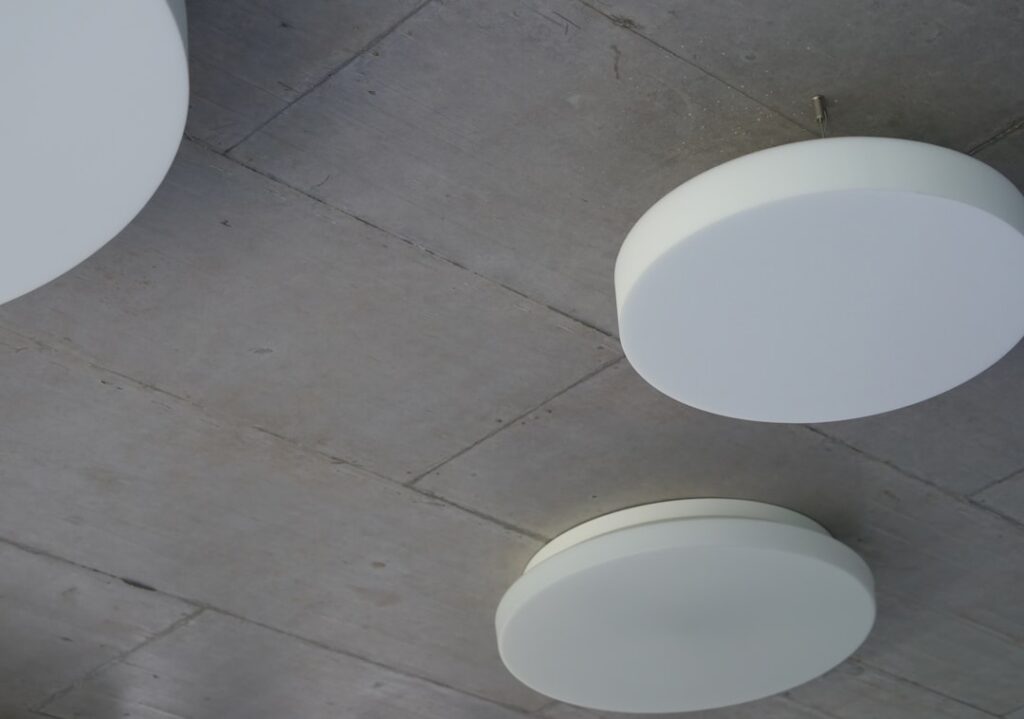
Low ceilings kill more lighting plans than small budgets do. On a standard 8-foot ceiling, a hanging pendant leaves barely 6 feet of head clearance, which is why flush mount ceiling lighting remains the workhorse of American homes — it delivers full-room light while hugging the ceiling within 4 to 8 inches. The category has changed dramatically in the past decade: integrated LED discs now outsell traditional “mushroom” domes, and designs run from $25 utility drums to $400 crystal semi-flush fixtures. This guide sorts out flush versus semi-flush, how many lumens each room actually needs, integrated LED trade-offs, and what installation really involves.
Flush vs. Semi-Flush: The 6-Inch Question
A true flush mount seats its canopy directly against the ceiling with the shade extending 4 to 8 inches down. A semi-flush hangs the shade from a short stem or frame, dropping 8 to 14 inches total. That difference sounds trivial, but it changes both clearance and light quality. Semi-flush fixtures let light wash the ceiling above the shade, which brightens the whole plane and makes rooms feel taller; true flush mounts push all their light down and out.
Use ceiling height as the deciding rule. At 8 feet, stick to true flush mounts in walkways and anywhere people pass under the fixture — you keep 7-plus feet of clearance. At 9 feet, semi-flush fixtures shine and give you far more design range. At 10 feet, you’re really shopping for small chandeliers, though an oversized semi-flush (18 to 24 inches wide) can still look deliberate. One exception: over a bed, dining table, or kitchen island, nobody walks under the fixture, so a semi-flush works even at 8 feet.
How Much Light Each Room Needs
Lumens, not watts, are the number to shop by. A useful baseline is 20 lumens per square foot for general living areas, 30 to 40 for kitchens and task zones, and 10 to 20 for hallways and bedrooms. Translated into typical rooms:
- Hallway or closet (25-50 sq ft): 500-1,000 lumens — one 10-13 inch flush mount
- Bedroom (120-180 sq ft): 2,000-3,000 lumens — one 14-16 inch fixture, ideally dimmable
- Kitchen (150-200 sq ft): 5,000-7,000 lumens total — a central flush mount plus recessed or under-cabinet task lighting
- Living room (200-300 sq ft): 4,000-6,000 lumens total, split between the ceiling fixture and lamps
- Laundry or garage: 3,000-4,500 lumens from one bright LED drum or wraparound
Color temperature matters just as much. Use 2700K (warm white) in bedrooms and living rooms, 3000K in kitchens and baths, and save 4000K for garages and workshops. Mixing temperatures in adjacent rooms is the most common amateur mistake — pick a scheme and hold it through the sight lines.
Integrated LED vs. Replaceable Bulbs
Integrated LED fixtures build the diodes into the fixture: slimmer profiles (some only 1 inch thick), higher efficiency, and rated lifespans of 25,000 to 50,000 hours. The catch is that when the LED array or driver fails, you replace the fixture. At $30 to $80 for a typical integrated flush mount, that’s an acceptable appliance-style trade — 50,000 hours is 22 years at 6 hours a day. Many integrated models add selectable color temperature (a 2700K/3000K/3500K/4000K/5000K switch on the back), which is genuinely useful and takes the guesswork out of matching rooms.
Traditional fixtures with E26 medium-base sockets keep the flexibility: swap bulbs for brighter, warmer, or smart versions anytime. Choose sockets when you want smart bulbs (Hue, Wyze), when the fixture is expensive enough that you don’t want its lifespan tied to a driver board, or in fixtures where the glass shade is the point. For a $250 semi-flush you love, sockets are the safer bet; for a $40 hallway light, integrated LED wins on every axis.
Styles and Real Prices
Budget tier ($20 to $60): basic LED discs, drum shades with fabric or frosted acrylic diffusers, and utility wraparounds. Perfectly good for closets, hallways, laundry rooms, and rentals. Mid-tier ($60 to $180): this is where design shows up — caged farmhouse flush mounts, schoolhouse globes, brushed-nickel drums with crystal accents, and quality semi-flush fixtures from Kichler, Progress Lighting, and Globe Electric. Upper tier ($180 to $450-plus): designer semi-flush pieces, real crystal, hand-blown glass, and brands like Hinkley, Visual Comfort, and Rejuvenation.
Bathrooms and covered porches need a damp rating on the label; shower enclosures and open exteriors need wet-rated fixtures. That one spec check prevents rusted sockets and tripped GFCIs two winters from now.
Sizing the Fixture to the Room
The designer’s rule of thumb: add the room’s length and width in feet, and that sum in inches is your fixture diameter. A 12-by-14 foot bedroom points to a 26-inch fixture — bigger than most people buy, which is why so many ceilings wear sad 11-inch mushrooms in the middle of large rooms. In practice, 13 to 16 inches suits small bedrooms and offices, 16 to 20 inches suits standard bedrooms, and 20 to 24 inches carries a living room. Undersizing reads worse than oversizing. In long hallways, place a fixture every 8 to 10 feet rather than stretching one to cover 20 feet.
Installation: 30 Minutes If the Box Is Good
Swapping a flush mount is one of the friendliest DIY electrical jobs. Kill the circuit at the breaker and verify with a non-contact tester. Remove the old fixture, then connect three wires with wire nuts: black to black (hot), white to white (neutral), and bare or green to the ground screw. Most fixtures mount to a crossbar screwed to the ceiling box; thread the crossbar’s screws into the fixture’s keyholes or center nipple, snug the canopy, and install bulbs or diffuser. Budget 30 to 45 minutes.
Three complications to watch for. Old homes may have no ground wire — a metal box that’s grounded through conduit can take the ground screw, but if you’re unsure, have an electrician confirm. Pre-1985 wiring often has brittle insulation that crumbles when disturbed; stop and call a pro if conductors look cooked. And heavy semi-flush fixtures (over 15 pounds) want a securely fastened metal box, not a plastic box flexing in drywall. An electrician charges $75 to $150 per fixture swap, and $200 to $400 to add a new box and switch leg where none exists.
Dimmers and Smart Control
Pair every bedroom and living room flush mount with a dimmer — it’s a $25 upgrade that doubles the fixture’s usefulness. Match the dimmer type to the load: integrated LED fixtures list compatible dimmers (Lutron Diva DVCL-153P and Caseta are the safe defaults), and mismatched dimmers cause flicker or a buzzing driver. If the fixture uses standard sockets, smart bulbs give you dimming and color control with no wiring at all, but leave the wall switch on — a smart bulb on a switched-off circuit is just a dark bulb. For whole-room automation, a Caseta or Zigbee smart dimmer at the wall beats smart bulbs in fixtures with three-plus sockets, purely on cost.
Mistakes That Date a Ceiling Instantly
A few recurring errors undo otherwise good lighting plans. The “boob light” problem is really a proportion problem — a 13-inch builder dome centered in a 200-square-foot room reads as an afterthought regardless of style; the fix is size, not just a trendier shade. Glare is the second offender: clear-glass fixtures with exposed filament bulbs look great on a shelf and blinding at 8 feet over a sofa — save exposed bulbs for semi-flush fixtures at 9-foot-plus heights or use them dimmed. Third is ignoring CRI: bulbs and integrated fixtures rated 90 CRI or higher render skin tones and wood floors noticeably better than the 80 CRI budget tier, and the price difference is a few dollars.
Finally, think in layers even in small rooms. A single ceiling fixture lights the floor plan, not the room’s edges — pairing the flush mount with one floor lamp or a pair of sconces removes the cave effect that makes overhead-only rooms feel harsh at night. The ceiling fixture should carry perhaps 60 percent of a living space’s light, not all of it.
Bottom Line
Flush mount ceiling lighting rewards a little math and a spec check: size the fixture with the length-plus-width rule, buy lumens for the room’s job, hold one color temperature per floor, and choose integrated LED for cheap workhorse locations while keeping sockets in fixtures you plan to love for a decade. Do those four things and even an 8-foot ceiling can be genuinely well lit.