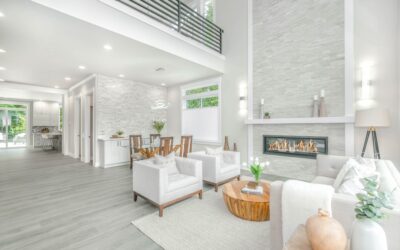
The wall around a fireplace is one of the most-viewed areas in any living room, and leaving it empty looks like an unfinished thought. Free standing cabinets next to fireplace placements add storage, balance the visual weight of the mantel, and create the polished built-in look without the cost of custom millwork. The tricky part is doing it safely. Building codes require minimum clearances from combustible materials to heat-producing appliances, and ignoring those rules can void homeowner insurance after a fire. After designing dozens of fireplace flanks for clients in homes ranging from 1920s craftsman bungalows to modern open-concept builds, I will walk you through the considerations that separate a great install from an expensive mistake.
Clearance Rules You Cannot Skip
Every fireplace has a manufacturer-required clearance from combustible materials, listed in the original installation manual or stamped on a metal plate inside the firebox.
Wood-burning masonry fireplaces typically require 12 inches of clearance from the firebox opening to any combustible material on the sides, and 6 inches at the top. Some older brick fireplaces have less restrictive requirements but check before assuming.
Gas direct-vent fireplaces vary by model. Most require 6 to 12 inches of side clearance from the glass face and 3 to 6 inches from the metal frame. Modern units like the Heat and Glo SlimLine 5 list specific dimensions on the rating plate.
Electric fireplaces have the least restrictive clearances, often just 6 inches from any combustible material. They generate radiant heat but never reach the temperatures of wood or gas units.
Measuring Your Space Correctly
Before shopping for cabinets, measure three dimensions in your room.
- Width of the wall from the side of the firebox opening to the nearest perpendicular wall
- Height of the mantel and the ceiling above
- Depth available without blocking traffic or air vents
Most cabinets that flank fireplaces measure 18 to 30 inches wide, 60 to 84 inches tall, and 16 to 24 inches deep. A common rule of thumb is to align the top of the cabinet within 6 inches of the mantel height for visual balance, but cabinets that reach to the ceiling can also look intentional when paired with deeper crown molding.
Material Choices That Survive Heat
Even at code clearances, cabinets near fireplaces experience radiant heat that affects materials over time. Some materials handle the conditions better than others.
Solid Wood
Solid hardwood (oak, maple, cherry, walnut) is the gold standard for fireplace flanks. Wood is stable at the moderate temperatures near a code-compliant install. Avoid softwoods like pine, which can darken or warp from sustained warmth.
Veneered Plywood and MDF
High-quality veneered plywood holds up well. MDF is acceptable but tends to release any moisture it has absorbed when warmed, occasionally causing trim to crack or finish to lift on units within 4 feet of an active firebox.
Painted Finishes
Latex paints can yellow or chalk under prolonged radiant heat. For cabinets near working fireplaces, choose an alkyd or oil-based enamel or a hybrid like Benjamin Moore Advance. These tolerate heat far better than standard wall paint.
Style Direction by Home Type
The right cabinet style depends on the home’s overall design language. Matching the architecture matters more than chasing trends.
Traditional and Transitional Homes
Tall, glass-front display cabinets with raised panel doors flank the fireplace beautifully. Look for cabinets with adjustable interior shelving so you can display books, pottery, or family photos. Pottery Barn, Ballard Designs, and Restoration Hardware all sell flanking pairs in the $900 to $2,200 range per unit.
Modern and Contemporary Homes
Low-slung horizontal cabinets keep the eye on the fireplace and any art above it. Try a 30 to 36-inch-tall console-style cabinet with clean flat fronts in matte black, walnut, or warm white. CB2 and West Elm both offer modern flanking pairs from $800 to $1,800 per unit.
Farmhouse and Cottage Homes
Open shelving paired with a closed base cabinet works exceptionally well in these styles. The asymmetry between solid base and airy top adds character. Magnolia Home, Crate and Barrel, and Birch Lane all offer pieces designed for this look.
Anchoring and Safety
Free standing cabinets near a fireplace should always be anchored to the wall. Heat-induced wood movement, kids climbing, or a stray bump can topple a tall cabinet, and the proximity to glass or hot surfaces makes that scenario dangerous.
Use anti-tip brackets rated for the cabinet weight. Most cabinets come with 100-pound nylon straps that screw to the back of the cabinet and into a wall stud. For taller units over 7 feet, upgrade to metal L-brackets rated for 150 to 200 pounds.
If the cabinets sit over a baseboard heat register, do not block the register. Cut a vent into the toe kick or raise the cabinet on legs to maintain airflow. Restricted airflow can cause both heating efficiency issues and overheating in nearby walls.
Lighting Inside the Cabinets
Interior lighting transforms flanking cabinets from storage to a focal point. LED puck lights or strip lighting under each shelf cost $40 to $120 and install with adhesive backing in 20 minutes. Plug-in versions skip the need for an electrician; hardwired versions require a junction box installed by a licensed electrician for $200 to $400.
Warm white (2700 to 3000 Kelvin) flatters most living room palettes. Skip cool white (4000K plus) unless the rest of the room uses cool-toned fixtures.
Common Mistakes to Avoid
The most common mistake is placing cabinets too close to the firebox without checking clearance requirements. The second is choosing cabinets that overpower the fireplace itself, drawing attention away from the architectural feature. The fireplace should remain the focal point.
A third mistake is using mismatched finishes. The mantel, cabinet trim, and any built-in shelving above should share a coherent finish family. White cabinets next to a mahogany mantel rarely looks intentional unless the rest of the room repeats both colors elsewhere.
Budgeting the Project
A pair of off-the-shelf cabinets runs $1,800 to $4,500 plus delivery and installation. Semi-custom flanking cabinets from companies like Inset by Crystal or KraftMaid cost $4,000 to $9,000 installed. Fully custom built-ins from a local cabinetmaker range from $8,000 to $25,000 depending on materials, complexity, and your region.
Free standing units offer the best value when budget is tight and the look needs to feel polished. Done right, they pass for built-ins to the casual observer and add real storage to a typically underutilized wall.