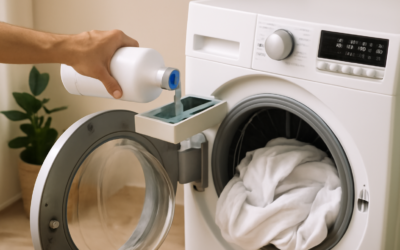
Pouring bleach straight onto a pile of white shirts is the fastest way to ruin them with yellow streaks and weak fabric. Doing it correctly is just as easy and gives you genuinely bright, crisp whites. Learning how to bleach whites in washer properly comes down to timing, dilution, and water temperature, three details that separate brilliant laundry from bleached-out, damaged clothes. Whether you have a dispenser or not, this guide walks through the right way to brighten whites without harming the fibers.
- Sort and Check Your Fabrics First
- Use the Right Amount of Bleach
- Never Pour Bleach Directly on Clothes
- Choose the Correct Water Temperature
- Add Bleach at the Right Time
- Consider Oxygen Bleach as an Alternative
- Finishing and Safety Tips
- Fixing Whites That Have Already Yellowed
- Common Mistakes to Avoid
Sort and Check Your Fabrics First
Before any bleach touches your laundry, separate true whites from off-whites, creams, and anything with colored trim. Chlorine bleach is unforgiving and will lighten patterns and pastels you intended to keep. Wash only pure whites together in the bleach load.
Just as important, read the care labels. Chlorine bleach is safe for cotton, linen, and most polyester, but it damages wool, silk, spandex, and many synthetic blends. A small triangle with lines through it on the label means no chlorine bleach. For those fabrics, reach for oxygen bleach instead, which is gentler and color-safe.
Use the Right Amount of Bleach
More bleach does not mean whiter clothes; it means weaker, yellowed fabric. The correct dose is the key to how to bleach whites in washer loads safely. For a standard top-load machine, use about three-quarters of a cup of regular liquid chlorine bleach per full load.
- Top-load standard: 3/4 cup of regular bleach per full load
- High-efficiency (HE) machines: follow the lower fill line, often about 1/3 cup
- Concentrated bleach: use roughly half the standard amount
Always check your machine’s manual and the bleach bottle, since HE washers use less water and need correspondingly less bleach to reach the same concentration.
Never Pour Bleach Directly on Clothes
This is the most important rule. Undiluted bleach hitting fabric creates permanent yellow or white spots and thin, weak patches. Bleach must always be diluted in water before it contacts your clothes.
If your machine has a bleach dispenser, that compartment dilutes the bleach automatically and releases it at the right point in the cycle. If you have no dispenser, dilute the bleach in a quart of water first, then add it to the water-filled drum before the clothes, or pour it into the running water at the start of the wash, never onto the garments themselves.
Choose the Correct Water Temperature
Temperature affects both whitening power and fabric safety. Warm water around 90 to 105 degrees Fahrenheit activates bleach effectively for most loads. Hot water boosts whitening and sanitizing for sturdy cotton like towels and sheets, but it can set certain stains and is too harsh for delicate items.
Avoid cold water with chlorine bleach, since it works slowly and less effectively at low temperatures. Match the heat to the fabric: hot for durable whites you want sanitized, warm for everyday white clothing.
Add Bleach at the Right Time
Timing within the cycle matters. Ideally, let the washer fill with water and add your detergent first, allowing it to begin loosening soil. Add the diluted bleach about five minutes into the wash cycle so the detergent has a head start, since adding both at the exact same moment can reduce the effectiveness of each.
With a dispenser, you simply fill the bleach and detergent compartments and let the machine handle the sequence. Modern dispensers are calibrated to release bleach at the optimal point automatically, which is one more reason to use them when available.
Consider Oxygen Bleach as an Alternative
If chlorine bleach feels too harsh or you are washing blended fabrics, oxygen bleach (sodium percarbonate) is a gentler choice. Brands like OxiClean brighten whites, lift stains, and are safe for most colors and fabrics, though they work more slowly and may need warm water and a longer soak to match chlorine’s punch.
For badly dingy whites, you can presoak items in a solution of oxygen bleach and warm water for an hour or more before running a normal wash. It will not match chlorine’s instant brightening on cotton, but it is far easier on fibers over the long run.
Finishing and Safety Tips
After the bleach load finishes, run an extra rinse if your machine allows it, ensuring no residue remains in the fabric. Dry whites in sunlight when possible, since UV light naturally brightens and helps eliminate any lingering bleach smell. Never mix bleach with ammonia or other cleaners, as the combination releases toxic fumes.
Once you know how to bleach whites in washer correctly, the routine is quick and reliable: sort carefully, measure the right dose, always dilute, choose the right temperature, and add bleach a few minutes into the cycle. Follow those steps and your whites will come out bright and intact, load after load.
Fixing Whites That Have Already Yellowed
If your whites have already turned dingy or yellow, a single bleach load may not fully restore them, and overusing chlorine can actually worsen yellowing. For set-in dullness, soak the items overnight in a solution of oxygen bleach and warm water before washing, which lifts gradual buildup without the harshness of repeated chlorine treatments. A scoop of laundry booster or a half cup of baking soda added to the wash also brightens results.
Yellowing often comes from detergent residue, hard-water minerals, or body oils rather than dirt. If your water is hard, adding a water softener or a splash of white vinegar to the rinse helps strip the mineral film that dulls fabric. Sun-drying gives a final natural bleaching boost that is gentle on the fibers.
Common Mistakes to Avoid
A few errors ruin more white loads than anything else. Never overload the drum, since clothes need room to move for the bleach and detergent to circulate evenly. Avoid mixing chlorine bleach with any other cleaning product, and do not leave items soaking in a strong bleach solution for hours, which weakens and yellows the fabric rather than whitening it.
- Pouring bleach directly onto dry clothes
- Using bleach on spandex, wool, silk, or “no chlorine” labeled items
- Guessing the amount instead of measuring
- Skipping the extra rinse, which leaves residue behind