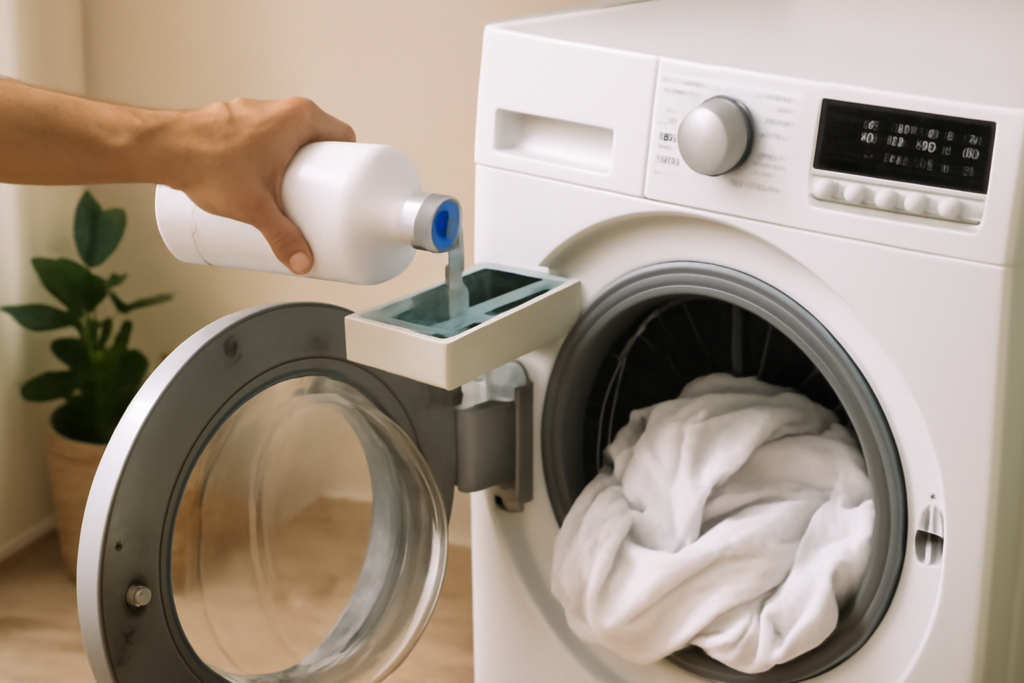
Nothing brings a graying undershirt or a dingy set of pillowcases back to life quite like a proper bleach cycle. Knowing how to bleach white clothes in washer the right way is the difference between crisp, hotel-grade whites and a load full of yellow streaks or thinned-out, weakened fabric. Most people pour a random amount straight onto the clothes and hope for the best, and that is exactly why they end up disappointed.
Bleach is a powerful oxidizer, and it does not need much help to work. A tablespoon in the wrong spot can leave a permanent pale blotch, while too little across a whole load does almost nothing. Get the dilution, timing, and water temperature right, though, and you will restore brightness that store-bought detergent alone can never touch. Here is exactly how the pros do it at home.
Know Which Whites Can Actually Take Bleach
Before you reach for the jug, check the care tag on each garment. Standard chlorine bleach, the kind sold as sodium hypochlorite at around 5 to 6 percent concentration, is safe for sturdy cottons, linens, and most cotton-poly blends. A white triangle on the label means chlorine bleach is fine. A triangle with diagonal lines means oxygen bleach only, and a solid black triangle with an X means no bleach at all.
Skip chlorine bleach entirely on spandex, wool, silk, leather, and anything labeled as containing elastane. It eats those fibers, yellows them, and can dissolve elastic waistbands over a few washes. Many “white” athletic shirts contain 10 to 15 percent spandex, so a shirt that looks like plain cotton may not survive a strong dose. When you are unsure, run a spot test: mix one teaspoon of bleach in a quarter cup of water, dab it on a hidden seam, wait one minute, and blot. If the color stays true and the fabric feels normal, you are clear to proceed.
Gather the Right Supplies First
You need regular liquid chlorine bleach, not the “splash-less” or scented gel versions. Those thickened formulas are made for surface cleaning and can leave residue or uneven whitening in laundry. A standard bottle of Clorox or a store brand at roughly 6 percent sodium hypochlorite runs about $4 to $6 per gallon and lasts for dozens of loads.
Have your regular detergent ready too, because bleach is not a substitute for it. Detergent lifts oils and dirt; bleach oxidizes stains and kills the microscopic buildup that turns whites dull. You will also want a measuring cup, since eyeballing is the number one cause of bleach damage. Old bleach loses strength, so if your bottle is more than six months past its date, buy fresh. Hypochlorite naturally degrades into salt water over about a year, which is why an old jug barely whitens.
How to Bleach White Clothes in Washer Step by Step
Sort first. Wash only whites together, and pull out anything with colored trim, printed logos, or stitched patterns that might not be colorfast. Load the machine no more than three-quarters full so the water and bleach can circulate freely. Overpacking traps garments against the drum and creates uneven exposure, which shows up as patchy brightness later.
For a top-loading washer, start the machine and let it fill with hot water, ideally 120 to 140 degrees Fahrenheit, since heat accelerates the reaction. Add your detergent, let it dissolve for a minute, then add the diluted bleach. The standard dose is two-thirds of a cup of regular-strength bleach for a full-size load. Never pour it directly onto dry fabric; instead, mix it into a quart of water first, or add it to the running water before the clothes go in. For a front-loader, use the dedicated bleach dispenser drawer, which meters the bleach into the wash at the correct point in the cycle automatically. Fill that compartment to the marked line, usually about half a cup, and let the machine handle the timing.
Choose the longest wash setting your fabric allows so the bleach has 10 to 12 minutes of contact time. That window is the sweet spot. Less than five minutes and stains survive; much longer than 15 minutes of soaking in concentrated bleach and the fibers start to weaken. When the cycle finishes, run an extra rinse to flush out every trace, then dry as usual. Line drying in direct sun adds a natural whitening boost, since ultraviolet light continues the brightening after the wash.
Getting the Dilution Right Every Time
Concentration is everything. Undiluted bleach that touches a single spot of fabric for even a few seconds can bleach it lighter than the surrounding cloth, leaving a permanent ghost mark. That is why the dilution step is non-negotiable, whether you mix it in a bucket first or rely on the dispenser drawer to do it for you.
A reliable ratio is roughly one-third cup of bleach for a small load, two-thirds cup for a large load, in a machine holding around 15 to 20 gallons of water. If your water is very hard, with high mineral content, bump the detergent slightly rather than adding more bleach, because minerals can react with hypochlorite and actually deposit a faint yellow tint. A water softener or a cup of washing soda in the load helps hard-water households get cleaner results.
Oxygen Bleach as a Gentler Alternative
When a garment cannot handle chlorine, or you simply want a milder approach, reach for oxygen bleach, sold as sodium percarbonate under names like OxiClean. It releases hydrogen peroxide in water and brightens whites without the harsh fumes or fiber damage. It is safe on most colors too, which makes it forgiving if a stray colored sock slips into the load.
Oxygen bleach works best in warm to hot water and rewards patience. For deeply grayed whites, dissolve a scoop in a sink or tub of hot water and let the items soak for two to six hours, or even overnight, before running a normal wash. It will not whiten as aggressively or as fast as chlorine, but it is far kinder to elastic, prints, and blended fabrics. Many households keep both on hand and choose based on the garment.
Common Mistakes That Ruin White Loads
The biggest error is mixing bleach with the wrong products. Never combine chlorine bleach with ammonia-based cleaners or with vinegar; the reaction releases toxic chloramine and chlorine gas that can send you to the emergency room. Keep bleach and any other laundry additive separate, and add them at different points in the cycle. If you use a fabric softener, wait for the rinse cycle, never the wash.
Another frequent problem is over-bleaching out of impatience. Running bleach on the same shirts every single wash will visibly thin the cotton within a few months, causing collars to fray and armpits to tear. Reserve full bleach loads for when whites genuinely look dull, roughly every third or fourth wash, and let detergent handle routine cleaning in between. Finally, resist the urge to add more bleach when a stain resists. Protein stains like blood, sweat, and grass often set worse under bleach and heat; treat those with an enzyme detergent or cold pre-soak first, then bleach the load once the stain is gone.
Keeping Whites Bright Between Bleach Cycles
Bleaching gets easier when your whites never sink into deep grayness in the first place. Wash them promptly rather than letting sweat and body oils oxidize in the hamper for a week, since set-in oils are what turn cotton dingy. Storing damp or dirty whites in a warm bathroom hamper is a fast track to yellowing, so keep the laundry basket somewhere dry and ventilated.
Add a scoop of oxygen bleach or a half cup of baking soda to routine warm-water washes to keep brightness up without the wear of chlorine. Every few months, run a hot maintenance wash on the empty machine with a cup of bleach to clear out the detergent scum and mildew that can transfer dinginess back onto clean clothes. Do that consistently, and full-strength bleach cycles become a rare touch-up rather than a constant battle, which extends the life of every white garment you own.