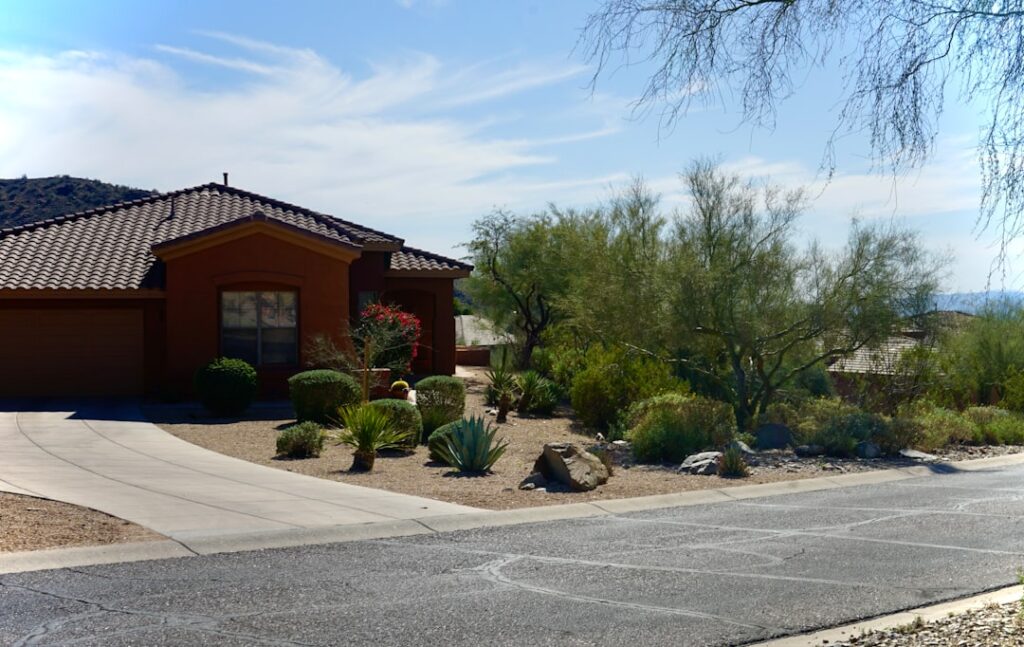
Combining stone and organic material gives you a yard that looks polished, drains well, and needs far less weekend labor than a thirsty lawn. Smart front yard rock and mulch landscape ideas lean on contrast: cool gray gravel against warm brown bark, rounded river stone beside crisp steel edging, and low evergreen shrubs anchoring the whole picture. Done right, the look holds up for years with only seasonal touch-ups.
This guide walks through design layouts, material choices, real cost ranges, plant pairings, and an installation sequence you can follow yourself. Whether you have a shaded ranch entry or a sun-baked corner lot, there is a mix here that fits your climate and budget.
Why Blend Rock and Mulch Instead of Choosing One
Rock and mulch each solve different problems, so pairing them beats committing to a single material. Gravel and stone never decompose, resist wind, and handle foot traffic near walkways and downspouts. Wood or bark mulch, on the other hand, feeds the soil, retains moisture around root balls, and keeps planting beds looking soft rather than industrial.
- Use rock in high-traffic zones, dry creek beds, driveway borders, and areas prone to erosion or splash-back.
- Use mulch directly around trees, shrubs, and perennials where soil health and water retention matter most.
- Transition between the two with steel, aluminum, or composite edging so the materials never bleed into each other.
A common ratio that reads as intentional is roughly 60 percent mulch beds to 40 percent rock features, though desert-style yards often flip that balance.
Popular Layout Ideas That Actually Work
Start with the bones of the yard before picking colors. These layouts repeat in professionally designed front yards because they solve drainage and sightline issues at the same time.
Dry Creek Bed
A meandering channel of mixed river rock (1 to 3 inch stone with a few 6 inch accent boulders) directs runoff away from the foundation while looking like a natural stream. Line it with landscape fabric, taper the width, and flank the banks with mulched drought-tolerant grasses.
Rock Border, Mulch Interior
Frame each planting bed with a 12 to 18 inch band of crushed granite or lava rock, then fill the center with shredded hardwood mulch and shrubs. The stone edge stops mulch from washing onto the sidewalk and gives a clean, finished line.
Foundation Strip Refresh
Along the front wall of the house, run a narrow gravel strip under the drip line to prevent soil splash on siding, then step out into a mulched bed of boxwood, hydrangea, or ornamental grass. This is the fastest single-day upgrade for curb appeal.
Island Beds and Boulder Clusters
Set groups of three or five boulders of varying size in a sea of decorative rock, with a mulched pocket at the base of each cluster for a specimen plant. Odd numbers always look more natural than pairs or rows.
Choosing the Right Rock
Stone comes in a wide range of colors and sizes, and the choice affects both price and function. Match the rock tone to your home’s trim and roof for a cohesive result.
- River rock (1-3 in): smooth, rounded, great for creek beds. About $50 to $90 per cubic yard, or $0.05 to $0.35 per pound in bags.
- Crushed granite / decomposed granite: compacts into a firm surface for paths, roughly $40 to $70 per cubic yard.
- Lava rock: lightweight, porous, holds heat; good in beds, around $100 to $180 per cubic yard.
- Pea gravel: small and walkable, $30 to $60 per cubic yard.
- Mexican beach pebble: premium accent stone, $200 to $500 per cubic yard.
Choosing the Right Mulch
Organic mulch breaks down over 1 to 3 years and needs periodic topping up, but it does the most for plant health. Inorganic options last longer at a higher upfront cost.
- Shredded hardwood: knits together and resists washout, about $30 to $45 per cubic yard bulk.
- Cedar or cypress: naturally rot-resistant with pleasant color, $40 to $60 per cubic yard.
- Dyed mulch (black, brown, red): holds color 8 to 12 months, $35 to $50 per cubic yard.
- Rubber mulch: inorganic, lasts a decade, $8 to $14 per bag but not soil-friendly.
Apply mulch 2 to 3 inches deep, and always keep it a few inches back from tree trunks and stems to avoid rot and pests.
Plant Pairings for a Low-Maintenance Look
The magic of these front yard rock and mulch landscape ideas is that the plants do the softening while the hardscape does the heavy lifting. Choose species matched to your USDA zone and sun exposure.
- Full sun, dry: blue fescue, agave, yucca, lavender, sedum, Russian sage.
- Part shade: hostas, ferns, hydrangea, heuchera, boxwood.
- Structure and evergreen bones: dwarf junipers, arborvitae, ornamental grasses like Karl Foerster.
- Seasonal color: black-eyed Susan, coneflower, daylily, and spring bulbs tucked into mulch pockets.
Cluster plants in groups and repeat two or three species across the yard for rhythm rather than a scattered, one-of-everything effect.
Step-by-Step Installation
- Plan and mark: lay a garden hose to outline beds and creek beds, then spray landscape paint along the line.
- Clear and grade: remove sod and weeds, then slope soil slightly away from the house for drainage.
- Install edging: set steel or composite edging between rock and mulch zones.
- Lay fabric: use woven landscape fabric under rock areas; skip heavy fabric under mulch beds where you want soil to breathe.
- Set boulders and plants first: place large stones and root balls before filling, since moving them later is a chore.
- Spread material: add 2 to 3 inches of rock or mulch, raking to an even surface.
- Water and settle: rinse dust off stone and water in new plants.
Budget and Cost Expectations
For a typical 400 to 600 square foot front yard, a DIY rock-and-mulch makeover runs about $600 to $2,500 in materials depending on stone choice. Hiring a landscaper for design, delivery, and installation usually lands between $8 and $20 per square foot, so the same yard might cost $3,500 to $10,000 professionally installed. Delivery fees for bulk material add $50 to $150 per load, and renting a mini-skid steer for a day runs $250 to $400.
Maintenance Tips to Keep It Sharp
- Top up organic mulch once a year, usually in spring, to restore depth and color.
- Rake gravel occasionally and blow leaves off before they decompose into the stone.
- Spot-treat weeds early; a pre-emergent in spring dramatically cuts new growth.
- Refresh edging lines each season so the rock-to-mulch transitions stay crisp.
Frequently Asked Questions
Should I put landscape fabric under both rock and mulch?
Use woven fabric under rock to keep stones from sinking into soil. Under mulch beds, skip it or use a light layer, since heavy fabric blocks the nutrients that make mulch worthwhile.
How deep should rock and mulch be?
Spread decorative rock about 2 to 3 inches deep and mulch 2 to 3 inches as well. Deeper rock wastes material, while thinner mulch lets weeds and sunlight through.
Which is cheaper, rock or mulch?
Mulch is cheaper to install but must be replaced every year or two. Rock costs more upfront yet lasts indefinitely, so it often wins over a 5 to 10 year horizon.
Can I combine rock and mulch without them mixing?
Yes. Install rigid edging between the two zones and keep a clean grade line. The edging is the single most important detail for a professional finish.
With a thoughtful layout, matched materials, and the right plants, a rock and mulch front yard delivers standout curb appeal on a maintenance schedule you will actually keep.