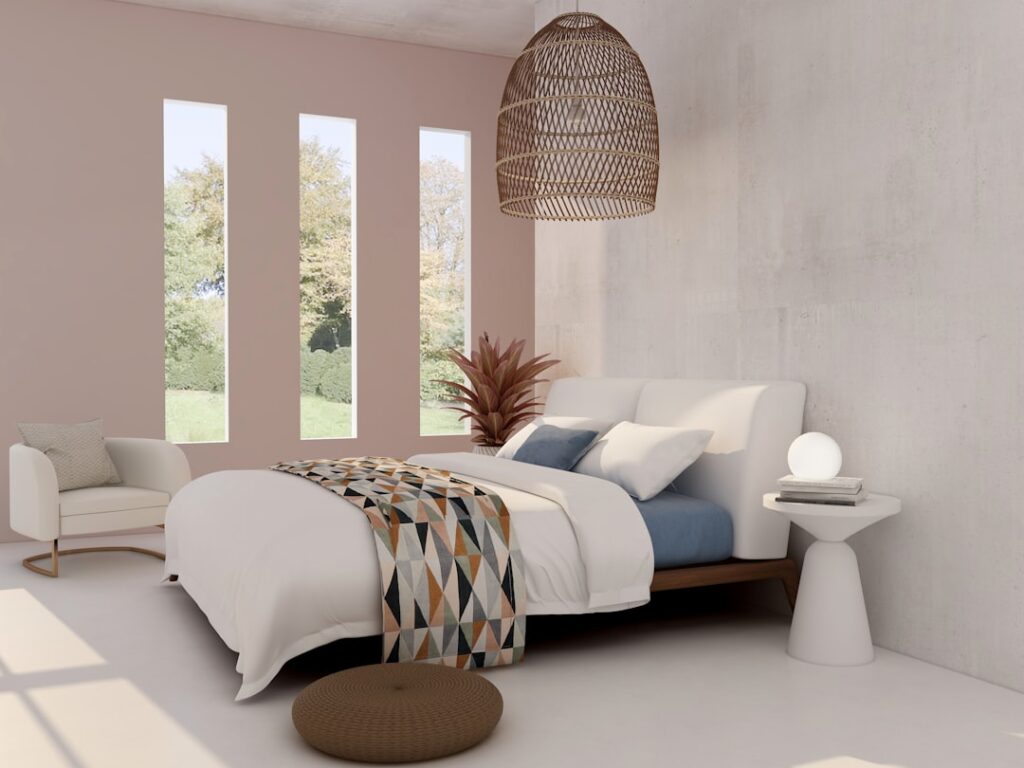
The biggest mistake homeowners make with gray is treating it like a single color. It isn’t. Choosing gray paint for bedroom walls means navigating dozens of undertones that shift dramatically depending on your light, your flooring, and the time of day. A swatch that looks like soft greige at the paint counter can turn cold and bluish on a north-facing wall at 7 a.m. Get the undertone right and gray becomes the most forgiving, restful backdrop in the house. Get it wrong and your bedroom feels like a parking garage.
This guide walks you through warm versus cool grays, the specific shades pros reach for again and again, the right sheen for a bedroom, and how to test colors before you commit a single gallon.
Warm Gray vs. Cool Gray: The Decision That Matters Most
Every gray leans one direction. Warm grays carry undertones of beige, taupe, or even a whisper of green, which makes them read cozy and inviting. Cool grays lean blue, purple, or steel, giving a crisp, modern, sometimes clinical feel. For a bedroom, where you want calm rather than sterile, most designers steer toward warm or true neutral grays.
Your room’s natural light decides which way to push. North-facing bedrooms get flat, bluish light all day, so a cool gray there will feel even colder. Counter it with a warm greige. South- and west-facing rooms flood with warm light, so they can handle a cooler gray without feeling icy. East-facing rooms get bright morning light that fades by afternoon, making them the trickiest to predict.
Top Gray Paint Shades Pros Trust
Rather than gamble on a random chip, start with proven performers. These shades have earned their reputation in thousands of real bedrooms:
- Sherwin-Williams Repose Gray (SW 7015): A warm greige with a light reflectance value (LRV) of 58. The most popular bedroom gray in America for a reason. It flexes warm or cool depending on light.
- Benjamin Moore Gray Owl (OC-52): LRV of 65, soft with a faint green undertone. Reads almost like a pale neutral in bright rooms.
- Sherwin-Williams Agreeable Gray (SW 7029): A true greige at LRV 60. Slightly warmer than Repose, excellent for north-facing spaces.
- Benjamin Moore Stonington Gray (HC-170): A cooler gray with blue undertones, LRV 59. Perfect for sun-drenched rooms that can take the chill.
- Behr Silver Drop (790C-2): A budget-friendly, light warm gray that pairs beautifully with white trim.
That LRV number is your secret weapon. It runs from 0 (black) to 100 (pure white). For a bedroom you want soft and airy, aim for an LRV between 55 and 70. Anything below 45 reads as a true mid-tone gray and can shrink a small room.
Light Gray, Mid Gray, or Charcoal?
Depth changes the entire mood. Light grays (LRV 60+) keep a small bedroom feeling open and are nearly impossible to get wrong. Mid-tone grays (LRV 35–55) add coziness and pair well with crisp white bedding and trim. Charcoal and deep grays (LRV under 25) make a bold, hotel-suite statement, especially on a single accent wall behind the headboard.
If you have a 10-by-12-foot bedroom with one window, lean light. If you have generous square footage and tall ceilings, a deep charcoal accent wall adds drama without making the room feel like a cave.
Choosing the Right Sheen for Bedroom Walls
Sheen affects both look and durability. Bedrooms see low traffic, so you don’t need the scrubbable finishes a kitchen demands. Here’s the breakdown:
- Flat/Matte: Best for bedroom walls. Hides drywall imperfections and gives gray that soft, velvety depth.
- Eggshell: A slight sheen, easier to wipe down. A safe choice if you have kids or pets.
- Satin: Reserve for trim, doors, and baseboards, not the main walls.
- Semi-gloss: Trim and window casings only.
For most adult bedrooms, a matte or eggshell wall paired with semi-gloss white trim is the classic combination. Expect to pay $45–$75 per gallon for a quality interior paint like Sherwin-Williams Emerald or Benjamin Moore Regal Select, with one gallon covering roughly 350–400 square feet.
Test Before You Commit
Never buy gallons off a tiny paint chip. Buy sample pots, around $6 each, or peel-and-stick samples from Samplize for about $6 to $8. Paint a two-foot square on at least two different walls, since light hits each wall differently. Live with it for a full 48 hours and check it at dawn, midday, and under your bedside lamp at night.
Pay attention to how the gray behaves under your specific bulbs. Warm-white LEDs at 2700K make grays read cozier; cool-white bulbs at 4000K push them blue. Many homeowners change their bulb temperature and suddenly love a gray they almost rejected.
Pairing Gray with Trim, Flooring, and Decor
Gray plays well with nearly everything, which is why it endures. Pair warm grays with creamy whites like Benjamin Moore White Dove for trim, and cooler grays with bright whites like Chantilly Lace. For flooring, warm gray walls flatter honey-toned oak and natural wood, while cool grays suit gray-washed LVP and white-oak engineered planks.
Add warmth back through textiles. A gray bedroom can feel flat without layered texture, so bring in a chunky knit throw, linen bedding, and a wood nightstand. Brass or matte-black hardware gives the room a finished, intentional look rather than a builder-grade blank slate.
Final Tips for a Gray Bedroom That Works
Stick to one gray for the main walls and resist the urge to mix three different grays in one room. Trust the LRV and undertone over the name on the can. And always, always sample first. Gray rewards patience: when the undertone aligns with your light and your furnishings, it becomes a quiet, sophisticated backdrop you’ll happily wake up to for years.