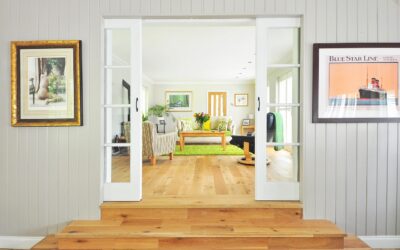
The grey hardwood trend that exploded around 2018 hasn’t faded the way most color cycles do. If anything, it’s matured — moving from cool, monochrome ash tones toward smokier, more layered greys with a warmer undertone. Grey engineered flooring now accounts for roughly a quarter of new hardwood installs in renovation projects across the US. This buying guide breaks down the finishes, the brands worth specifying, the install methods that suit each subfloor, and the pricing tiers you can plan against.
How Engineered Floors Become Grey
There are three primary methods, and each delivers a different visual:
- Smoked or fumed: Oak is exposed to ammonia vapor, which reacts with tannins and darkens the wood from the inside out. Produces deep, organic greys that won’t fade. Premium pricing.
- Reactive stain: Iron or vinegar-based stains create chemical reactions with tannins for grey-brown tones. Slightly more uniform than fuming.
- Surface stain plus lacquer: Standard pigmented stain wiped onto the wear layer and sealed. Most affordable but can scratch through to show the natural wood color underneath.
If longevity matters, fumed and reactive stains hold up far better than surface treatments because the color penetrates millimeters into the wear layer. A scratch through a surface-stained grey reveals raw tan oak; a scratch through fumed oak shows grey all the way down.
Wear Layer and Construction Quality
Engineered boards stack a hardwood face over a multi-ply or HDF core. The wear-layer thickness governs how many times the floor can be sanded and refinished. For grey engineered planks, this matters more than usual because fashion-forward colors might need refinishing into a different tone after 15 years.
- 2mm wear layer: Budget tier, cannot be sanded effectively. £30 to £45 per sq m / $3 to $4.50 per sq ft.
- 4mm wear layer: Mid-range, can be sanded once or twice. $5 to $7 per sq ft.
- 6mm wear layer: Premium, sandable 2 to 3 times. $7 to $10 per sq ft.
- 6mm+ over multi-ply birch: Heritage tier, decades of service life. $9 to $14 per sq ft.
Avoid HDF-core engineered if you’re installing in a kitchen or near a bathroom. The fiber core swells aggressively when wet. Multi-ply birch or poplar cores tolerate occasional moisture far better.
Brands Worth Specifying
Several manufacturers have built strong grey collections backed by quality engineering. The most-specified in North American showrooms include:
- Kahrs: Swedish maker, exceptional reactive-grey and smoked SKUs like the Da Capo Stenhus and Artisan Concrete. $8 to $12 per sq ft.
- Boen: Norwegian engineered specialist, Live Pure finishes give natural matte greys. $7 to $11 per sq ft.
- Mirage: Quebec mill with consistent quality control and deep grey palette. $7 to $10 per sq ft.
- Mohawk RevWood Premier: Budget grey wood-look composites for under $4 per sq ft.
- Hallmark Floors: Hand-scraped grey character grades, $6 to $9 per sq ft.
Skip generic private-label grey planks unless you’ve inspected a sample in your actual lighting. Cheap surface-stained grey often looks purple or muddy under warm LED, and showrooms typically use neutral 4000K daylight LEDs that flatter the product.
Plank Width Changes the Whole Room
Grey has a magnifying effect on plank proportions. Narrow 3 inch strips in grey can feel cold and busy, while 7 to 9 inch wide planks read as calm, contemporary, and intentional. Most current grey engineered SKUs ship in 190mm to 240mm widths (roughly 7.5 to 9.5 inches), with lengths from 1,200mm up to 2,200mm.
Wider boards demand a flatter subfloor. The tolerance for 9 inch grey oak is typically 3/16 inch flatness over a 10 foot radius. Anything worse and the boards will cup, gap, or fail the manufacturer’s warranty inspection.
Where Grey Works and Where It Doesn’t
Grey engineered floors look stunning in north-facing rooms with cool natural light, in modern kitchens with white or navy cabinets, and in open-plan living spaces with concrete or stone accents. They pair beautifully with brass, matte black, and warm leather upholstery — the contrast keeps the room from feeling clinical.
Where they struggle: heavily wooded southern exposures where warm afternoon sun makes the grey read as drab brown, and traditional colonial or craftsman interiors where the cool tone fights the warm trim and brick. If your home leans transitional or contemporary, grey wins. If it’s classic, consider warmer oiled finishes instead.
Installation Method by Subfloor
Engineered boards offer three installation paths, and the subfloor determines which one fits:
- Click-lock floating: Over plywood, concrete with vapor barrier, or existing vinyl. Fastest install. No nails or glue. Suitable up to 22 inch board widths.
- Glue-down: Mandatory for solid concrete subfloors, recommended for radiant heat. Use polyurethane adhesive like Bostik’s Best or Sika MB. Adds $2 to $4 per sq ft to labor.
- Staple or nail-down: Over plywood subfloor only. Fastest of the three for skilled installers, $3 to $5 per sq ft labor.
Moisture testing the subfloor is non-negotiable. Concrete must read below 4 percent moisture content using a calcium chloride test (ASTM F1869) or below 75 percent relative humidity via in-situ probe (ASTM F2170). Plywood should be below 12 percent. Skipping the test voids most manufacturer warranties.
Care and Long-Term Aging
Grey engineered floors show dust and pet hair more than warmer tones — that’s the trade-off for the bold look. Daily microfiber dust mopping keeps maintenance under control. For deeper cleaning, use a pH-neutral wood cleaner like Bona Pro Series Hardwood Cleaner or Loba CareFinish. Avoid steam mops, soap-based cleaners, and anything ammonia-based, which can dull the finish over time. A quality grey engineered floor installed properly will outlast its color trend by decades, and when you’re ready for a refresh, a 4mm or 6mm wear layer gives you the option to refinish into whatever the next era calls for.
Prefer to explore on your own?
See how new flooring looks in your actual room in seconds — free, no signup.
Try the free Floor Studio →