A humble galvanized floor flange is one of the most useful fittings you can keep in a workshop, doing double duty as both a plumbing anchor and the backbone of industrial-style furniture. Because a galvanized floor flange carries a zinc coating that resists rust, it holds up in damp basements, outdoor railings, and utility rooms far better than bare steel. This guide breaks down sizes, thread standards, real-world load limits, and how to install one so it stays tight for good.
- What a Floor Flange Does
- Common Sizes and What They Fit
- Understanding the Threads
- Load Ratings and Safety
- How to Install a Galvanized Floor Flange
- Cleaning, Sealing, and the DIY Look
- Building Furniture With Pipe and Flanges
- Troubleshooting Loose or Wobbly Flanges
- Galvanized Versus Black and Stainless
What a Floor Flange Does
A floor flange is a round metal plate with a threaded center hole and several bolt holes around the rim. You thread a pipe into the center and screw the plate down to a floor, wall, or bench, giving the pipe a stable, perpendicular base. Plumbers have used them for a century to anchor risers and stub-outs, but the fitting exploded in popularity for DIY projects like pipe shelving, desk legs, clothing racks, and handrails.
The galvanized version is simply a malleable iron or cast steel flange dipped in or plated with zinc. That coating is the whole point: it sacrifices itself slowly to protect the iron underneath, which is why galvanized fittings survive moisture that would rust black pipe in a season.
Common Sizes and What They Fit
Floor flanges are sized by the pipe thread they accept, not the diameter of the plate. The plate is always larger. Here are the sizes homeowners reach for most:
- 1/2-inch: Plate roughly 2-3/4 inches across. Light-duty shelving and small decor.
- 3/4-inch: Plate about 3-1/4 inches. A good middle ground for medium shelves and racks.
- 1-inch: Plate near 4-1/4 inches. The go-to for sturdy furniture legs and handrails.
- 1-1/4 and 1-1/2 inch: Heavy structural work, industrial tables, and load-bearing railings.
Remember that nominal pipe sizes do not match the physical measurement. A “1-inch” flange fits pipe with an outside diameter closer to 1.3 inches. When you buy pipe and flanges from the same aisle in the same size, they thread together correctly.
Understanding the Threads
Nearly all galvanized floor flanges in the US use NPT, or National Pipe Tapered thread. The taper means the threads wedge tighter as you turn the pipe in, creating a mechanical seal. For furniture that seal does not matter, but for anything carrying water you must add thread sealant tape or pipe dope to make the joint leak-free.
Do not force a galvanized flange onto black pipe threads that were cut differently, and never mix NPT with the straight threads found on some imported decor kits. Cross-threading a malleable iron flange strips the soft metal quickly, and once the first few threads are chewed up the joint will never sit square.
Load Ratings and Safety
People routinely underestimate how strong these fittings are and overestimate how strong their mounting surface is. A 3/4-inch malleable iron floor flange itself can handle well over 100 pounds of static load, but the real limit is almost always the fasteners and the material you screw into. Four #12 wood screws driven into a solid 2x wood joist hold vastly more than the same screws in 1/2-inch drywall, which will pull out under almost any weight.
For shelving that will hold books or tools, hit studs or use heavy toggle anchors rated for the load, and treat each flange as one of several support points rather than the sole anchor. For any handrail or grab application where a fall is possible, upsize to a 1-inch flange, bolt through the material with machine bolts and backing washers, and do not rely on wood screws into a hollow wall.
How to Install a Galvanized Floor Flange
Installation is straightforward with basic tools. Here is the reliable sequence:
- Wipe the flange with a rag; new galvanized fittings often carry an oily film from manufacturing that attracts grime.
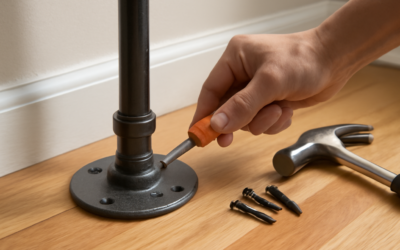
- Thread the pipe into the flange hand-tight, then give it a firm turn with a pipe wrench until it sits square and snug.
- Hold the plate flat against the mounting surface and mark the bolt holes with a pencil or awl.
- Drill pilot holes sized to your fasteners; for wood, a 1/8-inch pilot suits most #10 to #12 screws.
- Drive the fasteners, checking that the pipe stays perpendicular as you tighten in a cross pattern.
- Give the assembly a firm push to confirm there is no rock or flex before loading it.
For plumbing use, apply three to five wraps of PTFE tape clockwise on the pipe threads before threading in, then snug the joint and pressure-test for weeping.
Cleaning, Sealing, and the DIY Look
Straight from the store, galvanized flanges wear a mottled gray spangle finish and that manufacturing oil. If you want a cleaner industrial look, degrease the fitting with acetone or a strong dish soap and let it dry fully. Some builders leave the raw galvanized surface for a utilitarian vibe; others spray a clear matte lacquer to lock the finish and stop the slight dulling that happens as zinc oxidizes.
Avoid welding or heavily grinding galvanized fittings indoors. Burning the zinc coating releases fumes that cause metal-fume fever, a genuine health hazard. For furniture, mechanical assembly with pipe and fittings avoids that risk entirely, which is a big reason the threaded-pipe look became so popular.
Building Furniture With Pipe and Flanges
The industrial pipe look owes its popularity to how forgiving the parts are. A basic shelf bracket takes one floor flange, a short nipple, and an elbow, all threaded together by hand and mounted to a stud. Because everything is modular, you can build a whole bookshelf, a coat rack, or a rolling cart from the same handful of fitting types in different lengths.
Plan your cut list before buying, since pre-threaded nipples come in fixed lengths like 2, 4, 6, and 12 inches. For a floor-standing table leg, pair a flange at the top under the tabletop with another at the bottom as a foot, connected by a length of pipe. That top-and-bottom flange pattern gives the piece a stable footprint and keeps the pipe from twisting loose under weight, which is the classic mistake with single-flange designs.
Troubleshooting Loose or Wobbly Flanges
A flange that will not stop rocking almost always traces to one of three causes. First, check the mounting surface; screws in drywall or a cracked stud will never hold, so relocate to solid wood or add a plywood backer. Second, confirm the pipe is threaded fully home and square, because a pipe that bottoms out crooked tilts the whole assembly.
Third, look at the fasteners themselves. Undersized screws in oversized pilot holes strip out under load; step up a size or move to bolts with backing washers. If a threaded joint keeps loosening on a rack that gets bumped, a drop of removable thread locker on the pipe threads holds it in place without gluing it permanently. Address the root cause rather than just cranking the wrench harder, which only chews up the soft malleable iron.
Galvanized Versus Black and Stainless
Choosing the right flange comes down to environment and appearance. Black iron flanges cost a bit less and give a darker, moodier aesthetic, but they rust readily anywhere there is moisture, so keep them in dry indoor spaces or plan to seal them. Stainless steel resists corrosion best of all and looks bright and modern, but it costs two to four times more than galvanized.
For most homeowners, a galvanized floor flange hits the sweet spot: strong, rust-resistant, widely stocked, and priced around $3 to $8 for common sizes at any hardware store. Match the size to your pipe, anchor it into something solid, and it will serve reliably for years whether it is holding a shelf of tools or the leg of a workbench.
Prefer to explore on your own?
See how new flooring looks in your actual room in seconds — free, no signup.
Try the free Floor Studio →