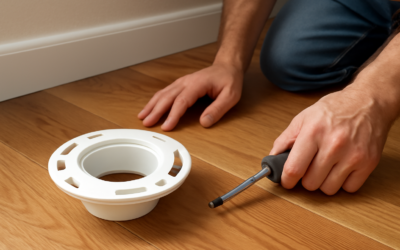
That mysterious wobble in your toilet usually traces back to a part you have never seen. A floor flange, also called a closet flange, is the round fitting that connects the bottom of a toilet to the drain pipe and bolts the whole fixture securely to the floor. It is a small, unglamorous component, but when it fails, you get a rocking toilet, sewer smells, and sometimes a slow leak rotting the subfloor beneath the bathroom. Understanding how it works makes the difference between a confident DIY repair and an expensive surprise.
What a Floor Flange Does
The flange performs two jobs at once. First, it joins the toilet to the drain pipe in the floor, creating the sealed pathway waste travels through. Second, it provides the anchor points, two slots that hold the closet bolts, which clamp the toilet down tight against the wax ring or rubber gasket. When the flange is solid and at the right height, the toilet sits rock-steady and the seal stays watertight. When it is cracked, corroded, or set too low, that seal breaks down and trouble follows.
Common Types of Floor Flanges
Flanges come in several materials, and the right one depends on your existing plumbing.
- PVC: Lightweight, inexpensive, and the standard for modern homes with plastic drain lines. Easy to glue onto PVC pipe.
- ABS: The black plastic equivalent, used where the drain system is ABS.
- Cast iron: Found in older homes with cast-iron waste lines. Durable but prone to rust over decades.
- Brass: Often paired with metal rings, corrosion-resistant and long-lasting.
- Stainless or metal repair rings: Used to reinforce or rebuild a damaged flange without replacing the whole thing.
The All-Important Height
If there is one rule that governs whether a toilet seals correctly, it is flange height. The flange should sit on top of the finished floor, with the bottom of its ring resting flush on the surface, so the toilet’s wax ring can compress properly. The ideal position puts the top of the flange roughly level with the finished floor, give or take. A flange set too low, often the result of new flooring being installed over the old, leaves a gap that the wax ring cannot bridge, leading to leaks. A flange set too high can crack the toilet base or prevent it from sitting flat.
When flooring height changes, the fix is a flange extender or spacer ring rather than stacking two wax rings, which is an unreliable shortcut.
Signs Your Floor Flange Is Failing
A failing flange announces itself in a few predictable ways. Watch for these warning signs.
- A toilet that rocks or shifts when you sit or lean.
- Water pooling around the base of the toilet.
- A persistent sewer-gas odor in the bathroom.
- Closet bolts that spin freely and will not tighten.
- Visible cracks, rust, or broken ears on the flange ring.
Ignoring these leads to water seeping under the toilet and damaging the subfloor, which is a far bigger repair than the flange itself.
How to Replace a Floor Flange
Replacing a flange is a manageable weekend job for a confident DIYer, though it does require removing the toilet.
- Shut off and drain: Turn off the water supply, flush, and sponge out the remaining water in the tank and bowl.
- Remove the toilet: Disconnect the supply line, unbolt the closet bolts, and lift the toilet off, setting it on an old towel.
- Clean the area: Scrape away the old wax ring and inspect the flange and the subfloor for damage.
- Remove the old flange: Unscrew or cut it free depending on the type. PVC flanges are often cut and replaced with a repair coupling.
- Install the new flange: Set it level with the finished floor, secure it to the subfloor with corrosion-resistant screws, and connect it to the drain.
- Reset the toilet: Place a new wax ring or rubber gasket, set the toilet over the bolts, press down evenly, and tighten the nuts gently and alternately.
Repairing Instead of Replacing
You do not always have to rip out the whole flange. If only the bolt slots have broken off but the pipe connection is sound, a metal repair ring screwed over the existing flange restores solid anchor points in minutes. For a flange that sits slightly too low after new flooring, a stackable spacer ring kit raises it to the right height with a fresh gasket. These partial fixes are far less invasive than a full replacement and solve the most common failure, broken ears, without touching the drain line.
Avoiding the Most Common Mistakes
The mistakes that cause repeat leaks are easy to avoid once you know them. Do not overtighten the closet bolts, which cracks porcelain; snug them firmly but stop the moment the toilet stops rocking. Never stack multiple wax rings to make up for a low flange, because they shift and fail; use a proper extender instead. Always make sure the flange is screwed down to the subfloor, not just resting in place. And replace the wax ring every time you pull the toilet, since the old one will not reseal reliably.
Choosing the Right Flange for Your Pipe
Matching the flange to your existing drain is what keeps a repair watertight, so identify your pipe before buying. PVC drain lines, the white plastic common in newer homes, take a PVC flange that glues on with solvent cement. Black ABS pipe takes an ABS flange. Older homes may have cast-iron or even lead pipe at the closet bend, which calls for a flange designed to fit or convert that connection. Flanges also come with different ring materials, an all-plastic ring is fine in many cases, while a stainless or brass metal ring resists breaking when you tighten the bolts. When in doubt, take a photo or a measurement to the store, or choose a repair-style flange designed to fit inside or over your existing pipe.
Keeping a Flange Trouble-Free
A little attention prevents most flange problems before they start. Whenever you have the toilet off for any reason, take a moment to inspect the flange for cracks, corrosion, and broken bolt ears, and replace the wax ring as a matter of course. If you ever notice the toilet beginning to rock, address it promptly rather than living with it, because a moving toilet slowly grinds the wax ring and eventually breaks the seal. Adding new flooring? Plan for the flange height before tiling, so you do not bury the flange too low and create a leak you will have to chase later. A flange that sits at the right height on a clean, solid subfloor simply does its job for decades without complaint.
When to Call a Pro
Many flange repairs are well within reach of a handy homeowner, but some situations call for a plumber. A cast-iron flange fused to old cast-iron pipe can be difficult and messy to remove. Significant subfloor rot under the toilet means structural repair before the flange even matters. And if you discover the drain pipe itself is damaged below the flange, that is plumbing work best left to a professional. For the everyday rocking toilet or broken bolt ear, though, the floor flange is a fixable problem that saves you a service call when you understand how it works.
Prefer to explore on your own?
See how new flooring looks in your actual room in seconds — free, no signup.
Try the free Floor Studio →