
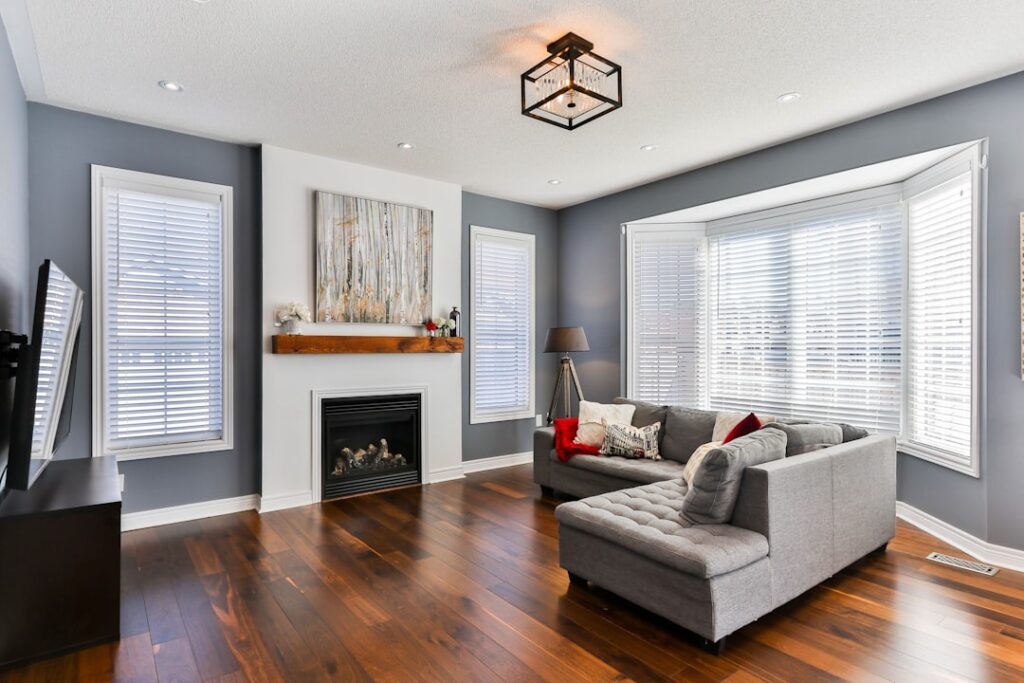
The Montreal climate is the worst-case scenario for solid wood floors. Indoor relative humidity swings from 20% in January to 65% in July, a range that causes hardwood to gain and lose roughly 1% of its width each season. Hardwood flooring Montreal homeowners install needs to be selected with that swing in mind, or the result is gapping in winter and cupping in summer. The good news is that domestic Canadian species, properly acclimated and properly finished, handle the cycle better than the imported tropicals that worked in milder climates. The wrong species in a Montreal triplex looks defeated within three years. The right species lasts a hundred.
- The Montreal Humidity Problem in Detail
- Best Species for Montreal Climate
- Solid vs Engineered: The Montreal Decision
- Finish Choices That Hold Up
- Installation Methods in Montreal Construction
- Sound Transmission and Building Codes
- Local Brands and Where to Buy
- Pricing in Montreal 2026
- Final Recommendations
The Montreal Humidity Problem in Detail
Montreal winters are dry — forced-air furnaces drop indoor RH below 20% by January in most homes without humidifiers. Summers are humid — outdoor dew points often hit 70 degrees F, and without air conditioning indoor RH climbs to 65%. That range is the worst conditions a wood floor sees anywhere in North America.
The acceptable range for stable hardwood is 30-50% RH. Hitting that range in Montreal requires a whole-house humidifier in winter and either central AC or a dehumidifier in summer. Without one or both, dimensional movement in any species exceeds the engineering tolerance of the planks.
Best Species for Montreal Climate
Three native Canadian species perform best in the local climate and are widely stocked at Montreal flooring dealers like Plancher Mercier, Boa-Franc, and Lauzon Distinctive Hardwood.
- Hard maple: 1,450 Janka, tight grain, narrow seasonal movement. The Quebec lumberyard default.
- Red oak: 1,290 Janka, wider grain, slightly more movement than maple, accepts stain better.
- White oak: 1,360 Janka, more weather-resistant than red oak, the most popular choice in 2026.
- Yellow birch: 1,260 Janka, the historic Quebec floor, often used in pre-war duplex restorations.
Avoid Brazilian cherry, teak, and other tropical imports in Montreal. The dramatic humidity swings cause cupping in summer and visible gaps in winter that no amount of finish can hide.
Solid vs Engineered: The Montreal Decision
Solid 3/4 in hardwood is the traditional Montreal choice, particularly for above-grade applications in single-family homes and duplexes. It can be sanded three to four times over a century, which matches the lifespan of many Plateau and Mile End buildings.
Engineered hardwood is the better choice for condominiums, basement apartments, and any installation over a concrete slab. The cross-ply core resists seasonal movement better than solid wood, and the 4 mm wear layer products from Boa-Franc Mirage Sweet Memories or Lauzon Designer collection can still be sanded once for a refresh.
Finish Choices That Hold Up
Site-finished hardwood (sanded and sealed in place after installation) gives the most uniform appearance and allows custom stain. The downside is dust, time (typically 5-7 days from start to finish), and VOC exposure during the cure. Most Montreal installers use water-based polyurethane from Bona, which is low-VOC and cures fast enough to handle winter installations.
Factory-finished hardwood arrives pre-stained and sealed with aluminum-oxide-fortified polyurethane that is significantly harder than any site-applied finish. Boa-Franc’s DuraMatt and Lauzon’s Pure Genius are the local benchmarks. The trade-off is a small bevel between each plank that some homeowners dislike visually, and limited color customization.
Installation Methods in Montreal Construction
Most pre-1970 Montreal homes have plywood or board subfloors over wood joists, which accept nail-down installation. Use 1 1/2 in to 2 in cleat nails every 6 in on perimeter, 8-10 in in the field. The original tongue-and-groove subfloor boards in many century-old homes can be installed over directly with no plywood overlay, saving height.
Condos in downtown Montreal almost always have concrete slabs, which require glue-down or floating engineered installation. Glue-down with a urethane adhesive like Mapei Ultrabond ECO 980 produces the firmest underfoot feel. Floating engineered with a 3 mm cork-rubber underlayment passes most condo board sound transmission requirements.
Sound Transmission and Building Codes
Montreal condo associations almost universally require an Impact Insulation Class (IIC) rating of 55 or better and a Sound Transmission Class (STC) of 55 or better between units. Achieving those ratings with hardwood flooring requires a high-performance acoustic underlayment.
- Mapei Mapesonic 2: 70 mil rubber, IIC 65, STC 60. The Montreal condo default.
- Proflex 90: peel-and-stick rubber sheet, IIC 64, STC 59. Easier DIY install.
- Maxxon Acousti-Mat: 1/4 in mat plus gypcrete pour, IIC 67. Used in higher-end conversions.
Confirm with your condo’s declaration which products are approved before purchase. Some buildings have specific brand requirements, and installing the wrong underlayment voids the warranty and triggers a removal order.
Local Brands and Where to Buy
Three Quebec manufacturers dominate the local market, and buying local means shorter shipping, easier warranty service, and species sourced from Quebec sugarbushes.
Boa-Franc, manufactured in Saint-Georges-de-Beauce, sells under the Mirage brand. The most established Quebec brand, with the broadest distribution in Montreal. Lauzon, based in Papineauville, offers the Pure Genius air-purifying finish. Plancher Mercier, based in Drummondville, is the oldest of the three with the widest species range. All three are stocked at Reno-Depot, Rona, and independent flooring stores throughout the metropolitan area.
Pricing in Montreal 2026
Hardwood flooring Montreal prices have risen with global lumber costs but remain competitive. Expect the following per square foot, material only:
- Domestic maple or red oak, 3 1/4 in: $5-$6.50
- White oak, 4-5 in widths: $6.50-$8.50
- Yellow birch, 3-4 in: $5.50-$7
- Engineered Mirage 5 in: $7-$10
- Wide-plank European white oak: $10-$14
Installation labor runs $3-$5 per sq ft for nail-down, $4-$6 per sq ft for glue-down or floating. Site-finishing adds $3-$4 per sq ft to factory-prefinished prices.
Final Recommendations
For most Montreal homes, the smart specification is engineered white oak with a factory aluminum-oxide finish, 5 in width, 4 mm wear layer, installed glue-down over slab or nail-down over plywood. Domestic Quebec manufacturers deliver better value than imported European products. Budget for whole-house humidification and dehumidification — the floor is only as good as the climate control around it. Hardwood flooring Montreal homeowners select with these constraints in mind will see a century of service from a well-installed floor.
Prefer to explore on your own?
See how new flooring looks in your actual room in seconds — free, no signup.
Try the free Floor Studio →

