A floor made from industrial hemp stalks compressed under high pressure into solid planks sounds like a marketing gimmick — but the product is real, FSC-style sustainable, harder than red oak, and now in production at a 40,000 sq ft Kentucky facility owned by Fibonacci LLC. Hemp wood flooring is one of the more interesting alternative materials to enter the US market in the past five years, and it’s already finding traction in eco-focused new construction, LEED-certified renovations, and biophilic-design commercial spaces. Whether it makes sense for your home depends on budget, design preference, and how much you value the sustainability story.
What HempWood Actually Is
HempWood is manufactured by Fibonacci LLC in Murray, Kentucky, from American-grown industrial hemp stalks. The process compresses long hemp fibers with a soy-based, formaldehyde-free protein adhesive under high heat and pressure, producing solid blocks that are then milled like traditional hardwood lumber. The result is a dense, fine-grained engineered material that machines like white oak and finishes like cherry.
The standard product is solid 3/4 inch thick flooring in 4-5 inch widths, tongue-and-groove edge, pre-sanded and ready for site-finish or available factory-finished with a UV-cured polyurethane.
Performance Specs
The numbers that matter:
- Janka hardness: approximately 2,000 lbs-force — harder than red oak (1,290), white oak (1,360), and hard maple (1,450).
- Dimensional stability: equivalent to or better than solid oak in radial and tangential shrinkage.
- Formaldehyde: none added; meets CARB Phase 2 / TSCA Title VI by a wide margin.
- VOC profile: ultra-low; soy-protein adhesive is non-toxic.
- Carbon footprint: negative — hemp sequesters more CO2 in growth than is emitted in manufacturing.
- Renewability: hemp matures in 4-6 months vs 60-100 years for oak.
Pros That Drive Adoption
The first hook is sustainability. A single acre of industrial hemp produces 4-10 times the fiber yield per year compared to an acre of hardwood timber, and harvests on a 4-month cycle. The soy-based adhesive eliminates formaldehyde concerns that plague some engineered woods. For projects pursuing LEED, Living Building Challenge, or Passive House certification, HempWood earns more points than virtually any other resilient or hardwood flooring.
Performance is also solid. The 2,000 Janka hardness puts it between hickory (1,820) and Brazilian cherry (2,350), which means it handles dog claws, dropped pans, and chair-leg traffic better than oak or maple. It accepts stains, oils, and polyurethanes the same as traditional hardwood, so finish flexibility is wide.
Cons and Honest Trade-offs
The biggest issue is price. HempWood material runs $9-14 per sq ft — roughly double mid-range oak and triple basic hickory. Add $4-8 per sq ft for nail-down install plus site finish, and your turnkey lands $13-22 per sq ft. Compare to oak engineered at $6-12 per sq ft installed, and you’re paying a 50-100% premium for the sustainability story.
Supply is also limited. The Murray, Kentucky facility produces a finite amount per year, and lead times can run 6-12 weeks for direct orders. Local retail availability is improving but still spotty outside of LA, NYC, Chicago, and a handful of design-focused metros.
Color and grain variation is also less than natural hardwood. The compression process produces a relatively uniform face, and while that suits modern minimalist designs, it doesn’t deliver the dramatic rustic character that wide-plank white oak does.
How It Installs
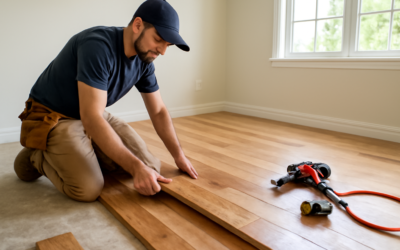
HempWood installs almost identically to solid hardwood:
- Acclimate the boxes on-site for 7-14 days at the home’s normal humidity (35-55% RH).
- Verify subfloor flatness to NWFA-spec ±3/16 inch over 10 ft.
- Lay a 15-lb roofing felt or HempWood-approved underlayment over the subfloor.
- Nail or staple at 16-22 gauge, every 8-10 inches along the tongue, with a flooring nailer.
- Maintain a 1/2 inch expansion gap at all walls.
- If site-finishing, sand with 36 grit, 60 grit, 100 grit, and screen at 120 grit before stain and finish.
- Apply 3 coats of waterborne or oil-modified polyurethane (Bona Traffic HD, DuraSeal, Loba 2K) for full residential durability.
Brand and Supplier Snapshot
HempWood by Fibonacci is the dominant US-made product. Direct purchase is available through hempwood.com, with samples and small-quantity orders shipping nationally. Authorized dealers include select green building suppliers, eco design centers, and a small number of progressive flooring specialty stores. Internationally, a handful of European mills also produce hemp-fiber composites, though import duties and shipping make them less practical for US buyers.
Where Hemp Wood Makes the Most Sense
- LEED, WELL, or Living Building Challenge certified projects where sustainability scoring matters.
- Residences for occupants with chemical sensitivity (MCS) or who avoid formaldehyde and VOCs.
- Boutique commercial spaces (wellness studios, design offices) where the material doubles as a brand statement.
- Eco-luxury custom homes where the budget supports premium materials.
Where It Doesn’t Make Sense
If your priority is the lowest cost per sq ft, the broadest design selection, or the easiest installation (vs traditional hardwood), oak engineered or bamboo strand at $5-8 per sq ft delivers similar performance at half the price. HempWood pays back primarily in story and certification credits, not in basic floor function.
How HempWood Compares to Bamboo
The closest competitor in the sustainable-hardwood-alternative space is strand-woven bamboo. Bamboo strand averages 3,000-4,000 Janka hardness, costs $4-7 per sq ft material, and renews on a 5-7 year growth cycle. HempWood at 2,000 Janka is softer than bamboo but harder than oak, costs roughly double bamboo, and renews on a 4-month cycle. Bamboo wins on hardness and price; HempWood wins on growth cycle, formaldehyde elimination, and US domestic manufacturing. For most projects bamboo strand is the better value; HempWood wins where the sustainability story is itself the product.
Long-Term Maintenance and Refinishing
HempWood maintains like any oil- or polyurethane-finished hardwood. Daily care is microfiber dust mopping; weekly cleaning with a neutral pH hardwood cleaner (Bona Pro Series Hardwood, Loba Care Cleaner). Avoid water-based mopping that leaves the surface wet, abrasive cleaners, and vinegar (acidifies the finish). Refinishing follows standard hardwood protocols — sand to 100 grit, screen at 120 grit, apply 3 coats of waterborne polyurethane (Bona Traffic HD, Loba 2K).
Bottom Line
Hemp wood flooring is a legitimate, well-engineered sustainable material with the durability to match its pitch. The premium pricing keeps it niche, but for the right project — eco-certified, indoor-air-quality-driven, or design-led — it’s the rare alternative material that genuinely earns its position.
Prefer to explore on your own?
See how new flooring looks in your actual room in seconds — free, no signup.
Try the free Floor Studio →