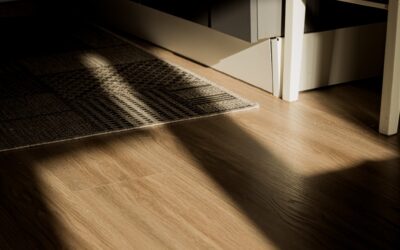
Most U.S. homeowners have never heard the term, but they have probably walked on the product daily. Heterogeneous vinyl flooring is the engineered, multi-layer sheet vinyl that covers commercial kitchens, hospitals, schools, and increasingly modern residential bathrooms and basements. The “heterogeneous” name refers to the layered construction: a clear wear layer over a printed design layer over a backing, which is what allows manufacturers to deliver realistic wood, tile, and stone visuals far beyond what older single-layer sheet vinyl could produce.
What Makes It Heterogeneous
The product is built from distinct layers, each engineered for a specific job:
- Wear layer: 0.55 to 1.0 mm transparent PVC, sometimes urethane-coated for stain and chemical resistance.
- Print layer: A digitally printed design film that creates the visual.
- Reinforcement layer: Glass fiber to keep the sheet dimensionally stable.
- Backing layer: Foam, felt, or fiber-reinforced PVC for cushion and sound dampening.
By contrast, homogeneous vinyl uses a single material throughout, with the color going all the way through. Homogeneous is the durable, simple choice for hospitals and labs; heterogeneous wins on visuals and is more common in residential and hospitality work.
Pros of Choosing Heterogeneous
- Realistic visuals: Print quality has reached a level where wood and tile imitations fool most observers at arm’s length.
- Cushion underfoot: The foam backing reduces foot fatigue and warms the floor.
- Excellent waterproofing: No seams except at room transitions when installed correctly.
- Affordable: $2.50 to $6 per sq ft for commercial-grade products, often less for residential.
- Easy cleaning: Urethane-coated wear layers wipe clean with neutral pH solutions.
- Long lifespan: 15 to 25 years in residential, 10 to 15 in heavy commercial.
The Honest Downsides
Once the wear layer is breached, the visual layer below shows through and there’s no fixing it short of replacement. This is the main reason commercial settings with extreme abrasion (think loading docks) opt for homogeneous instead.
Heterogeneous sheet also requires professional installation for best results. Heat-welded seams (the standard in commercial work) need a $300 to $800 hot-air welder and a steady hand with a grooving tool. DIY-installed loose-lay versions exist but trade off some longevity.
UV fading can be a concern with bright direct sunlight, especially with darker tones. Most modern products include UV inhibitors but aren’t immune.
Cost Breakdown
Residential-grade heterogeneous sheet from brands like Tarkett, Forbo Sphera, or Armstrong runs $2.50 to $5 per sq ft for materials. Commercial-grade lines (Tarkett iQ Optima, Forbo Eternal, Mannington Realities) come in at $4 to $7 per sq ft.
Installation adds $2 to $5 per sq ft for residential glue-down work and $3 to $7 per sq ft for heat-welded commercial installations. A 600 sq ft basement install averages $3,000 to $5,500 turnkey including subfloor prep, adhesive, and transition strips.
Where Heterogeneous Vinyl Shines
- Basements: Continuous waterproof coverage handles minor moisture issues.
- Bathrooms: Seamless installation eliminates grout maintenance.
- Laundry rooms: Spill-resistant and easy to clean.
- Healthcare facilities: Heat-welded seams meet infection control standards.
- Schools and daycare: Cushioned underfoot, easy to disinfect.
- Commercial kitchens: Anti-slip versions meet food service safety codes.
Where to Avoid It
Heavy industrial use with chemical spills or constant fork-lift traffic is better served by homogeneous vinyl or quarry tile. Direct outdoor exposure is also off-limits since adhesives and PVC films aren’t UV-rated for unconditioned spaces. Older homes with severely uneven subfloors will telegraph imperfections through any sheet vinyl unless heavily prepped first.
Installation Considerations
Subfloor flatness is critical. Heterogeneous sheet telegraphs anything sharper than 3/32 inch in 3 feet. Plywood underlayments (1/4 inch luan or Multicore) at $1.20 to $2 per sq ft installed solve most flatness issues. On concrete, a thin skim coat of Mapei Planiprep SC or Ardex Feather Finish handles minor pits and trowel marks.
Moisture testing matters too. Concrete substrates must show under 5 lbs per 1,000 sq ft / 24 hours via calcium chloride or under 75% RH. Plywood substrates need moisture content under 12%.
Adhesives vary by product. Pressure-sensitive adhesives (XL Brands T-3000) allow longer working time; permanent adhesives (Mapei Ultrabond ECO 575) hold better in high-moisture environments.
Heat-Welded Seams: The Commercial Difference
Commercial heterogeneous installs use a hot-air welding rod that fuses adjacent sheets into a single continuous surface. The grooving tool removes a half-moon channel along the seam; the welding gun melts a matching colored rod into the channel; a skiving tool levels the cooled rod flush with the surface.
This process eliminates seams as failure points and is required by code in many healthcare and food-service settings. Plan on an extra $2 to $4 per sq ft for properly heat-welded installations.
Maintenance
Daily care: sweep or dry mop. Weekly: damp mop with a neutral pH cleaner like Diversey Stride Citrus or Hillyard Top Clean. Avoid soap-based cleaners and bleach; both leave residue or damage wear layers over time.
Commercial settings typically buff and recoat with a manufacturer-approved finish every 1 to 2 years. Residential heterogeneous typically needs no surface treatment beyond regular mopping.
How It Compares to LVP and LVT
LVP and LVT are plank or tile formats of luxury vinyl with more rigid construction and click-lock or glue-down installation. Heterogeneous sheet vinyl is the continuous-roll product with foam cushioning. LVP has more realistic 3D embossing; sheet vinyl has fewer seams and better acoustics. Choose sheet for bathrooms, basements, and commercial settings; choose LVP or LVT for living areas where visual depth matters more.
Sustainability Considerations
Most modern heterogeneous sheet products carry FloorScore or Greenguard Gold certification for low VOC emissions. PVC-free alternatives exist (Forbo Marmoleum, ECOcore) for buyers concerned about chlorine-based plastics. Many manufacturers also offer take-back recycling programs for commercial installations at end of life.
The right product for the right space, installed by an experienced contractor with proper seam welding where applicable, delivers two to three decades of waterproof, low-maintenance performance. Heterogeneous vinyl flooring remains one of the best-kept secrets of commercial flooring, and it’s quietly becoming a top residential choice for basements, bathrooms, and laundry rooms.
Prefer to explore on your own?
See how new flooring looks in your actual room in seconds — free, no signup.
Try the free Floor Studio →