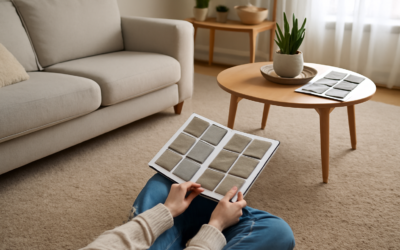
Carpet does more for a home theatre than just look the part. It absorbs the slap echo that ruins dialogue clarity, deadens footsteps during quiet moments, and prevents the screen reflections that destroy contrast on a projector setup. The right home theatre carpet is built for acoustic and optical performance, not just appearance. The wrong carpet bounces sound, lights up the front of the room, and reads as a missed opportunity in an otherwise carefully built space. This guide covers pile types, padding choices, colors, patterns, and the budget brackets that match a real-world theatre build.
What Theatre Carpet Has to Do
A dedicated home theatre is a controlled-acoustic, controlled-light environment. The carpet contributes to both functions. Acoustically, the dense fibers absorb mid and high frequencies that would otherwise bounce off the floor and arrive at your ears as a delayed echo. Optically, the carpet must be dark and non-reflective so it does not catch projector light and bounce it into the screen image as a glow at the bottom of the frame.
Standard residential carpet does some of this by accident. Theatre-grade carpet does it on purpose with denser pile, darker colors, and patterns that resist showing footprints during the dim portions of a movie.
Pile Type and Acoustic Performance
Three pile constructions show up in theatres, each with trade-offs.
- Cut pile (plush): Soft underfoot, decent absorption, but shows footprints and vacuum marks. Best for rooms with overhead lighting that stays off during movies
- Loop pile (Berber): Tighter weave, less footprint showing, less plush sound absorption, more durability
- Cut-and-loop pattern: Mix that disguises footprints and provides moderate absorption
For dedicated theatre rooms, a 36 to 50-ounce face weight cut pile in a deep, low-sheen color is the most common pick. The pile depth of 1/2 to 5/8 inch maximizes acoustic absorption. Anything denser than 60 ounces is overkill and starts to crush noticeably under furniture.
Padding Matters as Much as the Carpet
The padding under the carpet does at least half of the acoustic work. Cheap 1/4-inch rebond pad reduces sound transmission to the floor below by maybe 4 dB. A 7/16-inch density-7 pad knocks down another 8 to 10 dB. Premium acoustic padding like the Healthier Choice Pad rated for IIC 73 makes downstairs neighbors stop hearing your action movies entirely.
Plan to spend $0.80 to $1.50 per square foot on the padding alone. A 400 square foot theatre room runs $320 to $600 in padding before the carpet itself. This is where homeowners trying to save money make their biggest acoustic mistake. A premium carpet on cheap pad performs worse than a midrange carpet on premium pad.
Color Choices That Work
Dark colors absorb light. Period. A theatre with a tan or beige carpet floods the lower wall with bounced projector light during bright scenes, washes out the lower third of the image, and ruins contrast on black-frame inserts. The carpet has to be dark.
The most popular theatre colors are deep burgundy, midnight blue, charcoal gray, and black with subtle texture. Pure flat black shows lint and pet hair badly, which is why most builds opt for charcoal or burgundy with a small-scale pattern that hides debris between vacuum sessions. Mohawk Smartstrand Forever in Charcoal at $4 to $6 per square foot installed is a workhorse choice.
Patterns That Hide Wear
Solid carpet looks dramatic for the first month and then shows every footprint, every dropped popcorn kernel, and every vacuum stripe. A small-scale pattern reads as solid from across the room but disguises traffic patterns up close. Theatre carpet designs frequently use:
- Subtle damask or medallion: The traditional movie-palace look
- Geometric film-reel or starburst: Modern theatre vibe
- Two-tone tweed or heather: Reads as solid from a distance, masks dirt up close
- Cut-and-loop texture: No actual pattern but a subtle 3D texture that hides marks
If you are buying through a theatre carpet specialist like Joy Carpets or Brockway, expect $8 to $20 per square foot for a true patterned theatre carpet. The retail commercial-grade patterned carpets do not exist in big-box stores. Plan for special order with 4 to 8 week lead times.
Stairs and Risers Need Special Attention
Theatre stadium-tier seating usually requires carpet that wraps over each riser and tread. Use a pattern that flows continuously up the risers without abrupt cuts at the seams. The carpet seams on stair edges take heavy wear, so a 50-ounce or denser pile holds up where 30-ounce will pill out within two years.
LED strip lighting under each step needs to clear the carpet edge by at least 1/2 inch. Plan the lighting channel before the carpet goes down. Retrofitting LED strips after carpeting means lifting the edge and re-securing, which is messy and rarely lays flat afterward.
Budget Brackets That Match Real Builds
For a 400 square foot theatre, the carpet and pad budget falls into three brackets.
Entry level at $1,200 to $2,000 installed gets you a midrange residential cut pile in a dark solid color over a 7/16-inch density-7 pad. Performance is good for the price and acoustic absorption is acceptable for casual movie nights.
Mid range at $3,500 to $5,500 installed steps up to a true theatre-grade patterned carpet from Joy Carpets or similar, paired with a Healthier Choice acoustic pad. The room sounds significantly tighter and the carpet looks like a real cinema. Premium at $7,000 and above brings in custom-pattern wool blends, IIC 73+ acoustic padding, and custom-bound area rugs over hardwood for hybrid rooms.
Installation Tips That Save Money
Buy the carpet from a wholesaler and hire installers separately. Big-box retailers mark up carpet 100 to 200 percent and tie installation pricing to it. A local flooring contractor will install material you supply for $0.70 to $1.20 per square foot, which is a fraction of the retail markup.
Plan for at least 10 percent waste. Patterned carpets need to be aligned at seams, which means more cutting and more wasted material. Theatre rooms with irregular shapes or stadium tiers can push waste up to 20 percent. Order all the carpet from a single dye lot to avoid visible color variation at seams.
Maintenance and Long-Term Care
Vacuum weekly with a vacuum that has adjustable height. Set it for the deepest pile setting initially and confirm the brush does not grab and lift the carpet at corners. Avoid eating dark snacks or red wine in the theatre. The same dark carpet that hides general wear will permanently show stains from spilled food, especially anything with curcumin, beet juice, or red wine.
Plan for professional steam cleaning every 18 to 24 months at $250 to $400 for the typical room. Theatre carpets last 12 to 20 years with proper care, which is reasonable for the investment. The acoustic and visual benefits compound year after year, so the original investment pays back across thousands of hours of viewing time.