A blank wall behind a flat-screen reads as unfinished even if everything else in the room is perfectly styled. Learning how to decorate tv wall spaces is mostly about scale, lighting, and visual weight; balancing a 65-inch black rectangle takes more deliberate planning than the rest of the living room combined. A well-designed TV wall pulls the screen into the overall aesthetic instead of letting it dominate as an electronic afterthought.
Get the Viewing Height Right First
Before adding any decor, confirm the TV itself is mounted correctly. The center of the screen should land 42 inches above the seating floor when viewers are sitting on a standard 17 inch deep sofa cushion. For a 65-inch TV (32-inch tall picture area), that puts the bottom edge of the screen about 26 inches above the floor.
Mount the TV too high (the most common mistake) and viewers strain their necks within 30 minutes. Brands like SANUS VLF728-B2 ($349) and Echogear ELM4 ($199) make full-motion mounts that let you fine-tune position after installation. Confirm the mount supports your TV’s weight; a 65-inch OLED typically weighs 50 to 70 lbs.
Choose a Background Treatment
The wall itself becomes the foundation. Three approaches consistently work:
- Dark accent paint: Sherwin Williams Iron Ore SW 7069 or Behr Cracked Pepper N520-7
- Wood slat wall: ASTV pre-finished walnut slats, $9 per square foot at Home Depot
- Stacked stone veneer: AirStone Spring Creek, $50 per 8 sq ft box at Lowe’s
- Textured wallpaper: Cole and Son Wood texture, $150 per roll
- Built-in millwork: paint-grade poplar shaker panels, $400 to $1,200 for a DIY build
Dark colors reduce screen glare and make the TV bezel blend into the wall rather than stand out as a contrasting border. Pale walls behind a TV often look hospital-like in evening lighting.
Build a Gallery Around the Screen
Treat the TV as the largest element of a gallery wall. Arrange 4 to 8 framed pieces around it, leaving a consistent 4 to 6 inch margin. Vary frame sizes and orientations but keep frames within the same color family (all black, all natural wood, or all gold).
For balance, group two thirds of the artwork on the dominant side and one third on the other. Skip symmetry; perfectly mirrored layouts often look stiff. Use a level and painter’s tape to test arrangements before drilling. Command Picture Hanging Strips at $7 per pack let you test layouts without committing.
Add Functional Shelving
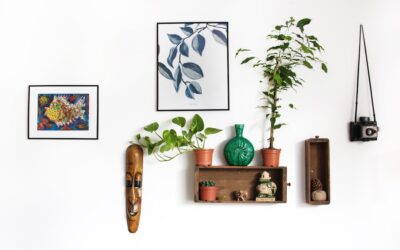
Floating shelves on either side of the TV provide both visual balance and useful storage. The Lack series from IKEA at $20 each in walnut or black works for casual rooms. For a more custom look, source 1×10 select pine boards from Home Depot at $25 each, stain with Minwax Special Walnut ($8), and mount with hidden brackets from EZ Shelf ($25 per pair).
Style shelves with the rule of threes: a tall object, a medium object, and a small grouping per shelf. Books laid flat with a small sculpture on top, ceramic vases, framed photos, and trailing pothos plants all work. Avoid filling shelves completely; 60 to 70 percent occupancy reads as intentional rather than cluttered.
Lighting Plan to Reduce Eye Strain
Watching TV in a dark room causes faster eye fatigue than watching with low ambient light. Add bias lighting behind the screen using a Govee H6199 LED strip ($35) that color-syncs to on-screen content. The 2700K to 3000K warm white at low brightness behind the TV reduces eye strain by up to 60 percent during nighttime viewing.
Layer in a floor lamp at 2700K and a pair of small picture lights above any flanking artwork. Avoid overhead recessed lighting directly above the TV; the reflected glare on glossy screens makes daytime viewing miserable.
Hide the Cables Professionally
Visible HDMI and power cords ruin even the best decor. Two options work well. For drywall installations, use a Sanus In-Wall Cable Management Kit ($65) that creates two recessed boxes connected by ENT conduit; cables run inside the wall and the TV looks floating. For brick, stone, or rental walls, use a flat raceway like Legrand Wiremold CordMate II ($25) painted to match the wall.
For media console connections, group all power adapters on a Cable Matters 12-outlet surge strip mounted to the back of the console with double-sided tape. Use cable sleeves (JOTO 60-inch at $11) to wrap multiple cords into a single clean run.
Style the Media Console
The console below the TV is prime real estate for layered decor. Choose furniture proportional to the TV; a 65-inch TV needs at least a 72-inch wide console for visual balance. The IKEA BESTÅ system ($300 to $600) and West Elm Mid-Century at $1,499 are popular choices.
Top the console with three groupings: a tall element (lamp or vase), a medium element (stack of books with a tray), and a small accent (sculpture, candle, or framed photo). Leave 40 percent open space so the console doesn’t compete with the TV.
Budget-Friendly TV Wall Under $500
You don’t need a designer budget to make the wall look intentional. Here is a complete makeover for a 12-foot living room wall:
- One gallon Sherwin Williams Iron Ore in eggshell: $75
- Six 8 by 10 inch black frames from Target: $90
- Two IKEA Lack floating shelves: $40
- Govee H6199 LED bias light: $35
- Sanus In-Wall Cable Kit: $65
- Sansevieria, pothos, and ceramic pots from Lowe’s: $80
- Small accessories from HomeGoods or thrift sources: $100
Total around $485, and the result looks like the room was professionally styled. Spread the work over a long weekend, painting and installing the mount Friday evening, hanging gallery art Saturday, and styling Sunday afternoon.
Common Mistakes to Avoid
Three mistakes consistently ruin TV walls. First, mounting the TV too high above a fireplace mantel: this creates persistent neck strain since the screen sits 60 to 70 inches above the floor, well above the recommended 42-inch center. Second, choosing a TV mount that doesn’t tilt or swivel; rooms with windows or off-center seating need flexibility built in.
Third, ignoring the surrounding wall while spending heavily on the TV itself. A premium 65-inch OLED next to bare drywall and a basic black plastic media console looks worse than a budget TV on a thoughtfully styled wall. Spend 20 percent of your TV budget on the surrounding decor and the entire room reads as intentional rather than tech-first.