
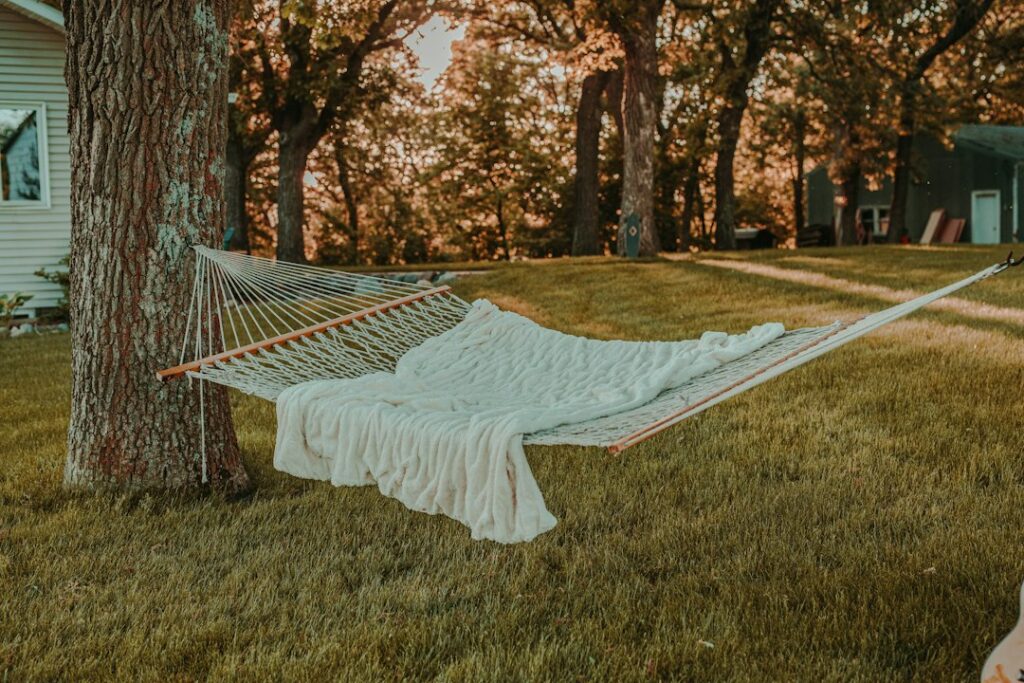
The quickest way to ruin a good shade tree is to screw an eye bolt into it or wrap it with thin rope that cuts into the bark. If you want to hang a hammock between trees season after season, the method matters as much as the hammock. Wide tree straps protect the bark, a quick health check protects you, and a few measurements give you a hang that is comfortable instead of saggy or drum-tight.
Here is the short version. Pick two healthy, living trees at least 6 inches in diameter (thicker is better) and roughly 12 to 15 feet apart for a typical gathered-end hammock. Wrap each trunk with a tree strap at least 1 inch wide, never nails, screws or eye bolts. Attach the hammock so the suspension hangs at about a 30 degree angle from horizontal and the seat sits around 18 inches off the ground. Check the hammock’s weight rating and the strap rating, and use the lower of the two as your limit.
- Why Tree-Friendly Methods Matter When You Hang a Hammock Between Trees
- What You Need
- Choosing the Right Trees
- Step-by-Step: Hanging Your Hammock
- Hanging Height, Distance and Angle Explained
- Weight Limits and Hardware Ratings
- Kids and Hammocks: Simple Safety Rules
- Other Hammock Styles and Options
- Troubleshooting a Bad Hang
- Cost Ranges
- Frequently Asked Questions
We cover tools, tree selection, step-by-step setup, adjustments for different hammock styles, safety around kids, and costs.
Why Tree-Friendly Methods Matter When You Hang a Hammock Between Trees
Just under the bark is the cambium, a thin living layer that carries water and nutrients. Thin rope or cord concentrates the load on a narrow band and grinds through bark as the hammock swings, which can damage that layer. Repeated injury invites insects and disease, and a ring of damage around the trunk can eventually kill the tree.
Hardware is worse. Eye bolts, lag screws and nails open a permanent wound, and a tree under constant load from a bolt can develop decay around it. A bolt can also loosen or pull out as the wood around it weakens, dropping whoever is in the hammock. Many parks and campgrounds ban anything other than wide straps for these reasons, and the same logic applies in your backyard.
What You Need
- Hammock tree straps: Flat webbing at least 1 inch wide, often 1 to 2 inches, with loops or daisy-chain pockets for easy adjustment. Polyester webbing stretches less than nylon.
- Carabiners or S-hooks rated for the load: Climbing-style carabiners with a stamped strength rating, or the connectors supplied with the strap kit. Avoid hardware-store key-ring clips.
- Tape measure: For tree spacing and hang height.
- Optional tree sleeves: Extra padding for trees with thin or soft bark.
- Optional rain fly or bug net: For overnight use.
If you plan to hang the hammock in the same spot all summer, a set of hammock tree straps with multiple adjustment loops saves time every time you set up or take down.
Choosing the Right Trees
Tree selection is the step people skip, and it is the one that prevents most accidents.
Size and Spacing
Look for trunks at least 6 inches across, and prefer 8 inches or more for adults. Trees that bend noticeably when you push on them are too small. For most gathered-end hammocks, 12 to 15 feet between trunks works well. A hammock with a spreader bar usually needs a tighter hang and a specific span listed by the maker, often 13 to 16 feet including hardware.
Healthy Tree Check
Walk around both trees and look up before anything else.
- Avoid dead trees or trees with large dead branches overhead (sometimes called widowmakers). A falling limb is the biggest hazard in a hammock.
- Skip trunks with deep cracks, large cavities, fungus or mushrooms at the base, or bark falling off in sheets.
- Watch for soil heaving or exposed roots on one side, a sign the tree may be leaning or unstable.
- Look for wasp nests, poison ivy on the trunk and sharp stubs where branches broke off.
- Avoid young, newly planted trees and thin-barked ornamentals that bruise easily.
If a tree looks questionable, choose another spot or use a freestanding stand. A certified arborist can assess a large tree near your house for a modest fee and is worth calling if you see decay or major dead wood.
Step-by-Step: Hanging Your Hammock
- Clear the ground. Remove rocks, stumps and sticks beneath where the hammock will hang. Soft grass or mulch is ideal.
- Wrap the first strap. Wrap the strap around the trunk at roughly 5 to 6 feet off the ground and pass one end through the loop on the other end. Pull it snug and flat, with no twists.
- Wrap the second strap. Place it at about the same height on the other tree. Check that both straps sit flat against the bark.
- Connect the hammock. Clip the hammock ends to a loop on each strap with rated carabiners. Choose loops that leave the hammock with a gentle curve, not stretched tight.
- Check the angle. Aim for the strap or suspension to leave the tree at about 30 degrees from horizontal. A flatter, tighter hang puts far more force on the straps and trees and can squeeze you like a banana peel.
- Check the height. With nobody in it, the lowest point of the hammock should sit about 18 to 24 inches above the ground. When you sit in it, the seat should drop to roughly chair height.
- Test it slowly. Sit in the center first, keeping your feet on the ground, and bounce gently. Watch for straps slipping down the trunk or knots tightening. Adjust before lying back.
Lying in a Gathered-End Hammock
Lie at a slight diagonal across a gathered-end hammock. The fabric flattens out, your back stays straighter and you are less likely to tip. Rope hammocks and spreader-bar styles are flatter by design but more prone to flipping, so get in slowly and center your weight.
Hanging Height, Distance and Angle Explained
Height, distance and angle all affect one another. A longer span between trees means you need to raise the straps higher to keep the same sag. A shorter span lets you strap lower.
| Tree distance | Approximate strap height | Notes |
|---|---|---|
| 10 to 12 ft | 4.5 to 5 ft | Use extra slack; good for short hammocks |
| 12 to 15 ft | 5 to 6 ft | Ideal for most gathered-end hammocks |
| 15 to 18 ft | 6 to 7 ft | Add suspension length; check the angle |
These are starting points. Every hammock length and fabric stretches differently, so hang it, sit in it and adjust one loop at a time. If you cannot reach a comfortable 30 degree angle with your trees, add a longer strap or pick a different pair.
Weight Limits and Hardware Ratings
Every hammock has a weight rating, and so do the straps and connectors. Your real limit is the lowest rating in the system. A hammock rated for 400 pounds hung on straps rated for 300 pounds is a 300 pound setup.
Ratings assume a person lying calmly at a proper angle. Swinging, jumping in or a drum-tight hang multiplies the force on every component. Two adults in a single hammock can exceed most ratings quickly, so use a double hammock rated for the combined weight and keep the hang loose.
Inspect straps, carabiners and hammock ends at the start of each season and every few weeks during heavy use. Replace straps that are frayed, stiff, faded or cut, and replace any connector that is bent, rusted or will not close fully. Sunlight breaks down webbing over time, so bring straps inside when the hammock is not in use.
Kids and Hammocks: Simple Safety Rules
Children love hammocks, and a few rules keep fun from turning into a trip to urgent care.
- Keep kids from swinging hard, spinning or flipping the hammock. Hard swinging can throw a child out or overload the straps.
- Hang the hammock low, with the seat close to knee height, when young children use it.
- Allow only as many kids as the weight rating allows, and keep standing and jumping off the menu.
- Supervise young children, and never leave infants or toddlers alone in a hammock. Fabric can fold around a small child.
- Take down or tie up the hammock when not in use so it does not become an unsupervised play spot.
- Keep the area below free of hard edges, toys and garden tools.
Other Hammock Styles and Options
A hammock for tree hanging is not your only option. A rope hammock swing or hammock chair hangs from a single point, which usually means a sturdy horizontal branch at least 8 inches thick. Use a wide strap around the branch, keep the attachment close to the trunk where the limb is strongest, and avoid branches that are dead, cracked or growing at a sharp upward angle.
If your yard has no suitable trees, a hammock without stand options is limited. A freestanding steel or wood stand is the safer choice, and most fit standard gathered-end hammocks. Hanging from house posts or porch beams is possible only into solid structural framing with hardware rated for the load, and that is a job to plan carefully or hand to a pro.
Troubleshooting a Bad Hang
- Straps slide down the trunk: Wrap them a second time around the tree or cinch them tighter. Smooth-barked trees grip less.
- Hammock sits too low: Raise both straps or move to a closer clip loop.
- Hammock feels tight and squeezes your shoulders: Add sag by clipping farther out on the straps.
- Hammock tips easily: Lower the hang, center your weight, and lie diagonally in gathered-end styles.
- Bark scuffing: Switch to wider straps or add tree sleeves, and take the hammock down between uses.
Cost Ranges
A simple gathered-end hammock costs roughly $25 to $80. Rope and spreader-bar hammocks generally run $50 to $200. Tree strap kits are usually $15 to $50, and freestanding stands range from about $80 to $300 or more. An arborist inspection for a large tree typically falls in the low hundreds, which is cheap insurance when a heavy limb hangs over your favorite spot.
Take ten minutes to check the trees, use wide straps and set the angle, and you can hang a hammock between trees safely without leaving a mark on them.
Frequently Asked Questions
How far apart should trees be for a hammock?
For most gathered-end hammocks, 12 to 15 feet works well. Spreader-bar hammocks often need the exact span listed by the maker, usually somewhat longer.
How high should hammock straps be on the tree?
Start around 5 to 6 feet off the ground for trees 12 to 15 feet apart. Raise them for wider spacing and lower them for closer trees, aiming for a 30 degree hang angle.
Can I screw an eye bolt into a tree for a hammock?
It is not recommended. Bolts and screws wound the tree, can lead to decay and may loosen over time. Wide tree straps are safer for you and the tree.
How thick should a tree be to hang a hammock?
Choose healthy, living trunks at least 6 inches in diameter, and 8 inches or more for adults. Avoid any tree that flexes when you push on it.
Is it safe for kids to swing in a hammock?
Gentle rocking with supervision is fine, but keep kids from swinging hard, flipping or standing. Hang it low and stay within the weight rating.


