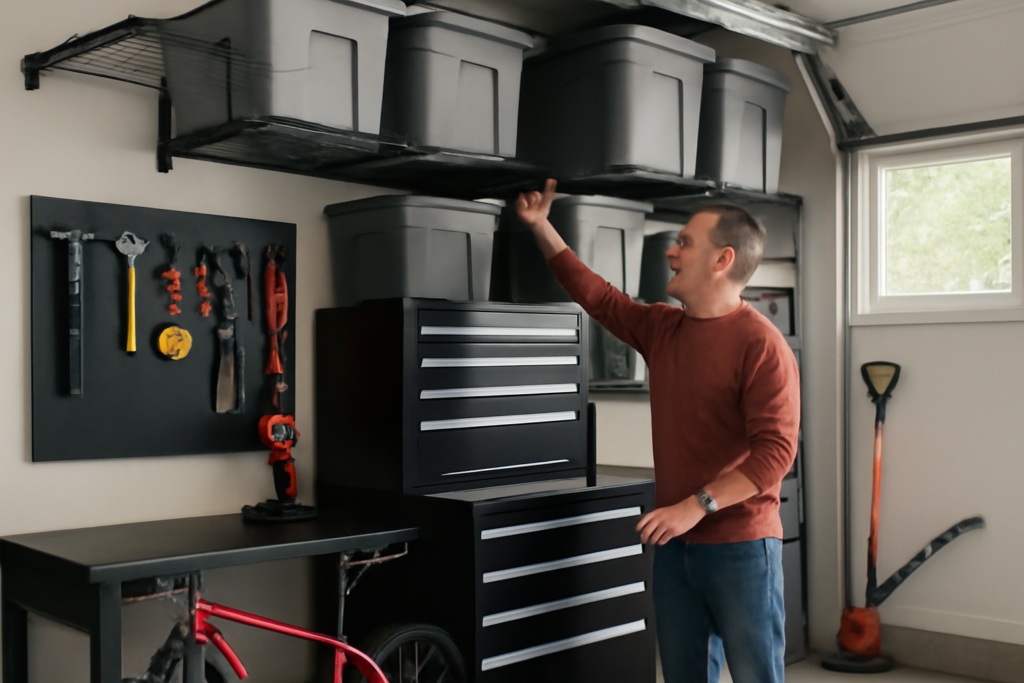
After 20-plus years of hanging cabinets and building out garages, I keep coming back to one line most people already know from Home Depot. Husky garage storage hits the sweet spot between the flimsy big-box junk and the $3,000 pro systems that never pencil out for a homeowner. It is not the last word in cabinetry, but for a two-car garage that needs to hold tools, paint, lawn gear, and the seasonal bins, it is hard to beat on price-to-durability.
- What Husky Garage Storage Actually Includes
- Weight Ratings: What the Numbers Really Mean
- What You Should Expect to Pay
- Welded vs. Ready-to-Assemble
- Planning Your Layout Before You Buy
- Installation Tips From the Field
- Where Husky Falls Short
- Husky vs. Gladiator and NewAge
- Matching the System to How You Use the Garage
- Expanding the System Over Time
- Is Husky Right for Your Garage?
This guide walks through what Husky actually sells, what the weight ratings mean in practice, what you should pay, and where the line’s real weaknesses show up once you load it down.
What Husky Garage Storage Actually Includes
Husky is Home Depot’s house brand, and the storage line is broad. You are choosing between a handful of families that mix and match:
- Welded steel cabinets — the tall 2-door units, base cabinets, and wall cabinets that ship fully assembled. These are the backbone of most builds.
- Ready-to-assemble (RTA) cabinets — cheaper, bolt-together versions in similar sizes.
- Freestanding steel shelving — 4- and 5-shelf racks, often boltless.
- Workbenches — with solid wood, bamboo, or stainless tops, sometimes with a pegboard back and drawers.
- Track wall / slatwall systems — for hanging bikes, tools, and hoses off the floor.
- Modular tool chests and rolling cabinets — the mechanic-style boxes.
Most homeowners end up mixing a couple of tall cabinets, a workbench, and some open shelving. That combo covers 90% of what a garage needs.
Weight Ratings: What the Numbers Really Mean
Husky publishes shelf and cabinet ratings, but read them closely. A cabinet rated for “1,000 lbs total” is usually a distributed load across four adjustable shelves — roughly 200-250 lbs per shelf, not 1,000 lbs stacked on one. The heavy-duty welded steel cabinets typically carry 100-200 lbs per adjustable shelf, and the boltless shelving units run 1,000-2,000 lbs total distributed, or about 200-450 lbs per shelf.
In the real world, that is plenty. A shelf of paint cans, a car battery, and a case of oil rarely tops 120 lbs. The place people get in trouble is loading one shelf with a full toolbox and a bench grinder and wondering why it sags. Spread the weight, keep the heaviest items low, and anchor tall cabinets to the wall so they cannot tip.
What You Should Expect to Pay
Prices move, but these are realistic 2025 ranges for a homeowner buying at Home Depot:
- Welded 2-door tall cabinet (36 in. wide): $300-$550
- RTA tall cabinet: $180-$300
- Base + wall cabinet combos: $250-$450 per set
- 5-shelf boltless steel shelving (about 4 ft wide): $80-$160
- Solid wood-top workbench (46-52 in.): $250-$450
- Rolling tool chest: $200-$900 depending on size
- Track wall kit with hooks: $120-$250
A solid two-car garage build — two tall cabinets, a workbench, two shelving units, and a track wall — lands around $1,200-$1,800. That is roughly half what a comparable Gladiator or NewAge configuration costs, which is why Husky sells so well.
Welded vs. Ready-to-Assemble
If you can spare the extra $100-$150 per cabinet, buy welded. The welded units arrive as one rigid box, so the frame is square and stays square when you load it. RTA cabinets rely on bolts and cam locks; over years of opening and closing heavy doors, they can rack and loosen. I have installed both, and the welded cabinets simply age better.
The catch is delivery. A welded 78-inch tall cabinet is a 150-plus-lb awkward box. You want a helper and a hand truck, and you should measure your garage door and any interior doorways before it shows up.
Planning Your Layout Before You Buy
Measure the wall run and sketch it before you order anything. A few rules that save headaches:
- Keep at least one full wall clear for a workbench with elbow room on both sides.
- Leave 30-36 in. of walking clearance between cabinet fronts and a parked car’s mirror.
- Mount wall cabinets so the bottom sits about 54 in. off the floor — high enough to clear a bench, low enough to reach.
- Put open shelving in the corners and behind the car nose where deep storage does not block traffic.
- Reserve the track wall for anything that eats floor space: bikes, string trimmers, folding chairs, ladders.
If your garage floor slopes toward the door — most do, for drainage — plan to shim cabinet feet so doors hang plumb and close on their own.
Installation Tips From the Field
Freestanding units are simple, but a few steps separate a solid install from a wobbly one:
- Anchor everything tall. Find the studs, and screw the cabinet’s back rail into at least two of them with 3-inch structural screws. A loaded tip-over is a real injury risk with kids around.
- Level side to side and front to back. Adjustable feet handle small slopes; shims handle the rest.
- Gang cabinets together. Bolt neighboring cabinets to each other through the side panels for a rigid wall of storage.
- Add a pegboard or slatwall above the bench so hand tools live at eye level, not in a drawer.
Concrete anchors are only needed if you are securing base cabinets to the slab, which most homeowners skip. Wall anchoring is the one that matters.
Where Husky Falls Short
No brand is perfect, and it is worth knowing the limits before you commit:
- Powder coat scratches. The finish is decent but not bulletproof. Drag a metal shelf across it and you will see bare steel. Touch-up paint handles it.
- Drawer slides on cheaper units are ball-bearing but lighter duty than a pro tool chest. Do not load a base-cabinet drawer with 80 lbs of sockets.
- Selection varies by store and season. A configuration you saw last spring may be discontinued. Buy the full set at once if you want matching pieces.
- Not truly weatherproof. In a humid or coastal garage, bare-steel edges can surface-rust. A wipe-down and a dehumidifier go a long way.
Husky vs. Gladiator and NewAge
People shopping Husky garage storage usually cross-shop Gladiator (Whirlpool) and NewAge. Gladiator runs a bit heavier-gauge with a hammered finish and costs 20-40% more. NewAge is the near-furniture-grade option with thicker steel, soft-close doors, and prices that easily double Husky’s. For a homeowner who wants a clean, functional garage without spending like a shop owner, Husky wins on value. Step up only if you are running a serious hobby shop or want the showroom look.
Matching the System to How You Use the Garage
Before buying anything, be honest about what your garage really is. A garage that mainly parks two cars and stores lawn gear has different needs than a weekend woodworking shop. For the former, lean heavily on tall closed cabinets and open shelving, and keep the workbench modest. For the latter, invest in a heavy wood-top workbench, a rolling tool chest, and a full track wall so hand tools live at arm’s reach. Buying the wrong mix is the most common regret I see — people spend on a giant tool chest they never fill, or skimp on cabinets and end up with clutter on every surface.
Think in zones. Reserve one wall for the “wet and dirty” stuff — lawn chemicals, oil, fertilizer — in closed cabinets that keep fumes and mess contained. Give another wall to clean storage and a bench. Keep the track wall near the door for grab-and-go items. Zoning up front makes the whole build feel intentional instead of a pile of cabinets bought one at a time.
Expanding the System Over Time
One underrated strength of Husky is that you can build it in stages without it looking mismatched. Because the line stays fairly consistent in color and dimension, you can start with a single tall cabinet and a workbench this year, add shelving next season, and finish with a track wall later. That matters for a homeowner spreading the cost out. My advice: buy the anchor pieces — the tall cabinets and bench — first, since those set the look and are the hardest to add cleanly later. Shelving and track accessories are easy to bolt on anytime.
If matching finishes matter to you, note the specific series name and color on the box when you buy, because Husky rotates product lines. A quick photo of the label saves you guessing whether next year’s cabinet will match the one already on your wall.
Is Husky Right for Your Garage?
If you want durable steel storage at a fair price, sold everywhere, with parts you can match and expand over time, Husky garage storage is the practical default. Buy welded where the budget allows, anchor everything to studs, spread your loads, and you will have a garage that stays organized for a decade or more. Save the premium brands for the day your garage becomes a workshop — for the vast majority of homeowners, this line does exactly what it needs to.