You don’t have to spend a fortune on a branded garage system to get organized, and plenty of savvy homeowners have figured that out. IKEA garage storage — built around a handful of affordable, modular product lines — delivers flexible shelving, cabinets, and wall organization for a fraction of what specialty garage brands charge. The trick is knowing which IKEA lines actually hold up to garage duty and which are best left indoors. Here’s the complete playbook, including the hacks the DIY crowd swears by.
Why People Use IKEA in the Garage
The appeal comes down to three things: price, modularity, and looks. IKEA systems cost far less than NewAge or Gladiator cabinet setups, they’re endlessly reconfigurable, and they give a garage a clean, finished appearance that bare steel racks don’t. Because the lines are modular, you can start with one unit and expand as budget allows, mixing shelving, cabinets, and wall rails into a coordinated system. For anyone who wants an organized garage that looks intentional without a four-figure spend, IKEA is a legitimate answer.
The Best IKEA Lines for the Garage
IVAR — the workhorse
Untreated solid pine shelving, and the single most popular IKEA garage choice. IVAR is sturdy, adjustable, and cheap. A standard 35 3/8″ wide shelf is rated for around 110 lbs when properly mounted, and the frames are strong enough for tools, bins, and general storage. Because it’s raw pine, you can stain or seal it to resist garage humidity. IVAR expands infinitely — add sections, cabinets, and shelves as you go.
BROR — the heavy-duty pick
Galvanized steel and wood shelving designed for utility spaces. BROR is IKEA’s most garage-appropriate line, with shelves rated up to about 110 lbs each and a rugged look that suits a workshop. It comes as open shelving, cabinets, and even worktables, and the powder-coated steel handles a garage environment far better than particleboard.
PLATSA / other systems
PLATSA and similar wardrobe-style systems can work for enclosed garage storage in a clean, climate-stable garage, but they’re melamine-particleboard and don’t love moisture — better for finished, insulated garages than damp detached ones.
Wall organization — SKÅDIS and rails
The SKÅDIS pegboard system and various IKEA kitchen rails (like the HULTARP or older GRUNDTAL lines) make excellent garage wall organizers for hand tools, cords, and small gear — repurposed from their intended kitchen or craft-room use.
Weight Ratings: Know the Limits
Be realistic here, because it’s where IKEA differs most from dedicated garage brands. IVAR and BROR shelves are typically rated around 110 lbs per shelf when correctly assembled and, where required, anchored to the wall. That’s plenty for bins, hand tools, paint, and household overflow — but it’s not the 300–1,000 lbs of industrial steel shelving. Don’t store engine blocks, a full mechanic’s tool chest, or heavy automotive parts on IKEA shelving. Match the line to medium-weight, high-organization storage and you’ll be happy; overload it and you’ll be disappointed.
Popular IKEA Garage Hacks
The IKEA-hacking community has refined some genuinely clever garage moves:
- Seal your IVAR. Raw pine soaks up garage moisture. A coat of polyurethane, stain, or even leftover paint protects it and gives a finished look.
- Bolt IVAR sections together into a long wall of shelving for a built-in appearance at a fraction of custom-cabinet cost.
- Add IVAR cabinet doors to hide clutter and keep dust off stored items.
- Combine BROR shelving with a butcher-block or KARLBY countertop to build a sturdy workbench.
- Mount SKÅDIS pegboards above a bench for tool organization with movable hooks and holders.
- Use TROFAST or SAMLA bins on the shelves for sorted small-parts storage.
- Repurpose kitchen rails to hang tools, spray bottles, and gloves along the wall.
Assembly and Anchoring
IKEA units assemble with the usual hex key and cam locks, and most go together in an hour or two. The critical safety step people skip: anchor tall units to the wall. IKEA explicitly includes and requires wall-attachment hardware on tall shelving because these units can tip, and tip-over accidents are a real, documented hazard — especially with children in the home. Locate your studs with a stud finder and screw the included anti-tip bracket into solid framing, not just drywall. It takes five minutes and it’s non-negotiable.
In an unfinished garage with open studs, anchoring is easy — screw directly into the framing. If your garage is drywalled, find the studs behind it and fasten there.
The Moisture Question
Garages swing through temperature and humidity, and that’s the main risk to IKEA products. Solid wood (IVAR) and galvanized steel (BROR) handle it best, especially if you seal the pine. Particleboard and melamine lines (PLATSA, BILLY, KALLAX) will swell, warp, and delaminate if they get damp, so reserve those for insulated, climate-controlled garages only. If your garage is detached, uninsulated, or prone to dampness, stick to IVAR (sealed) and BROR and you’ll avoid the disappointment of a bookshelf disintegrating over a humid summer.
Cost Comparison
Here’s why people go this route. A wall of dedicated garage cabinets from a premium brand runs $1,500 to $4,000+. A comparable run of IVAR shelving with a few cabinet doors and some bins can come together for $300 to $700. BROR shelving units run roughly $100 to $200 each. You trade some weight capacity and the pre-finished garage look for major savings and total modularity — a tradeoff that makes sense for most homeowners storing normal household and hobby gear rather than a professional workshop’s worth of heavy equipment.
Building Your System
- Measure the space — walls, ceiling height, door tracks, and the electrical panel’s required clearance.
- Inventory what you’re storing and sort by weight and frequency of use.
- Choose your backbone — IVAR for general storage, BROR for heavier or workshop use.
- Add wall organization — SKÅDIS and rails for tools and frequently grabbed items.
- Seal wood units before loading them if your garage sees humidity.
- Anchor everything tall to the studs.
- Fill with labeled bins to keep the system tidy long-term.
IKEA vs. Dedicated Garage Systems
It’s worth being clear-eyed about the tradeoffs versus purpose-built garage brands like Gladiator or NewAge. IKEA wins decisively on price and modularity, and IVAR in particular is beloved because you can reconfigure and expand it endlessly. Where dedicated systems pull ahead is weight capacity (industrial steel holds 300 to 1,000-plus pounds per shelf versus IKEA’s ~110), moisture resistance out of the box, and a pre-finished, garage-specific look with features like slatwall integration and locking cabinets.
The honest verdict: if you’re storing normal household overflow, hobby gear, tools, and bins, IKEA delivers 80% of the result for 30% of the cost. If you’re outfitting a serious workshop with heavy equipment and want a showroom finish, the premium garage brands earn their price. Many homeowners split the difference — IKEA for general shelving and a couple of heavy-duty steel units for the truly heavy stuff.
A Realistic IVAR Garage Wall
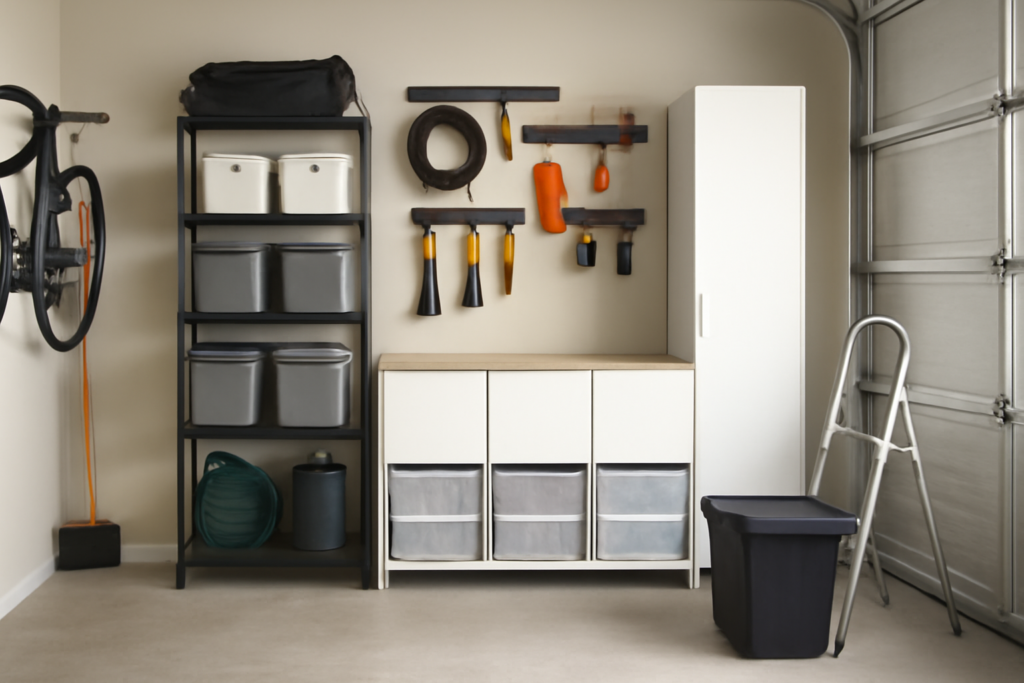
To make it concrete, here’s a common setup people build. Take three IVAR side units and two or three sets of shelves each to create a run of open shelving along one garage wall, roughly 8 to 10 feet wide, for a few hundred dollars. Seal the pine with a quick coat of polyurethane first so garage humidity doesn’t warp it. Add a couple of IVAR cabinets at the base to hide the ugly stuff and keep chemicals behind doors. Mount a SKÅDIS pegboard at eye level between sections for hand tools, and fill the shelves with matched SAMLA or TROFAST bins, labeled by zone. Anchor every section to the studs. The finished wall looks intentional, stores a garage’s worth of gear, and costs a fraction of a cabinet system — the exact reason IKEA garage builds have such a following.
Bottom Line
IKEA garage storage is a smart, budget-friendly path to an organized garage as long as you play to its strengths: use IVAR (sealed) and BROR for their solid-wood and galvanized-steel durability, respect the roughly 110-lb-per-shelf ratings, keep particleboard lines out of damp garages, and anchor every tall unit to the studs. Layer in SKÅDIS pegboards and bins, and you’ll have a modular, good-looking system for a few hundred dollars instead of a few thousand. It won’t out-muscle industrial steel, but for the everyday garage, it hits the sweet spot of price, flexibility, and looks.