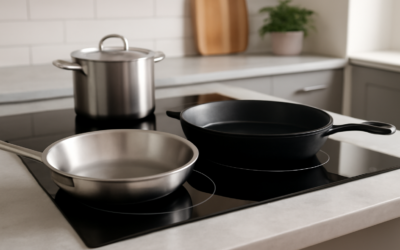
Switching to induction often reveals an awkward truth: half your favorite pans simply will not heat. An induction adapter plate is a flat, magnetic steel disk that sits on the induction zone, heats up from the magnetic field, and then passes that heat to whatever pan sits on top. It lets aluminum, copper, glass and some ceramic cookware work on an induction cooktop, although the pan is now heated by contact rather than directly by the magnetic field.
That workaround is useful, but it comes with trade-offs. You lose much of the speed and efficiency that make induction attractive, the plate itself gets extremely hot, and the cooktop surface under it can heat far more than it would with a proper induction pan. For a favorite saucepan or an occasional espresso pot, a plate makes sense. For daily cooking, compatible pans are usually the better investment.
How an Induction Adapter Plate Works
Induction burners create a changing magnetic field under the glass. When a pan with a magnetic base sits on the zone, that field makes the pan itself generate heat. Aluminum, copper, glass and most ceramic pans are not magnetic enough, so the cooktop either shows an error or does nothing.
An induction adapter plate, sometimes called an induction adaptor plate or an induction interface disk, solves this by adding a magnetic layer. The plate is typically made of stainless steel with a magnetic core, sometimes with an aluminum layer to spread heat. The cooktop heats the plate, and the plate heats your pan by conduction, much like a traditional electric coil.
A quick way to test whether you need one: hold a kitchen magnet against the bottom of the pan. If it sticks firmly, the pan will work on induction without help. If it barely clings or falls off, you will need an interface disk or a new pan.
What to Expect: Efficiency and Performance
The biggest trade-off is efficiency. Direct induction transfers heat to the pan very efficiently, which is why water boils so fast. With an interface disk in between, you add a second heat transfer step and lose a good share of that advantage. Expect slower boiling, slower response when you turn the heat down, and more heat escaping into the kitchen.
Responsiveness suffers too. On true induction, lowering the power reduces heat almost instantly. With a plate, the steel disk holds heat and keeps cooking for a while after you turn it down. Delicate sauces and caramel need more attention as a result.
Some cooktops also struggle to detect a plate properly or may cycle power on and off, particularly at high settings. Many induction manufacturers note in their manuals that adapter plates are not recommended, or that using them can void coverage if the glass is damaged. Check your manual before buying.
Safety Considerations
This is where people most often get caught off guard. Unlike a pan on induction, a plate stores a lot of heat and stays dangerously hot long after the burner is off. Keep these rules in mind:
- Never leave the plate empty on a hot element. With nothing on it to absorb heat, the plate can overheat quickly, discolor, warp, and pass extreme heat into the glass surface, which can crack or damage the cooktop.
- Treat the surface as very hot. The plate and the glass underneath can reach temperatures high enough to cause serious burns. Use oven mitts to move it, and set it on a trivet or heatproof surface to cool.
- Keep flammables away. Towels, paper, plastic utensils and oven mitts left on or near the plate can scorch or ignite.
- Use moderate power. Start at medium and increase gradually. Running a plate at full boost is where overheating and cooktop damage most often happen.
- Never leave it unattended while cooking, and keep children away from the cooktop until the plate has fully cooled.
Some plates include a heat-resistant handle, which is worth having. Even with a handle, remember the disk itself can stay hot for many minutes after cooking.
Choosing the Right Plate
Size is the first consideration. Plates commonly come in about 8, 9.5 and 11 inch diameters. Match the plate to the induction zone, and make sure it is at least as large as the base of the pan you plan to use. A pan that overhangs the plate heats unevenly, with a hot center and cool edges.
Look at thickness and construction as well. Thicker plates with a layered design spread heat more evenly and resist warping. Very thin, inexpensive plates tend to develop hot spots and can bow over time, which reduces contact with both the cooktop and the pan.
Flatness matters for both surfaces. A warped plate or a pan with a domed bottom makes poor contact and heats unevenly. Before each use, set the plate on the cooktop and check that it sits flat without rocking.
Finally, consider the handle. A folding or removable handle makes it easier to lift the hot plate off the cooktop safely.
Using an Interface Disk Step by Step
- Clean both surfaces. Wipe the glass and the bottom of the plate to remove grit that could scratch the cooktop.
- Center the plate on the correct size zone.
- Put the pan on the plate before turning on the heat. Add food or liquid first so the plate is never heating empty.
- Start at low to medium power and let the plate warm up. Increase gradually as needed.
- Stay nearby and watch for overheating. Discoloration, smoking oil or a burning smell means the heat is too high.
- Turn off the zone a little early, since the plate keeps cooking for a while.
- Remove the pan, then lift the plate with mitts onto a trivet to cool. Do not set it on a countertop, cutting board or plastic.
Once cool, wash the plate with warm soapy water, dry it fully and store it flat to prevent warping.
Troubleshooting Problems
- Cooktop shows a no-pan error: the plate may be too small for the zone, off center or not magnetic enough. Try a smaller zone or recenter it.
- Power cycles on and off: some cooktops reduce output when they sense high temperatures. Lower the setting.
- Food heats unevenly: the pan may be larger than the plate, or one of them may be warped. Use a matching size and check flatness.
- Loud buzzing: some hum is normal on induction. Loud rattling can indicate a warped plate.
- Discoloration on the glass: often mineral residue or overheating. Clean with a cooktop cleaner and lower the heat next time. If you see cracks, stop using the cooktop and have it serviced.
When to Buy New Pans Instead
An adapter plate is best seen as a bridge rather than a permanent solution. It works well for a few special pieces: a copper sauce pan, a glass kettle, a stovetop espresso maker or a favorite aluminum pan. For everyday cooking, induction-compatible cookware is faster, more efficient, safer for the glass and easier to control.
Common induction-friendly options include stainless steel pans with a magnetic base, cast iron, enameled cast iron and carbon steel. Many cookware sets now carry an induction symbol on the box or base. Because you already paid for a fast, responsive cooktop, using an induction adapter plate for every meal wastes much of that advantage.
A practical approach: keep one plate for your specialty pieces, then gradually replace the pans you use most often with compatible versions.
General Cost Ranges
Adapter plates are inexpensive compared with new cookware. Basic plates often fall in the range of about $15 to $35. Thicker, layered plates with better handles and more even heating commonly cost $35 to $80. By comparison, a single good induction-compatible skillet or saucepan can cost anywhere from about $30 to well over $150, and a full set can run several hundred dollars.
If you only need to use one or two non-magnetic pieces now and then, an interface disk is a sensible, low-cost fix. If you find yourself using it daily, the math usually favors buying a few compatible pans.
When to Call a Pro
Adapter plates do not require installation, but a few situations call for professional help. If the cooktop glass cracks or chips, stop using it and contact an appliance repair technician. If the cooktop repeatedly shuts off, shows error codes that persist with proper cookware, or trips the breaker, have it inspected. Any wiring problems or new circuits for an induction cooktop are work for a licensed electrician.
Frequently Asked Questions
Do induction adapter plates damage the cooktop?
They can if used at high power or left empty, because the plate transfers much more heat into the glass than a normal pan. Use moderate settings and check your cooktop manual, since some makers advise against them.
Can I use a cast iron pan instead of an adapter plate?
Cast iron works directly on induction, so it does not need a plate. Adapter plates are only for pans that are not magnetic, such as aluminum, copper or glass.
How hot does an induction interface disk get?
Hot enough to cause serious burns and scorch surfaces. Always lift it with mitts and set it on a trivet to cool.
Why does my induction plate heat so slowly?
The heat goes through an extra transfer step from the cooktop to the plate and then to the pan. Some speed loss is normal compared with a magnetic pan.
What size adapter plate should I buy?
Match it to the cooking zone and make sure it is at least as wide as the base of your pan. Common sizes are about 8, 9.5 and 11 inches.