Insulation only works when it stays put and stays fully lofted, and that is exactly what gravity fights against in a floor or a sloped ceiling. Insulation supports are the cheap little wires, rods, and mesh systems that hold batts up against the subfloor or sheathing so they don’t droop, fall out, or compress. Homeowners tend to overlook them, then wonder why the insulation they paid for is sagging out of the floor joists a year later, leaving a cold air gap doing nothing. Spend a few dollars on the right support and the batt performs the way it was rated to.
- Why Batts Need Support in the First Place
- Insulation Support Rods, the Classic "Lightning Rods"
- Support Wire and Mesh Netting
- Insulation Hangers and Impaling Pins
- Choosing the Right Support for the Job
- Installation Tips That Save Callbacks
- How Many Supports You Actually Need
- Supports in Retrofit and Encapsulation Jobs
- The Bottom Line
Why Batts Need Support in the First Place
Fiberglass and mineral wool batts are held in a wall by friction between the studs, and on a vertical surface that friction is usually enough. Turn the assembly horizontal, like insulation in a floor over a crawlspace, or run it up a steep rafter bay, and friction alone loses the fight. Over time the batt pulls away from the subfloor, sags into the joist bay, and leaves an air gap. That gap is a thermal short circuit; heat rises straight through the empty space and the R-value you paid for is effectively cut in half. Supports hold the batt tight against the surface it is meant to insulate so the whole thickness does its job.
Insulation Support Rods, the Classic “Lightning Rods”
The most common product is the insulation support rod, often called a lightning rod or tiger tooth because of its stiff bowed shape. These are lengths of spring-steel wire, typically 16 inches or 24 inches long to match standard joist spacing. You compress one slightly and wedge it across the underside of the joist bay; the springy bow pushes up against the batt and pins it to the subfloor. Push them in every 12 to 18 inches along the run. A bundle of 100 rods runs about $12 to $20, so supporting a whole crawlspace floor costs only a few dollars per hundred square feet. They install in seconds with no tools, which is why crews love them.
- 16-inch rods for standard 16-inch on-center joists
- 24-inch rods for 24-inch on-center joists and trusses
- Space them 12 to 18 inches apart along each bay
- Wear gloves, the wire ends are sharp
Support Wire and Mesh Netting
For larger spans or where you want continuous support, insulation support wire on a roll or plastic mesh netting stapled across the joists does the job. Netting is common under blown-in insulation in floors and crawlspaces, where it forms a cradle that holds loose fill up against the subfloor. You staple the mesh to the bottom of the joists, then blow the cavity full. A roll of poly support netting covers a lot of square footage for $30 to $60 and is the standard way to retain dense-pack or loose fill in an open floor system. Twine or support wire laced back and forth across the joist bottoms accomplishes the same thing with batts and costs even less.
Insulation Hangers and Impaling Pins
On metal buildings, ductwork, and flat surfaces where you can’t wedge a rod, self-stick impaling pins do the work. These have an adhesive base you stick to the surface; the batt or board is pressed onto the protruding pin and a speed washer snaps on to lock it. They are standard in commercial mechanical rooms and for insulating the inside face of metal panels. For a homeowner they come up when insulating a metal garage or lining ductwork, and a bag of 100 runs around $15 to $25.
Choosing the Right Support for the Job
Match the support to the insulation and the cavity:
- Batts in a floor over a crawlspace: spring rods every 12 to 18 inches, the fastest and cheapest fix
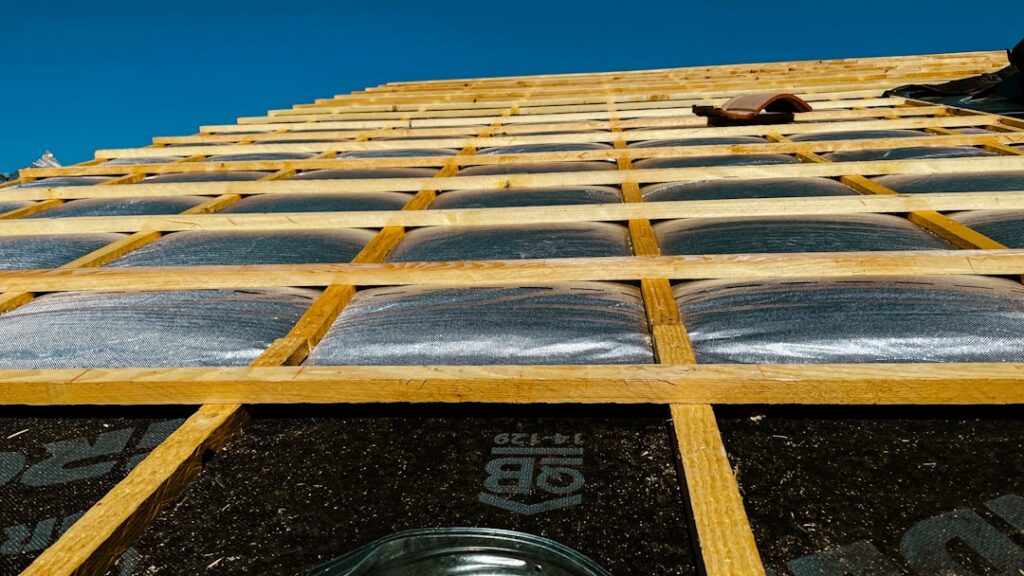
- Batts in a sloped or cathedral rafter bay: rods plus, ideally, a rigid air channel to keep the vent path open
- Loose fill or dense-pack in an open floor: stapled mesh netting
- Insulation on metal panels or ducts: adhesive impaling pins and washers
Get the length right and the install is trouble-free. A 16-inch rod jammed into a 24-inch bay won’t have enough spring to hold, and a 24-inch rod forced into a 16-inch bay bows too hard and can tear the batt facing. Measure your actual joist spacing before you buy, because framing is not always the nominal number you expect, especially in older homes where 16 inches on center can drift to 14 or 18.
Installation Tips That Save Callbacks
Push the batt fully up against the subfloor before you set the support, so there is no gap at the top of the cavity where warm air can pool and cool. Stagger the rods rather than lining them up, which spreads the holding force more evenly along the batt. In a crawlspace, work from one end and support each bay as you go rather than insulating the whole floor and then trying to prop up a run that is already sagging. If you are using mesh netting under blown fill, staple it tight with a slight upward curve so it doesn’t belly down once the weight of the insulation is on it.
One detail crews forget: keep supports clear of wiring and plumbing. A spring rod driven across a bay can pinch a wire against the subfloor over time, and in a cold climate you never want a support pressing a water line tight to an uninsulated surface. Route the rod above or below the utility, not across it.
How Many Supports You Actually Need
Estimating quantity is simple once you know the spacing. For batts in a floor system, plan on one spring rod every 12 to 18 inches along each joist bay. A joist bay that runs 12 feet needs roughly eight to twelve rods on the tighter spacing, and a typical crawlspace with a dozen bays might consume 100 to 150 rods. Since rods come in bundles of 100 for $12 to $20, a whole-crawlspace job costs only $20 to $40 in supports, which is nothing against the value of the insulation they protect. For mesh netting under blown fill, measure the square footage of the floor and add about 10 percent for overlap and stapling waste; a 500-square-foot crawlspace floor takes one large roll with a little left over.
Buy a few more than you calculate. Rods get bent, dropped through the plastic ground cover in a crawlspace, and occasionally snapped when you force one into a bay that is out of square. Having a surplus in your pocket beats crawling back out to the truck for one more handful.
Supports in Retrofit and Encapsulation Jobs
Supports become especially important in two increasingly common projects: crawlspace encapsulation and re-insulating an older home. In an encapsulated crawlspace, the current best practice often moves insulation to the perimeter walls with rigid board, but many homes still have batts in the floor that need to stay put and stay dry. If you are keeping floor batts, re-support any that have sagged, because a drooping batt over a sealed crawlspace traps humid air against the subfloor and invites mold. In an older home where the original insulation has slumped out of the joists over decades, a bundle of spring rods and an afternoon under the house restores most of the lost R-value for the cost of a pizza, no new insulation required.
When you are adding support to an existing insulated floor, work methodically bay by bay, pushing each batt fully up against the subfloor before pinning it. Watch for evidence of past moisture, dark staining or matted insulation, which tells you the batt was hanging and collecting condensation. Fix the support and the moisture source together, or the new rods will just hold a wet batt in place. Combined with a properly sealed and, where needed, conditioned crawlspace, well-supported floor insulation is a quiet but real contributor to a warm floor and a lower heating bill.
The Bottom Line
Supports are the least glamorous part of an insulation job and one of the most important. A crawlspace full of R-19 batts is worthless if half of them are hanging out of the joists by next winter. For the price of a few bundles of spring rods or a roll of netting, you lock the insulation where it belongs and protect the far larger investment in the insulation itself. Whenever I insulate a horizontal or sloped cavity, insulation supports go in as part of the same pass, because the ten minutes they add up front is far cheaper than crawling back under the house to re-hang sagging batts a year down the line.