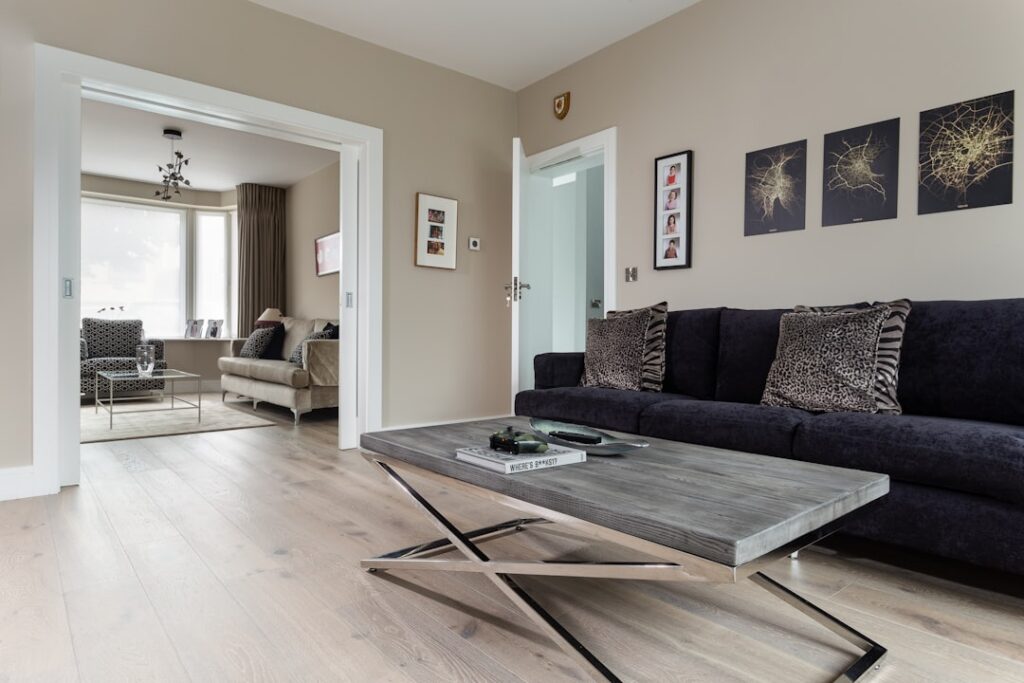
Walk into a showroom and ask a sales rep whether laminate is plastic, and you will get three different answers from three different staff members. The confusion is understandable because the product blends plastic-like materials with real wood components in a way that no marketing brochure explains clearly. Is laminate plastic is one of the most-searched flooring questions because homeowners want to know what they are actually buying. The short answer is that laminate is partially plastic but mostly wood byproducts, with the plastic playing a critical role in the wear layer that defines the floor’s lifespan.
The Four-Layer Construction
Modern laminate is built like a sandwich with four distinct layers. From bottom to top:
- Backing layer — melamine plastic, prevents moisture absorption from below
- Core layer — high-density fiberboard (HDF), compressed wood fibers
- Decorative layer — printed paper with the wood or stone image
- Wear layer — clear melamine resin (a plastic-like polymer)
The HDF core makes up about 80 percent of the total thickness. That is technically wood (sawmill byproducts compressed with resin), not plastic. The other 20 percent across the top and bottom is melamine resin, which is a thermosetting plastic polymer.
What Is Melamine and How Does It Behave
Melamine resin is a synthetic polymer formed by condensing melamine with formaldehyde. It cures into a hard, scratch-resistant, heat-tolerant surface. The same chemistry shows up in countertops (Formica) and kitchen cookware. Technically a plastic, but a thermoset rather than the thermoplastic used in vinyl flooring.
The melamine wear layer on premium laminate is what gives the product its AC4 or AC5 abrasion rating. It resists scratches from chair legs, pet claws, and high heels in ways that polyurethane-finished hardwood cannot. The trade-off is that once the melamine layer is worn through, the floor cannot be refinished.
How Laminate Differs From Vinyl
The confusion between laminate and vinyl comes from both products being click-lock and both having printed image layers. Construction is completely different. Vinyl is 100 percent synthetic, with a PVC core and PVC wear layer. Laminate is roughly 80 percent compressed wood with a melamine plastic skin.
This construction difference drives the performance gap. Vinyl handles water because PVC does not absorb moisture. Laminate’s HDF core swells when water sits on the seams for hours. Premium laminates from Pergo and Mohawk now offer 24-hour waterproof warranties through tighter seam locks, but the core material is still wood-based.
Is the Wood Real or Synthetic
The wood look is printed on paper, not real wood. High-resolution digital printers create the image, which is then sealed under the melamine wear layer. Premium laminates from Pergo, Mohawk, and Quick-Step use 12 to 24 unique face variations per SKU to avoid visible pattern repeats across a room.
Embossed-in-register (EIR) technology adds physical texture that matches the printed grain. Run your hand across a premium EIR laminate and you can feel knots, planks, and woodgrain. Run it across budget laminate and the surface feels flat regardless of the printed image.
Formaldehyde and Indoor Air Quality
The resin that binds the HDF core can release formaldehyde over time, especially in the first months after installation. California’s CARB 2 standard sets the strictest residential limit at 0.05 ppm. Look for the FloorScore certification on the box, which verifies CARB 2 compliance plus broader VOC emission limits.
European E1 standard is comparable to CARB 2 and most laminates sold in the U.S. now meet one or both. Avoid imported laminate without certification labels. The price difference between certified and uncertified is small, and the indoor air quality impact is real.
Recyclability and Sustainability
Laminate’s wood-byproduct core makes it more sustainable than vinyl in some respects, but the melamine layer complicates recycling. Most laminate ends up in landfills at end-of-life because the layers cannot be separated economically.
The HDF core does use wood waste from other manufacturing, which keeps usable fiber out of landfills during production. Premium European brands like Quick-Step publish full Environmental Product Declarations (EPDs) that document carbon footprint per square meter. American producers are slower to publish but moving in that direction.
Why the “Plastic” Label Sticks
Homeowners call laminate plastic mostly because of how it looks and feels. The melamine top layer is glossier and harder than polyurethane-finished hardwood. The click-lock seams feel synthetic. The product comes from a factory rather than a sawmill. From a visual and tactile standpoint, calling laminate plastic is reasonable shorthand.
Industrially and chemically, it is more accurate to call laminate a wood-and-plastic composite. The performance characteristics blend both material families: the dimensional stability and feel of wood with the scratch and stain resistance of plastic.
Heat, Cold, and Static Behavior
Because laminate combines wood and plastic, its thermal behavior sits between the two pure categories. The HDF core expands and contracts with humidity like hardwood but at smaller magnitudes. The melamine layer can develop static in dry winter conditions, though premium products use anti-static additives that reduce the effect significantly.
Radiant heat compatibility varies by brand. Pergo, Mohawk RevWood, and Quick-Step all approve floor heating up to 81 degrees F surface temperature. Going higher than 85 degrees F degrades the resin binder in the core and can cause premature failure. Check the specific SKU before installing over radiant.
How This Affects Your Buying Decision
Understanding the construction helps you compare laminate against alternatives. If you want true wood with refinishing potential, choose engineered or solid hardwood at $4.99 to $11.99 per sq ft. If you want true waterproof construction, choose LVP at $1.99 to $5.99 per sq ft. If you want the scratch resistance of melamine, the dimensional stability of an HDF core, and the price advantage of a manufactured product, laminate at $1.49 to $4.99 per sq ft is the right answer.
The is laminate plastic question matters most when you compare warranties, expected lifespan, and end-of-life disposal. Knowing that you are buying a wood-core product with a plastic wear layer helps you maintain it correctly and set realistic expectations about its 15 to 25 year lifespan.
Prefer to explore on your own?
See how new flooring looks in your actual room in seconds — free, no signup.
Try the free Floor Studio →