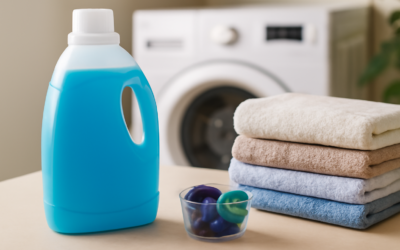
The honest answer to is powdered detergent better than liquid depends on three variables most shoppers ignore: water hardness in your zip code, the stains you fight most often, and whether your washer is a high-efficiency front loader or a traditional top loader. Powder dominates on mud, grass, and ground-in dirt because it contains higher concentrations of surfactants and oxygen bleach. Liquid wins on grease, oil, and food stains because it dissolves instantly in cold water. Below is the breakdown that takes the marketing noise out of the decision.
How the Two Formulas Actually Differ
Powdered detergent is a dry blend of alkaline builders, sodium carbonate, surfactants, enzymes, and often sodium percarbonate — the active ingredient in OxiClean. Liquid detergent uses water as a carrier with synthetic surfactants like linear alkylbenzene sulfonate, nonionic surfactants, and stabilizers that keep enzymes active in solution. Tide Original Powder, for example, contains roughly 40 percent active cleaning agents by weight, while Tide Liquid runs closer to 18 to 22 percent active agents.
That density difference explains a lot. Powder gives you more cleaning chemistry per dollar, but it needs warmer water — generally 60 degrees Fahrenheit or above — to dissolve fully. Liquid is pre-dissolved and works at any temperature, including the 50 to 55 degree tap water common in northern winters.
Cleaning Power on Real Stains
Independent testing by Consumer Reports and the American Cleaning Institute consistently shows powder beating liquid on clay, dirt, grass, and blood. The oxygen bleach in powders like Tide, Persil, and Arm and Hammer breaks down protein and tannin stains that liquids leave behind. If you have kids in soccer or do gardening on weekends, powder is the smarter buy week after week.
Liquid takes the win on grease, lipstick, salad dressing, and motor oil. The pre-dissolved surfactants attack oil-based stains immediately, especially when you pretreat by pouring liquid directly onto the spot. Persil ProClean Liquid, Tide Hygienic Clean Heavy Duty, and Arm and Hammer Plus OxiClean Liquid all earned top marks on greasy food stains in recent CR testing rounds.
Water Hardness Changes the Answer
Water hardness is the variable most people overlook. If your home sits in a hard water area — most of the Southwest, Midwest, and Florida register above 7 grains per gallon — powder’s higher builder content of sodium carbonate and zeolites softens the wash water and lifts soil better than liquid. The USGS publishes a hardness map by county; check it before you commit to one format.
In soft water areas like the Pacific Northwest and New England, liquid performs just as well and sometimes better because it does not leave the slight residue that under-dissolved powder can leave on dark fabrics. If you run a water softener at home, the playing field is level and you can pick based purely on stain type and cost per load.
Cost Per Load Breakdown
Cost per load is where powder usually wins by a meaningful margin. A 143-load box of Tide Original Powder runs about $22 to $26 at Walmart or Costco, putting the price at $0.15 to $0.18 per load. The same brand in liquid form, at 146 loads for $26 to $30, lands at $0.18 to $0.21 per load. Persil and Arm and Hammer show similar gaps in their lineup.
Bulk warehouse buying widens the lead further. Costco’s Kirkland Signature Ultra Clean Powder works out to roughly $0.11 per load when bought in 169-load boxes. Liquid pods are the most expensive format at $0.28 to $0.42 per load, even though they market themselves as convenient. The convenience cost is real and adds up to $70 annually for a family of four.
HE Washer Compatibility
Both formulas work in high-efficiency front loaders and top loaders, but only if you use the right amount. HE washers use 30 to 50 percent less water, so dosing matters. Powder marked HE-compatible — look for the blue HE symbol on the box — dissolves in low-water cycles. Tide HE Powder, Persil HE, and Arm and Hammer HE all fit modern Whirlpool, LG, and Samsung HE machines without issues.
If you run cold-only cycles in an HE front loader, liquid is the safer pick because dissolution failures show up as white streaks on dark fabric. For warm or hot cycles, powder works without issue. Never use non-HE detergent in an HE machine — the excess suds trigger error codes, shorten pump life, and void most manufacturer warranties before you reach year three.
Storage, Shelf Life, and Environmental Impact
Powdered detergent stores for two years in a sealed container without losing potency, while liquid detergent degrades after 9 to 12 months as enzymes break down in solution. If you buy in bulk or shop infrequently, powder is the practical choice. Keep both formats below 100 degrees Fahrenheit and away from humidity to maximize shelf life and avoid clumping.
On the environmental side, powder ships in cardboard boxes that recycle in most curbside programs, while liquid jugs use HDPE plastic that requires separate collection. Powder also weighs less per load, which lowers shipping carbon. The EPA Safer Choice program certifies both Method Powder and Seventh Generation Liquid as low-impact options if eco-friendliness matters to your buying decision.
The Bottom Line for Most Households
So is powdered detergent better than liquid? For most American households dealing with mixed loads, hard water, and a mix of warm and cold washes, powder delivers stronger cleaning at lower cost per cycle. Buy Tide Original Powder, Persil ProClean Powder, or Arm and Hammer Plus OxiClean Powder for general use. Keep a small bottle of liquid — Tide Liquid or Persil ProClean Liquid — for pretreating greasy stains and for cold-only winter loads.
Households with infants, sensitive skin, or septic systems should default to liquid for easier dosing and lower residue concerns. Otherwise, the math and the chemistry both favor powder. Track your stain types for one month, check your water hardness through the USGS map, and the right answer will be obvious within four weeks of laundering.