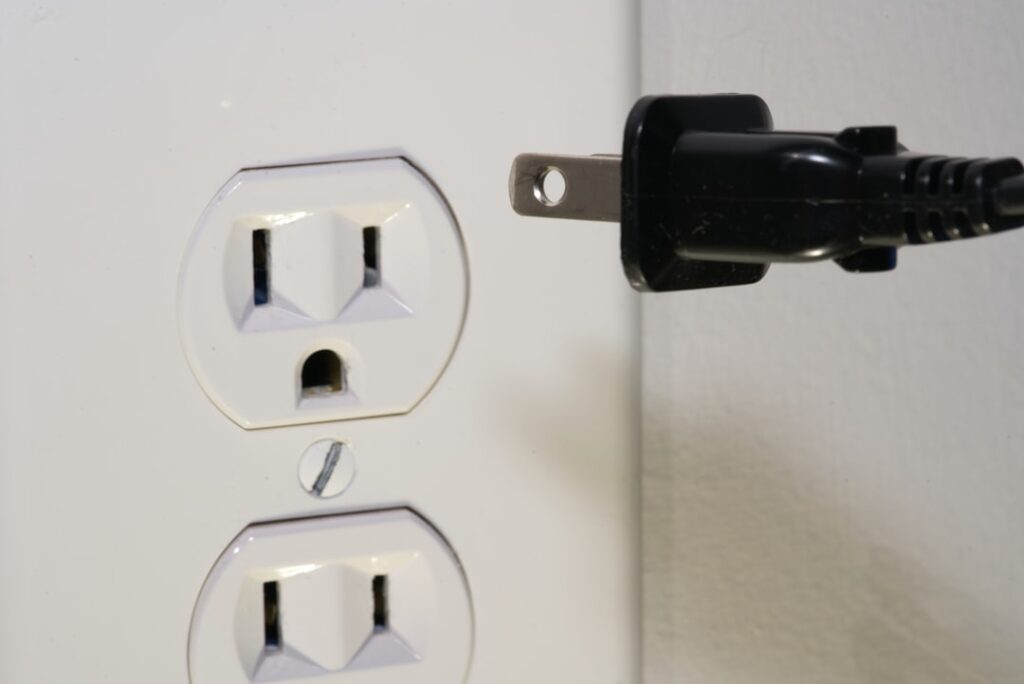
If you are packing for Tokyo or wiring up a device you bought there, the first thing to understand is that a Japan electrical outlet looks almost exactly like a North American one — two flat vertical slots — but the voltage behind it is different. Japan runs on 100 volts, not the 120V you get in the United States, and the country is split between 50 Hz and 60 Hz depending on the region. Most US plugs physically fit, but “fits” and “safe to run” are not the same thing.
- Outlet Types: A and B
- Voltage and Frequency — the Part That Actually Matters
- Check Your Device’s Rating First
- Adapter vs. Converter — Know the Difference
- Sizing a Converter by Wattage
- Practical Packing List for Japan
- Common Devices and What They Need
- Why the 100V Difference Rarely Hurts
- Hotels, Rentals, and Charging Multiple Devices
- Quick Reference
Here is exactly what the outlets are, which of your devices will work, and when you need a simple adapter versus a real voltage converter.
Outlet Types: A and B
Japan uses the same plug standards as the US and Canada:
- Type A: Two flat parallel prongs, no ground. The most common outlet you will see in older buildings and hotels.
- Type B: Two flat prongs plus a round grounding pin. Found in newer construction, kitchens, and near appliances that need a ground.
One important difference from the US: many Japanese Type A outlets are not polarized the same way — the two slots are often the same size. A US polarized plug, with one prong wider than the other, may not fit a Japanese outlet where both slots are narrow. That is the one physical incompatibility that surprises travelers.
Voltage and Frequency — the Part That Actually Matters
- Voltage: 100V in Japan vs. 120V in the US. A 20-volt difference.
- Frequency: Eastern Japan (Tokyo, Yokohama, Sendai) runs 50 Hz; Western Japan (Osaka, Kyoto, Nagoya, Hiroshima) runs 60 Hz. The dividing line runs roughly through the middle of the country.
The 100V vs. 120V gap is small enough that most modern US electronics run fine in Japan without a converter — they just run at slightly lower power. The frequency split mainly affects old motor-driven and clock devices, not modern switching power supplies.
Check Your Device’s Rating First
Before you buy anything, read the fine print on the device or its power brick. Look for the input rating:
- “INPUT: 100–240V, 50/60Hz” — This is dual-voltage. It works anywhere in the world. You only need a plug adapter, never a converter. Nearly all phone chargers, laptop bricks, camera chargers, and tablet chargers are dual-voltage.
- “INPUT: 120V, 60Hz” — This is single-voltage US-only. It expects 120V. Running it on Japan’s 100V will underpower it (usually harmless but sluggish for heaters), and running a 100V-only Japanese device on US 120V can overheat it.
The 100V/120V difference is the reverse of the usual travel-converter problem. US devices in Japan get less voltage than they expect, so the risk is underperformance, not burnout. It is Japanese devices brought to the US that face higher voltage and can be damaged.
Adapter vs. Converter — Know the Difference
These two get confused constantly:
- Plug adapter: Changes only the shape of the plug so it fits the outlet. It does not change voltage. Cheap, small, $5–$15.
- Voltage converter (transformer): Actually changes the voltage — steps 100V up to 120V or 120V down to 100V. Bulky, heavier, $20–$80 depending on wattage.
For US Travelers Going to Japan
- If your device says 100–240V: you need no converter. Bring a simple Type A plug adapter only if your plug is polarized or three-pronged and won’t fit — often it fits fine.
- If your device is 120V-only and low-draw (a small radio, a lamp): it will usually run at 100V, just dimmer. No damage.
- If your device is 120V-only and heat- or motor-critical (a US hair dryer, curling iron, CPAP heater): consider a step-up converter so it gets full 120V and performs correctly. Better yet, buy a dual-voltage travel version.
For Japanese Devices Used in the US
This is the more dangerous direction. A 100V-only Japanese appliance plugged into a US 120V outlet gets 20 percent over-voltage, which can overheat motors and heating elements. Use a step-down converter (120V to 100V) sized for the device’s wattage — for a rice cooker or a hair dryer that means a converter rated well above the appliance’s draw.
Sizing a Converter by Wattage
If you do need a converter, match its wattage rating to the device with headroom:
- Electronics (chargers, small devices): a 50–100W converter is plenty — but most of these are dual-voltage and need none.
- Hair dryers, irons, kettles: 1,500–2,000W. Buy a converter rated at least 25 percent above the appliance to avoid overheating.
Never run a high-wattage heating appliance through an undersized converter — it is a fire risk and will trip or melt.
Practical Packing List for Japan
- Phone, laptop, camera chargers — check for “100–240V,” then just bring a couple of Type A plug adapters (and a Type B if anything is three-pronged).
- A small power strip / multi-USB charger that is dual-voltage — powers several devices from one adapter.
- Skip the US hair dryer; use the hotel’s or buy a cheap dual-voltage travel dryer.
- Leave single-voltage US-only appliances at home unless you bring the right converter.
Common Devices and What They Need
It helps to run down the gear people actually pack. Phone and tablet chargers are virtually always 100–240V — plug adapter only, if anything, and many fit a Japanese outlet with no adapter at all. Laptop bricks are dual-voltage; check the label, but the answer is almost always yes. Camera and drone battery chargers are typically dual-voltage too. Electric toothbrush and shaver chargers are usually 100–240V. The problem children are hair dryers, flat irons, and curling wands — many US models are 120V-only and high-wattage, so they either underperform on 100V or, if you brought a dual-voltage travel version, work fine. CPAP machines usually accept 100–240V but confirm the heated-humidifier draw. When in doubt, the “INPUT” line printed on the device or its brick settles it.
Why the 100V Difference Rarely Hurts
Travelers coming from higher-voltage countries worry about frying their gear, but Japan’s 100V is lower than the US 120V, so US devices in Japan receive slightly less voltage than they expect. For electronics with switching power supplies — which is nearly everything with a charging brick — that 20-volt shortfall is well within tolerance and they run normally. The only noticeable effect is on resistive heating and motor devices: a US hair dryer will blow a little cooler, a US-made heater will run at reduced output. Nothing gets damaged going from 120V down to 100V. The genuine hazard runs the other way — a 100V-only Japanese appliance plugged into US 120V receives over-voltage and can overheat, which is why that direction needs a step-down converter.
Hotels, Rentals, and Charging Multiple Devices
Japanese hotel rooms often have only one or two accessible outlets, and older buildings may have unpolarized Type A receptacles where both slots are the same narrow width. Two practical moves cover you: bring a compact multi-port USB charger that is dual-voltage, so one outlet powers your phone, watch, earbuds, and a tablet at once; and bring a small non-grounded travel power strip rated for 100–240V to multiply a single outlet. Avoid plugging a US surge-protected power strip with a grounded three-prong plug into a two-slot Japanese outlet — the ground pin will not seat, and forcing it defeats the protection. A couple of Type A adapters plus one good multi-charger is the lightest kit that keeps everything topped up.
Quick Reference
- Outlet type: A (2-prong) and B (2-prong + ground).
- Voltage: 100V.
- Frequency: 50 Hz east, 60 Hz west.
- US dual-voltage gear: plug adapter only.
- US single-voltage heat/motor gear: step-up converter or buy dual-voltage.
- Japanese 100V gear in the US: step-down converter, sized above the wattage.
The bottom line on the Japan electrical outlet: the plug shape is nearly identical to a US outlet, so most of your modern electronics simply work with a cheap adapter, if they need anything at all. Read the “INPUT” label on each device, carry a couple of Type A adapters, and save the bulky voltage converter for the one or two single-voltage heat-hungry appliances you truly cannot leave behind.