Planning a laminate flooring project starts with one critical question: how much will it cost? A laminate flooring installation cost calculator helps you estimate your total budget by factoring in material costs, labor rates, room size, and the hidden expenses that catch many homeowners off guard.
- Average Laminate Flooring Installation Costs in 2026
- How to Calculate Your Laminate Installation Cost
- Step 1: Measure Your Square Footage
- Step 2: Choose Your Laminate Grade
- Step 3: Add Underlayment Costs
- Step 4: Factor in Labor Costs
- Step 5: Add Hidden and Ancillary Costs
- Room Size Cost Estimates
- Small Bedroom (10 x 10 = 100 sqft)
- Standard Bedroom (12 x 14 = 168 sqft)
- Living Room (16 x 20 = 320 sqft)
- Open Floor Plan (30 x 40 = 1,200 sqft)
- Whole House (1,500 sqft)
- DIY vs Professional Installation Cost Comparison
- DIY Installation Costs
- Professional Installation Costs
- The Real Savings Calculation
- When to Hire a Professional
- Hidden Costs That Blow Budgets
- Subfloor Problems
- Moisture Testing and Barriers
- Asbestos in Old Flooring
- Trim and Molding Replacement
- Furniture Moving and Storage
- Cost-Saving Tips for Laminate Installation
- Regional Cost Variations
- Getting Accurate Quotes
- Final Thoughts
In this comprehensive guide, we break down every cost component of laminate installation in 2026, provide room-by-room estimates, compare DIY versus professional pricing, and give you the tools to calculate your own project budget with confidence.
Average Laminate Flooring Installation Costs in 2026
Before diving into the calculator details, here are the national average costs for laminate flooring installation in 2026:
- Materials only: $1.00 to $5.00 per square foot
- Professional labor: $1.50 to $4.00 per square foot
- Total installed cost: $2.50 to $9.00 per square foot
- National average for a 200 sqft room: $800 to $1,800
- Whole house (1,500 sqft): $3,750 to $13,500
These figures include the laminate planks, underlayment, and basic installation but do not include old flooring removal, subfloor repairs, or trim work. Those extras can add 20 to 40 percent to your total.
How to Calculate Your Laminate Installation Cost
Use the following step-by-step method to estimate your own project cost. This serves as your laminate flooring installation cost calculator.
Step 1: Measure Your Square Footage
Measure the length and width of each room in feet and multiply them together. For L-shaped or irregularly shaped rooms, break the space into rectangles and add the areas together.
- Rectangular room: length x width = square feet
- L-shaped room: (section 1 length x width) + (section 2 length x width)
- Add 10 percent for waste, cuts, and mistakes
Step 2: Choose Your Laminate Grade
Laminate flooring ranges dramatically in quality. Here is what to expect at each price tier:
- Budget ($1.00 to $2.00/sqft): 6-7mm thickness, AC3 rating, basic wood-look designs, shorter warranties
- Mid-range ($2.00 to $3.50/sqft): 8-10mm thickness, AC3-AC4 rating, embossed-in-register textures, 20-25 year warranties
- Premium ($3.50 to $5.00/sqft): 10-12mm thickness, AC4-AC5 rating, waterproof core options, lifetime warranties
Step 3: Add Underlayment Costs
Underlayment is required for all laminate installations unless the planks come with pre-attached padding. Standard underlayment costs:
- Basic foam underlayment: $0.15 to $0.30 per square foot
- Premium cork or rubber underlayment: $0.50 to $1.00 per square foot
- Moisture barrier underlayment (for concrete subfloors): $0.25 to $0.60 per square foot
Step 4: Factor in Labor Costs
Professional installation rates depend on your location, room complexity, and the installer’s experience:
- Basic installation (straightforward room): $1.50 to $2.50 per square foot
- Complex installation (stairs, angles, many doorways): $2.50 to $4.00 per square foot
- Minimum job charges: Many installers have a minimum charge of $200 to $500, regardless of room size
Step 5: Add Hidden and Ancillary Costs
These are the expenses that blow budgets. Factor them in from the start:
- Old flooring removal: $0.50 to $2.00 per square foot
- Subfloor leveling: $1.00 to $3.00 per square foot if needed
- Baseboards and trim: $0.75 to $2.00 per linear foot for new quarter round or baseboards
- Transition strips: $5 to $30 per doorway
- Door jamb undercutting: $10 to $30 per doorway
- Furniture moving: $50 to $200 if the installer handles it
- Disposal fees: $25 to $100 for hauling away old flooring
Room Size Cost Estimates
Here are complete cost estimates for common room sizes, assuming mid-range laminate ($2.50/sqft material) and professional installation ($2.00/sqft labor):
Small Bedroom (10 x 10 = 100 sqft)
- Laminate material (110 sqft with waste): $275
- Underlayment: $33
- Installation labor: $200
- Trim and transitions: $75
- Total estimate: $583
Standard Bedroom (12 x 14 = 168 sqft)
- Laminate material (185 sqft with waste): $463
- Underlayment: $56
- Installation labor: $336
- Trim and transitions: $100
- Total estimate: $955
Living Room (16 x 20 = 320 sqft)
- Laminate material (352 sqft with waste): $880
- Underlayment: $106
- Installation labor: $640
- Trim and transitions: $150
- Total estimate: $1,776
Open Floor Plan (30 x 40 = 1,200 sqft)
- Laminate material (1,320 sqft with waste): $3,300
- Underlayment: $396
- Installation labor: $2,400
- Trim and transitions: $400
- Total estimate: $6,496
Whole House (1,500 sqft)
- Laminate material (1,650 sqft with waste): $4,125
- Underlayment: $495
- Installation labor: $3,000
- Trim, transitions, and extras: $750
- Total estimate: $8,370
DIY vs Professional Installation Cost Comparison
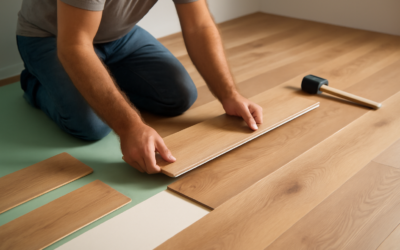
One of the biggest ways to cut your laminate flooring budget is to install it yourself. Laminate is one of the most DIY-friendly flooring options thanks to its click-lock installation system. But is it always worth doing yourself?
DIY Installation Costs
When you install laminate yourself, you eliminate labor costs entirely. For a 300 square foot room with mid-range laminate, your costs break down like this:
- Laminate material: $750
- Underlayment: $90
- Tools (if buying): $75 to $150 (pull bar, tapping block, spacers, saw)
- Trim and transitions: $100
- DIY total: $1,015 to $1,090
Professional Installation Costs
The same 300 square foot room with professional installation:
- Laminate material: $750
- Underlayment: $90
- Labor: $600
- Trim and transitions: $100
- Professional total: $1,540
The Real Savings Calculation
DIY saves approximately $450 to $600 on a 300 square foot room. However, consider the time investment of 8 to 16 hours for a first-time installer. If you value your time at $25 per hour, that is $200 to $400 in time, reducing your real savings to $50 to $400.
DIY installation makes the most financial sense for larger projects where labor savings compound. On a 1,500 square foot whole-house project, you could save $2,500 to $3,000 by doing it yourself.
When to Hire a Professional
Hire a pro when your project involves stairs, complex room shapes, extensive subfloor repair, or if you have limited time. Professional installers also handle warranty requirements, as some laminate warranties require certified installation.
Hidden Costs That Blow Budgets
The most common reason laminate flooring projects go over budget is hidden costs that were not accounted for in the initial estimate. Here are the ones to watch:
Subfloor Problems
If your subfloor is uneven, damaged, or has moisture issues, it must be fixed before laminate goes down. Subfloor leveling with self-leveling compound costs $1 to $3 per square foot. Plywood subfloor replacement runs $2 to $5 per square foot. These repairs can add $500 to $2,000 to a typical project.
Moisture Testing and Barriers
Concrete subfloors require moisture testing before installation. If moisture levels exceed the laminate manufacturer’s specifications, you need a vapor barrier or may need to address the moisture source. Testing costs $50 to $200, and additional moisture mitigation can run $200 to $1,000.
Asbestos in Old Flooring
Homes built before 1980 may have asbestos in vinyl tiles, adhesives, or underlayment. Professional asbestos abatement costs $5 to $20 per square foot, which can add thousands to a project. Never remove suspected asbestos-containing materials yourself.
Trim and Molding Replacement
Installing new laminate often means your existing baseboards no longer sit flush with the floor. You may need to remove and reinstall baseboards, add quarter round molding, or replace trim entirely. Budget $1 to $3 per linear foot for new trim and installation.
Furniture Moving and Storage
All furniture must be removed from the room before installation. If you cannot do this yourself, installers charge $50 to $200 for furniture moving. For whole-house projects, you may need temporary storage.
Cost-Saving Tips for Laminate Installation
Here are proven strategies to reduce your laminate flooring installation cost without sacrificing quality:
- Shop seasonal sales: The best laminate deals appear during holiday weekends (Memorial Day, Labor Day, Black Friday) and during January clearance events.
- Buy slightly more than you need: While adding 10 percent for waste seems counterintuitive as a savings tip, running short and reordering costs more due to shipping and potential dye-lot differences.
- Choose laminate with attached underlayment: This eliminates a separate purchase and saves on labor time, reducing your overall cost by $0.30 to $0.75 per square foot.
- Remove old flooring yourself: Even if you hire a pro for installation, doing the demolition yourself saves $0.50 to $2.00 per square foot.
- Get multiple quotes: Always get at least three installation quotes. Prices vary significantly between contractors, and you can sometimes negotiate by sharing competing bids.
- Consider engineered wood flooring alternatives: In some cases, engineered hardwood on sale can cost similar to premium laminate while adding more resale value.
Regional Cost Variations
Installation costs vary significantly by region. Here is how major metro areas compare to the national average:
- New York City / San Francisco: 30 to 50 percent above national average
- Los Angeles / Seattle / Boston: 15 to 30 percent above average
- Dallas / Atlanta / Denver: Near national average
- Phoenix / Charlotte / Nashville: 5 to 15 percent below average
- Rural areas: 10 to 25 percent below average, but fewer contractor options
Getting Accurate Quotes
When requesting installation quotes, provide the following information to get the most accurate estimate:
- Total square footage with room dimensions
- Current flooring type (will it need removal?)
- Subfloor type (wood or concrete)
- Number of rooms and doorways
- Whether stairs are included
- Your laminate product choice (or ask the installer to supply)
- Whether you need baseboards and trim
Ask each installer to provide an itemized quote so you can compare line items directly. Be wary of quotes that are significantly lower than competitors, as they may not include essential steps like subfloor preparation.
Final Thoughts
A laminate flooring installation cost calculator is only as accurate as the inputs you provide. By measuring carefully, choosing the right product grade, accounting for hidden costs, and comparing multiple quotes, you can budget your project with confidence. Whether you go the DIY route to save on labor or hire a professional for a polished finish, laminate flooring remains one of the most affordable ways to get the look of hardwood without the hardwood price tag.
Prefer to explore on your own?
See how new flooring looks in your actual room in seconds — free, no signup.
Try the free Floor Studio →