Shopping for laminate flooring San Jose homeowners can rely on means navigating a competitive Bay Area market where prices, installers, and product quality vary widely. The good news is that laminate is one of the most forgiving and budget-friendly floors you can choose, and San Jose’s mild, dry-summer climate is genuinely well suited to it. This guide walks you through choosing the right product, comparing local quotes fairly, and avoiding the mistakes that lead to buckled seams and disappointing results.
- Why Laminate Works Well in San Jose
- Choosing the Right Laminate Grade
- What Laminate Costs in the Bay Area
- How to Compare Local Quotes Fairly
- Pros and Cons of Laminate
- Installation Tips for San Jose Homes
- Choosing a Look That Fits Bay Area Homes
- Water-Resistant vs. Standard Laminate
- Maintenance and Longevity
- The Bottom Line
Why Laminate Works Well in San Jose
The South Bay’s Mediterranean climate is kind to laminate. Summers are warm and dry, winters are mild, and indoor humidity stays relatively stable compared with the humid Southeast or the frigid Upper Midwest. That stability matters because laminate’s fiberboard core swells when it gets wet or when humidity swings hard. With reasonable HVAC use, San Jose homes rarely push laminate outside its comfort zone, which means fewer gaps, less peaking, and a longer service life.
Choosing the Right Laminate Grade
The most important spec on any laminate box is the AC (Abrasion Class) rating. It tells you how much traffic the floor can handle.
- AC3: Standard residential. Fine for bedrooms and low-traffic living areas.
- AC4: Heavy residential and light commercial. The sweet spot for most family homes with kids or pets.
- AC5: Commercial-grade. Overkill for most homes but worth it for entryways and high-traffic hallways.
Beyond AC rating, look at plank thickness (8mm to 12mm feels more solid and quiets footsteps), the locking system, and whether the product carries a water-resistant or waterproof top layer. Modern water-resistant laminates handle the occasional spill far better than the products of a decade ago.
What Laminate Costs in the Bay Area
Bay Area labor runs higher than the national average, so plan your budget accordingly. Material costs are roughly consistent nationwide, but installation in San Jose tends to sit at the upper end.
- Material: $1.50 to $4.00 per sq ft depending on thickness and brand.
- Underlayment: $0.30 to $0.80 per sq ft if not pre-attached.
- Professional installation: commonly $3 to $6 per sq ft in the South Bay.
- Subfloor prep and old-floor removal: variable; always get this itemized.
These are general ranges, not quotes. Because labor and disposal fees fluctuate, the only way to know your real number is to collect several local estimates.
How to Compare Local Quotes Fairly
The single best thing you can do is gather at least three written estimates and compare them line by line. A low headline price often hides costs that competitors included. To compare apples to apples, make sure every quote specifies the exact product brand and AC rating, the underlayment type, subfloor leveling, old-flooring removal and disposal, transitions and trim, and a written workmanship warranty.
- Confirm the installer is licensed and insured for work in California.
- Ask how they handle subfloor moisture testing, especially in slab-on-grade homes.
- Request references or recent project photos in the San Jose area.
- Get the warranty terms in writing, separating the manufacturer’s product warranty from the installer’s labor warranty.
Be wary of any quote that is dramatically lower than the rest; it usually means corners will be cut on prep, which is exactly where laminate failures begin.
Pros and Cons of Laminate
Laminate earns its popularity through value and looks, but it is not the right floor for every room. Knowing the trade-offs keeps your expectations realistic.
On the plus side, laminate delivers convincing wood and stone visuals at a fraction of the cost, resists scratches and fading well, and installs quickly as a floating floor over most existing surfaces. The downsides are real too: standard laminate cannot be refinished, water intrusion at the seams can ruin it, and cheaper products can sound hollow underfoot without quality underlayment. For kitchens and bathrooms, a waterproof rigid-core vinyl is often the safer choice.
Installation Tips for San Jose Homes
Many South Bay homes, especially Eichlers and mid-century builds, sit on concrete slabs. Slabs require a moisture barrier and careful moisture testing before any laminate goes down, because trapped slab moisture is a leading cause of failure. Let the laminate acclimate in the room for 48 hours so it adjusts to indoor temperature and humidity. Leave a 1/4 to 3/8 inch expansion gap around the perimeter so the floor can move with the seasons. If your home has significant temperature swings from large west-facing windows, that expansion gap is non-negotiable.
Choosing a Look That Fits Bay Area Homes
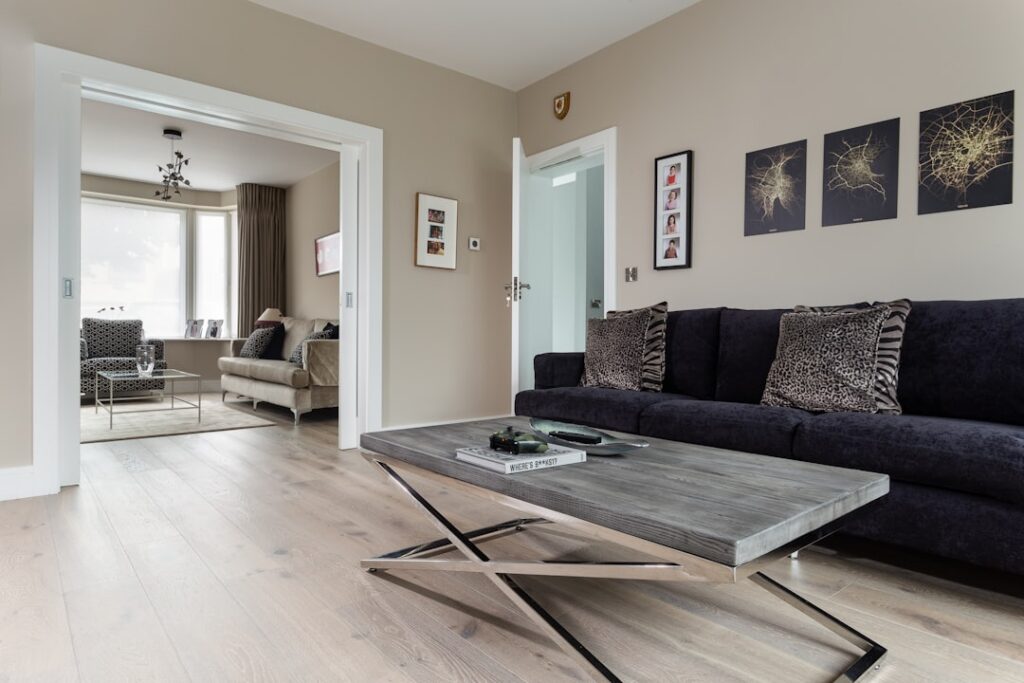
San Jose’s housing mix runs from mid-century ranches and Eichlers to modern townhomes and condos, and your laminate’s visual should suit the architecture. Light, wide-plank oak and pale gray tones complement the clean lines and big windows of mid-century and contemporary homes, making rooms feel larger and brighter. Warmer, medium-brown wood looks ground more traditional spaces and hide everyday dust well. Higher-end laminates now feature embossed-in-register textures, where the surface texture aligns with the printed grain, plus beveled edges that mimic real plank seams convincingly. Bring samples home and view them against your cabinets, trim, and natural light at different times of day, since the strong California sun shifts how tones read from morning to afternoon.
Water-Resistant vs. Standard Laminate
Laminate has come a long way, and one of the most useful upgrades is water-resistant construction. Standard laminate swells quickly if water sits on the seams, which is why it has long been discouraged in kitchens. Newer water-resistant products use tighter-locking joints and treated cores that can withstand spills for several hours before damage occurs, making them a safer choice for a Bay Area kitchen or a busy family entryway. Fully waterproof rigid-core vinyl is still the better pick for bathrooms and laundry rooms, but if you love the feel and price of laminate and want it in a kitchen, paying up for a water-resistant rated product is money well spent. Always confirm the specific rating and its warranty coverage before assuming a laminate can handle moisture.
Maintenance and Longevity
Laminate is among the easiest floors to live with. Sweep or dry-vacuum regularly, and clean with a barely damp microfiber mop and a laminate-safe cleaner. Never wet-mop or steam-clean, since standing water is laminate’s worst enemy. Wipe spills immediately, use felt pads under furniture, and place mats at entryways to catch grit. With AC4 laminate and good habits, a Bay Area homeowner can reasonably expect 15 to 25 years of service.
The Bottom Line
For laminate flooring San Jose buyers, success comes down to matching the AC rating to your traffic, respecting the slab with proper moisture testing, and comparing several itemized local quotes rather than chasing the lowest sticker price. The region’s stable climate plays to laminate’s strengths, so with the right product and a careful installer, you can get a great-looking, durable floor without overspending.
Prefer to explore on your own?
See how new flooring looks in your actual room in seconds — free, no signup.
Try the free Floor Studio →