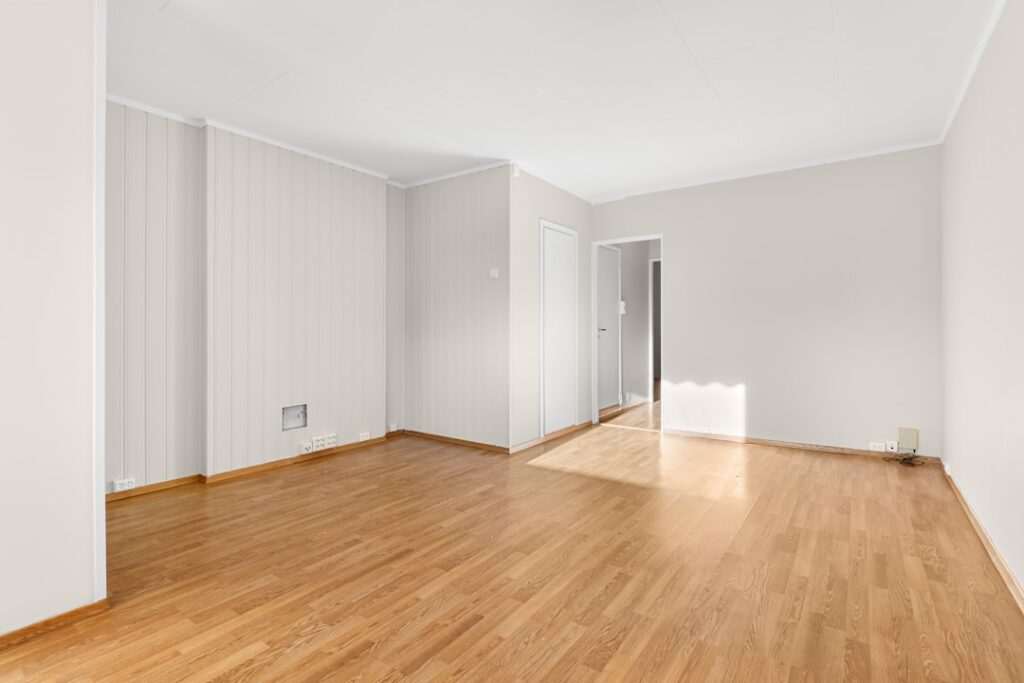
Hiring a laminate flooring service can be the difference between a floor that snaps tight and lies flat for 20 years and one that buckles at the seams within a single humid summer. Laminate is one of the most DIY-friendly floors on the market, yet the failures that show up most often, gapping, peaking, and squeaks, almost always trace back to skipped prep rather than the product itself. A good installer earns their fee in the parts of the job you never see. Here is how to figure out what a service should cover, what it should cost, and how to separate a careful crew from a quick one.
- What a Laminate Flooring Service Actually Includes
- Why Subfloor Prep Decides Everything
- Typical Costs for Professional Installation
- How to Vet a Laminate Flooring Contractor
- Pros and Cons of Hiring Out vs. DIY
- Questions to Settle Before You Sign
- Acclimation and Timing You Should Not Skip
- Common Problems a Good Service Prevents
What a Laminate Flooring Service Actually Includes
The price you are quoted should spell out exactly what work is bundled in. At minimum, a professional laminate flooring service covers measuring the space, calculating material with a waste allowance, and the labor to install planks over an approved subfloor. Beyond that baseline, services vary widely, and the line items either add value or hide it.
- Site assessment and measurement — checking room dimensions, squareness, and ordering 7 to 10 percent extra for cuts and waste.
- Furniture moving — some crews include it, others charge per room or expect an empty space.
- Old flooring removal and disposal — tear-out of carpet, tack strips, or old vinyl, often billed separately at $1 to $2 per square foot.
- Subfloor prep — cleaning, leveling, and moisture testing, the single most important step.
- Underlayment and installation — laying the pad and clicking the planks with proper expansion gaps.
- Trim and transitions — installing baseboards, quarter round, and thresholds at doorways.
Why Subfloor Prep Decides Everything
Laminate is a floating floor, meaning it is not glued or nailed down. It relies entirely on a flat, dry base to perform. Industry guidance calls for the subfloor to be flat within roughly 3/16 inch over a 10-foot span. Any high or low spot beyond that creates flex, and flex grinds the locking joints until they fail. A reputable service runs a straightedge across the floor and grinds down high spots or fills lows with self-leveling compound before a single plank goes down.
Moisture is the other silent killer. Over concrete, a calcium chloride or relative humidity test should come before installation, because vapor pushing up through a slab will swell the fiberboard core from below. If a contractor wants to lay laminate over a fresh slab or a basement floor without testing moisture, treat it as a red flag.
Typical Costs for Professional Installation
Across most US markets, professional laminate installation runs about $3 to $8 per square foot for labor alone, with the material adding another $1 to $5 per square foot depending on quality and thickness. For a 300-square-foot room, an all-in installed price commonly lands between $1,200 and $3,500. Several factors push you toward the higher end:
- Extensive subfloor leveling or repair.
- Removal and disposal of old flooring.
- Complex layouts with many doorways, closets, or angled walls.
- Stairs, which are labor-intensive and often priced per step at $40 to $100.
- Premium thick planks (10mm or 12mm) with attached underlayment.
Always ask whether a quote is a fixed bid or an hourly estimate, and get the waste factor in writing. A flat bid protects you from surprises.
How to Vet a Laminate Flooring Contractor
Because “laminate flooring service” describes a category rather than one company, your job is to compare providers carefully. Start by confirming the basics: a contractor should carry liability insurance and, in most states, hold a license for flooring or general contracting work. Ask for it and verify the number with your state board.
Then dig into the work itself. A few questions reveal more than any sales pitch:
- How do you check and correct subfloor flatness?
- What expansion gap do you leave at the walls? (A quarter inch is standard.)
- Do you let the planks acclimate in the room for 48 hours first?
- What does your workmanship warranty cover, and for how long?
- Can you share photos and references from recent jobs?
Crews that talk fluently about acclimation and expansion gaps tend to be the ones who do the prep right.
Pros and Cons of Hiring Out vs. DIY
Laminate is genuinely installable by a confident DIYer with a tapping block, a pull bar, and a miter saw. So why pay for a service? Speed and risk. A pro crew can lay a large open room in a single day, while a first-timer might spend a long weekend on the same space. More importantly, a professional carries the liability if the floor fails.
The trade-off is cost. Hiring out roughly doubles your project budget compared to buying the same materials and doing the labor yourself. The honest middle ground for many homeowners is to pay for the parts that are hard to get right, subfloor leveling, transitions, and stairs, while handling the straightforward field plank yourself if you have the time.
Questions to Settle Before You Sign
Before work begins, pin down the timeline, the cleanup expectations, and who supplies the underlayment and trim. Confirm how transitions at carpet, tile, and exterior doors will be handled, since mismatched heights are a common complaint. Get the manufacturer warranty registered, because many laminate warranties require professional installation or proof of proper acclimation to stay valid.
A laminate flooring service is worth the money when it delivers a floor that stays flat, tight, and quiet underfoot. The product is forgiving, but the prep is not, so choose the crew that treats the subfloor like the foundation it is.
Acclimation and Timing You Should Not Skip
One detail that separates a careful service from a rushed one is acclimation. Laminate planks expand and contract with the temperature and humidity of the room where they will live, so manufacturers typically require the boxes to sit, unopened or loosely opened, in the installation space for about 48 hours before work begins. Skip this, and a floor installed in a cold, dry garage one morning can swell and peak once it warms to room conditions. Ask whether the service builds acclimation time into the schedule, or whether they plan to deliver and install the same day. The honest answer reveals how much they prioritize a lasting result over a fast one.
Seasonal timing matters too. Installing during an extreme weather swing, deep winter dryness or peak summer humidity, can lock the floor at an unusual moisture state. A seasoned crew aims to install when the home is at its normal year-round conditioning, with the HVAC running as it will once you live there.
Common Problems a Good Service Prevents
Most laminate complaints fall into a short list of avoidable failures, and each traces back to a step a quality service handles correctly:
- Peaking — planks lifting at the seams, usually from no expansion gap or trim pinning the floor down.
- Gapping — seams pulling apart, often from poor acclimation or an uneven subfloor.
- Squeaks and hollow spots — caused by an unlevel base the planks bridge over.
- Edge swelling — moisture wicking into the fiberboard core from spills or slab vapor.
When you interview a service, describing these failures and asking how they prevent each one is a fast way to gauge expertise. A pro will connect every problem to a prep step rather than blaming the product.
Prefer to explore on your own?
See how new flooring looks in your actual room in seconds — free, no signup.
Try the free Floor Studio →