Real slate, travertine, and marble look incredible underfoot, but the price and cold hardness send plenty of homeowners looking for a smarter option. That is where laminate stone earns its keep, giving you the texture and depth of natural stone at a fraction of the cost and with far easier installation.
Whether you are eyeing a stone-look floor for an entry or a stone-pattern laminate counter for a budget kitchen, this guide covers what the product actually is, what it costs, and how to get a convincing result.
- What Laminate Stone Really Is
- Where Laminate Stone Works Best
- What Laminate Stone Costs
- Installing Stone-Look Laminate Flooring
- Durability and Everyday Care
- How to Pick a Convincing Look
- Laminate Stone vs. the Alternatives
- Stone-Look Laminate Countertops
- Comparing Laminate Stone Product Types
- Key Takeaways
What Laminate Stone Really Is
Laminate stone is a multilayer engineered product printed to mimic natural stone. A high-resolution photographic layer sits under a clear, tough wear layer, all bonded to a dense core. The best versions use embossed-in-register texture, meaning the surface bumps and grooves line up with the printed grout lines and mineral veins so it feels like stone, not a flat photo.
The category splits two ways. Stone-look laminate flooring comes in planks or square tiles that click together over a foam underlayment. Stone-pattern laminate countertops use the same printed-surface idea over a particleboard substrate, sold as post-formed tops or sheet goods you bond down yourself.
Where Laminate Stone Works Best
This material shines in spaces where you want the stone look without the stone budget or weight. Good candidates include:
- Entryways and mudrooms that need a rugged, wipeable floor.
- Kitchens and half-baths where you want a tile aesthetic without grout upkeep.
- Basements, where floating floors handle minor slab imperfections.
- Rental units and flips that need a high-end look on a tight number.
Skip laminate in areas with standing water. Even water-resistant lines only tolerate splashes and quick wipe-ups, not a flooded laundry room or a shower surround.
What Laminate Stone Costs
Price is the whole reason people choose this product, and the savings are real. Here is how it breaks down in 2026:
- Stone-look laminate flooring: $1.50 to $4 per square foot for material; $2 to $5 more for professional installation.
- Premium water-resistant lines: $3 to $6 per square foot with thicker 10mm to 12mm cores.
- Laminate countertops: $10 to $40 per square foot installed, versus $40 to $120 for real granite.
For a 200-square-foot floor, materials often land around $400 to $800, a fraction of the $2,000-plus you would spend on porcelain tile with a mortar bed. That gap is why laminate stone keeps winning budget renovations.
Installing Stone-Look Laminate Flooring
A confident weekend DIYer can install a stone-look floating floor in a day or two. The click-lock system needs no glue or nails. Follow the basic sequence:
- Let the planks acclimate in the room for 48 hours at normal living temperature, ideally 60°F to 75°F.
- Roll out foam underlayment and lay a moisture barrier over concrete.
- Leave a 1/4- to 3/8-inch expansion gap around every wall and fixed object.
- Click each row into the last, staggering end joints at least 8 inches for a natural stone layout.
- Trim the final row to width and cap the perimeter with baseboard or quarter-round.
The one honest limitation is repair. Laminate cannot be sanded or refinished, so a badly gouged plank gets swapped out rather than fixed. Buy 10 percent extra for cuts and future patches.
Durability and Everyday Care
Quality laminate carries an AC rating from AC1 to AC5 that measures abrasion resistance. For a busy household, insist on AC3 or higher, which handles heavy residential and light commercial traffic. The wear layer resists scratches, fading, and dents better than most people expect.
Cleaning stays simple. Sweep or vacuum grit, then damp-mop with a laminate-safe cleaner. Never wet-mop with standing water, and wipe spills fast so nothing seeps into the seams. Felt pads under furniture and a doormat at the entry do more to protect the finish than any product you can buy.
How to Pick a Convincing Look
Cheap laminate stone reads as fake the moment you walk in. A few details separate the convincing products from the obvious ones:
- Pattern repeat: more unique tile faces mean fewer visible repeats; look for 8-plus variations.
- Texture registration: run your hand across it; the grooves should match the printed grout.
- Matte finish: low-gloss surfaces mimic honed stone; high gloss screams plastic.
- Beveled or grouted edges: painted micro-bevels create realistic grout shadow lines.
Bring home full samples and view them in your actual light, both day and night. Stone tones shift dramatically under warm bulbs versus daylight.
Laminate Stone vs. the Alternatives
It helps to know where this product sits against the competition before you commit:
- vs. natural stone tile: laminate is warmer underfoot, far cheaper, and DIY-friendly, but not as permanent or water-tight.
- vs. luxury vinyl (LVT): vinyl is fully waterproof and quieter; laminate feels harder and often looks more textured.
- vs. porcelain that looks like stone: porcelain is waterproof and lasts decades, but costs three to four times more installed.
Choose laminate when budget and easy installation lead your priorities and the room stays dry. Choose vinyl or porcelain when waterproofing is non-negotiable.
Stone-Look Laminate Countertops
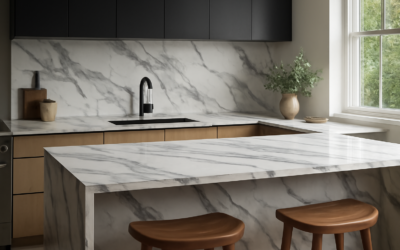
The countertop version of laminate stone deserves its own look because it has come a long way. Modern high-definition printing plus deep matte textures make a marble-look or granite-look laminate top convincing from a few feet away, and it costs a quarter of what real stone runs. Expect $10 to $40 per square foot installed against $40 to $120 for granite.
The trade-offs are honest. Laminate counters cannot take a hot pan straight off the burner; anything above roughly 275°F can scorch or bubble the surface, so always use a trivet. Knife cuts damage the wear layer too, so keep a cutting board handy. Handle those two habits and a stone-look laminate top serves a busy kitchen for 10 to 20 years.
Comparing Laminate Stone Product Types
Not all laminate stone is built the same, and the core underneath drives how it performs. Know what you are buying:
- Standard HDF-core laminate: the most common floor type; strong and affordable but swells if water sits in the seams.
- Water-resistant laminate: a treated core and tighter locking joints that shrug off splashes and quick spills.
- Tile-format laminate: square pieces with grouted-look edges that read most like real stone tile.
- Post-formed laminate counters: the printed surface bonded to particleboard for kitchen and bath tops.
For a kitchen or entry floor, spend up for a water-resistant core; the small premium buys real peace of mind in a room that sees spills. In a dry bedroom or hallway, a standard core does the job for less.
One more spec matters: the wear layer thickness, measured by the AC rating covered earlier. Thicker wear layers and denser cores add a few dollars per square foot but pay for themselves in rooms that see daily traffic, pets, and dragged furniture. Cheap thin-core laminate can telegraph every imperfection in the subfloor below and click loudly underfoot, so feel a sample before you commit.
Key Takeaways
Laminate stone delivers the marble, slate, and travertine look for $1.50 to $6 per square foot, a huge saving over the real thing. Insist on an AC3-plus rating, embossed-in-register texture, and a matte finish to get a result that actually fools the eye.
Install it as a floating floor with proper expansion gaps, keep it dry, and clean it with a damp mop only. Do that, and stone-look laminate gives you a high-end room for a budget number that will hold up for a decade of daily use.
Prefer to explore on your own?
See how new flooring looks in your actual room in seconds — free, no signup.
Try the free Floor Studio →